

The period preceding the campaign is marked by deep structural inequalities in the media space which afford the authorities a significant advantage. In August 2026 President Vučić's media dominance intensified further. At the same time, the announced change of ownership is under way in media that were regarded as independent and critical of the authorities, accompanied by a change of management. Should those changes be reflected in editorial policy, the already narrowed space for critical reporting could be all but erased.
The lack of pluralism is also visible in the programming of the public broadcaster, Radio Television of Serbia (RTS): in Dnevnik 2, the most-watched evening news programme, the ruling majority received as much as 96 per cent of the time devoted to domestic political actors, while just four per cent was left to the opposition. This stark disproportion is further deepened by the way political actors are portrayed: the authorities were shown predominantly positively (almost 40 per cent of the time), while opposition actors were conspicuously less present and predominantly portrayed negatively (40 per cent of the time); the students were portrayed most negatively of all (58 per cent of the time).
President Aleksandar Vučić was not only present in Dnevnik 2 far more than any other actor of the authorities or the opposition; he was now also given almost four times as much time as in the pre-election period and the campaign for the 2022 presidential elections. The time in which he was reported on positively was more than eleven times longer than at the last presidential elections, while the share of positive tone rose from 18 to 51 per cent.
In the media with the widest audience and the greatest influence, The monitoring sample covers: television channels available through all licensed cable operators which, according to data from the independent audience measurement agency, are among the five channels with the largest audience share (the public broadcaster RTS 1 - Dnevnik 2, TV Pink - Nacionalni dnevnik, TV Prva - Vesti u 18h, TV Informer - Srpski dnevnik and TV B92 - Vesti u 16h), and the front pages of all nine daily newspapers (Informer, Kurir, Večernje novosti, Politika, Alo!, Srpski telegraf, Danas, Nova). an intensification of manipulative narratives directed against the authorities' political opponents is recorded, including narratives about possible violence after the elections and the non-recognition of the election results.
Media concentration, the stifling of critical voices and the manipulation of public opinion are all growing ahead of the start of the official election campaign, leaving citizens with ever less opportunity to hear anything but a single voice.
The lack of pluralism is also visible in the programming of the public broadcaster, Radio Television of Serbia (RTS): in Dnevnik 2, the most-watched evening news programme, the ruling majority received as much as 96 per cent of the time devoted to domestic political actors, while just four per cent was left to the opposition. This stark disproportion is further deepened by the way political actors are portrayed: the authorities were shown predominantly positively (almost 40 per cent of the time), while opposition actors were conspicuously less present and predominantly portrayed negatively (40 per cent of the time); the students were portrayed most negatively of all (58 per cent of the time).
President Aleksandar Vučić was not only present in Dnevnik 2 far more than any other actor of the authorities or the opposition; he was now also given almost four times as much time as in the pre-election period and the campaign for the 2022 presidential elections. The time in which he was reported on positively was more than eleven times longer than at the last presidential elections, while the share of positive tone rose from 18 to 51 per cent.
In the media with the widest audience and the greatest influence, The monitoring sample covers: television channels available through all licensed cable operators which, according to data from the independent audience measurement agency, are among the five channels with the largest audience share (the public broadcaster RTS 1 - Dnevnik 2, TV Pink - Nacionalni dnevnik, TV Prva - Vesti u 18h, TV Informer - Srpski dnevnik and TV B92 - Vesti u 16h), and the front pages of all nine daily newspapers (Informer, Kurir, Večernje novosti, Politika, Alo!, Srpski telegraf, Danas, Nova). an intensification of manipulative narratives directed against the authorities' political opponents is recorded, including narratives about possible violence after the elections and the non-recognition of the election results.
Media concentration, the stifling of critical voices and the manipulation of public opinion are all growing ahead of the start of the official election campaign, leaving citizens with ever less opportunity to hear anything but a single voice.
The media market and editorial policy
The concentration of media ownership in Serbia accelerated during the election year through several parallel processes: the sale of the media arm of United Group's business, Telekom's further expansion in the market,
At the end of 2025 Telekom took over Mondo INC, owned by Wireless Media Group, which owns several media outlets, among them Kurir. https://link.crta.rs/xj
the change of leadership at RTS, and the consolidation of ownership of local media. Media ownership is becoming concentrated in the hands of a small group of actors close to the authorities.
Željko Mitrović (Pink Media Group) and Dragan Vučićević (Informer, together with the takeover of local media through a stake in the company Best Media Team) are long-standing vehicles of pro-government media campaigns; Predrag Ranković Peconi, linked to the Surčin clan, built his influence through Happy TV, while Srđan Milovanović, a businessman linked to SNS, expanded into ownership of national media after selling Kopernikus Technology to Telekom.
Asymmetric changes were also recorded in the terms on which television channels are available to audiences: while some channels were removed from packages or from distributors' revised channel line-ups, other channels were simultaneously given wider access to audiences. After Telekom Serbia took over Total TV from United Group, the critically oriented channels N1 and Nova were first moved to considerably lower positions in the channel line-up, and were then removed from that platform's offering altogether. Cenzolovka (2025), Total TV izbacio N1 i Nova S iz programa: Koja su prava korisnika ove platforme?, https://link.crta.rs/xi. Changes in the offering have also been recorded among Yettel subscribers: at the end of August 2026 an unknown number of subscribers had access to certain channels, among them N1 and Nova S, withdrawn without their prior consent. At the same time as the channels were switched off, subscribers were informed that they had been selected at random to take part in a pilot project, under which they were offered a reduction of RSD 300 in their monthly subscription in return for the revised channel line-up - and that by calling the call centre they could ask to have the channels restored, with their bill increased accordingly. Before that, in April 2026, SBB was legally merged into Yettel, ceasing to exist as a separate legal entity, with Yettel becoming its legal successor. SBB continued to exist as a brand. The company said at the time that there would be no changes in the use of its services.
At the same time, Telekom Serbia expanded the availability of other television channels by unlocking the Arena Plus package as part of a six-month promotion, making around 30 channels freely available to citizens who receive their television signal via aerial. Among them are channels predominantly favourable to the authorities: Informer TV, Kurir TV, K1 and Euronews Serbia. This gave those broadcasters additional terrestrial reach, even though some of them do not hold REM licences for terrestrial broadcasting in the areas in which they thereby became available. Telekom Serbia explains the move as a business promotion and a test of subscriber interest in the service.
Of particular significance is the further expansion of Telekom Serbia, which in April 2026 alone formally took over seven local cable operators. This is part of a wider pattern of consolidation in which, between 2024 and April 2026, it took over 17 companies in total. Telekom Srbija a.d. Beograd, History (overview of acquisitions and ownership structure) https://link.crta.rs/xg That company, whose majority shareholder is the Serbian state, controls the infrastructure through which content reaches viewers, and increasingly the content itself, since it also owns media such as Kurir and Euronews Serbia.
Asymmetric changes were also recorded in the terms on which television channels are available to audiences: while some channels were removed from packages or from distributors' revised channel line-ups, other channels were simultaneously given wider access to audiences. After Telekom Serbia took over Total TV from United Group, the critically oriented channels N1 and Nova were first moved to considerably lower positions in the channel line-up, and were then removed from that platform's offering altogether. Cenzolovka (2025), Total TV izbacio N1 i Nova S iz programa: Koja su prava korisnika ove platforme?, https://link.crta.rs/xi. Changes in the offering have also been recorded among Yettel subscribers: at the end of August 2026 an unknown number of subscribers had access to certain channels, among them N1 and Nova S, withdrawn without their prior consent. At the same time as the channels were switched off, subscribers were informed that they had been selected at random to take part in a pilot project, under which they were offered a reduction of RSD 300 in their monthly subscription in return for the revised channel line-up - and that by calling the call centre they could ask to have the channels restored, with their bill increased accordingly. Before that, in April 2026, SBB was legally merged into Yettel, ceasing to exist as a separate legal entity, with Yettel becoming its legal successor. SBB continued to exist as a brand. The company said at the time that there would be no changes in the use of its services.
At the same time, Telekom Serbia expanded the availability of other television channels by unlocking the Arena Plus package as part of a six-month promotion, making around 30 channels freely available to citizens who receive their television signal via aerial. Among them are channels predominantly favourable to the authorities: Informer TV, Kurir TV, K1 and Euronews Serbia. This gave those broadcasters additional terrestrial reach, even though some of them do not hold REM licences for terrestrial broadcasting in the areas in which they thereby became available. Telekom Serbia explains the move as a business promotion and a test of subscriber interest in the service.
Of particular significance is the further expansion of Telekom Serbia, which in April 2026 alone formally took over seven local cable operators. This is part of a wider pattern of consolidation in which, between 2024 and April 2026, it took over 17 companies in total. Telekom Srbija a.d. Beograd, History (overview of acquisitions and ownership structure) https://link.crta.rs/xg That company, whose majority shareholder is the Serbian state, controls the infrastructure through which content reaches viewers, and increasingly the content itself, since it also owns media such as Kurir and Euronews Serbia.
The presence of the largest media owners across platforms
presentnot present
The concentration of ownership is evident at local level too. Dragan Vučićević and Saša Blagojević, the owners of Informer and Alo!, expanded their portfolio in the first months of 2026 by buying 13
Miomedia, TV Lav plus, TV 5 Užice, TV V5 Valjevo, TV Priboj, Radio Koran Priboj, RTV Golija - Ivanjica, TV Kikinda, RTV Bačka Palanka, Lotel plus - Loznica, TV Santos, Infomačva Šabac and RTV Majdanpek.
local media outlets. According to the president of the board of the Association of Independent Electronic Media (ANEM),
N1 (2026) "Cilj je zastrašivanje na lokalu i - 'spaljena zemlja'": Kakvu ulogu imaju "ispostave-klonovi" Informera i Aloa? https://link.crta.rs/xe.
this has created a network functioning as a system of local outposts, with the aim of intimidating the authorities' political opponents in local communities. Concerning patterns have been observed at several television stations in that network - the publication of personal data, the identification of people seen at gatherings, and the targeting of journalists, prosecutors, judges, lawyers and activists of non-governmental organisations.
For example, the company Zaple Media Group, Crta (2026) Izveštaj o dugoročnom posmatranju lokalnih izbora 2026 https://link.crta.rs/xd. established at the end of 2025, took over and registered 14 local media outlets whose editor-in-chief is Gradimir Banković, a figure publicly linked both to the Centre for Social Stability The Centre for Social Stability is an association registered in Novi Sad, described by independent media as an organisation close to the authorities. Among the people linked to the Centre is the current Minister for European Integration, Nemanja Starović. Istinomer (2025) „Centar za društvenu stabilnost - ili stabilnost propagande“, [URL]. Over the past year the Centre has produced more than 20 short films directed against voices critical of SNS. and to the Serbian Progressive Party. ANEM (2026) Slučaj Zaple Media Group: Milioni na medijskim konkursima za tek osnovane portale koji već krše kodeks, https://link.crta.rs/xb.
The Portuguese investment group Alpac Capital agreed with United Group to take over Adria News Network, which comprises media perceived as critical of the authorities: the daily newspapers Danas and Nova, the television stations N1 Serbia and Nova S, the weekly Radar, and the portals n1info.rs and Nova.rs. Although the sale has not yet formally been completed, the new management has already taken up director positions in four companies, The four companies are: United Media Digital (the newspaper and portal Nova and the weekly Radar), Dan Graf (Danas), Adria News and Adria News Nova S. changing the management before the purchase concludes. the Commission for Protection of Competition in Serbia has in the meantime approved the concentration, while approval from the competent authority in Luxembourg is still awaited. The takeover Cenzolovka (2026) ‘Politička pozadina preuzimanja nezavisnih medija u Srbiji i regionu: Duboke veze novog vlasnika sa Orbanom i Vučićem’ https://link.crta.rs/xa. attracted additional attention because of the new owner's political connections, including the Vargas David family's links to Viktor Orbán and the friendly relationship between his father, Mário David, and the President of Serbia, Aleksandar Vučić. As of the closing of this report there were no indications of a wider change of editorial policy, but at the beginning of September the new management decided not to renew the contract for the programme 24 minuta sa Zoranom Kesićem, which had been broadcast on TV Nova S since 2020.
A further attempt at pressure regarding future editorial policy is reflected in an open letter that the Ministry of Information and Telecommunications addressed to the owner of Alpac Capital, "recommending" that it register the media with the domestic regulator (REM). According to the letter, the media - which have until now been protected by their status as cross-border broadcasters - would thereby become directly subject to domestic regulatory oversight. Ministarstvo informisanja i telekomunikacija, Отворено писмо власнику фонда Alpac Capital, г. Варгасу, https://link.crta.rs/x9
The European Commission, however, found in its 2024 Serbia Report that the domestic regulatory body, REM, had not fully exercised its mandate and that serious concerns remained as to its independence in practice, while in 2025 the European Parliament pointed to the critical importance of ensuring the independence of key institutions, including REM. The process of awarding the fifth national frequency, launched back in 2022, has still not been concluded years later. The European Commission found in its 2024 Serbia Report that the procedure remained unfinished and that no justification for this had been given.
In February 2026 Manja Grčić was appointed head of the public broadcaster (RTS), which opened up a series of controversies in public. Her appointment was contested, among other things, over a dispute about the validity of her degree, which according to the Journalists' Association of Serbia carried fewer ECTS credits than the law requires for the position, and over her long-standing closeness to the authorities, including the fact that she had previously served on the board of the Belgrade Philharmonic alongside President Vučić's media adviser, Suzana Vasiljević. Journalists' Association of Serbia, „Šta je diploma Manje Grčić“, [URL]. Her business connections up to 2 February include ownership and director roles in the media companies K1 and Tanjug and in the agency Majo Public, NUNS, Manja Grčić više nije ni vlasnica firmi koje poseduju Tanjug i K1, https://link.crta.rs/x7 which regularly receive contracts from state enterprises. Her appointment to her previous position at the media house B92 was followed by the closure of critical segments of its programming. NUNS (2014) "Utisak nedelje" skidaju sa B92? https://link.crta.rs/x8 Her arrival at RTS was likewise followed by significant personnel changes, including the removal of at least seven editors and journalists in a short period. Those replaced were Miša Stoiljković, Aleksandra Madenović, Igor Obračević and Biljana Šujdović; Dejan Cukić lost his programme on Radio 202; Vladimir Kecmanović was removed as editor of RTS's Arts and Culture programming, while Jelena Popadić Sumić, author of the programme „Važne stvari“, was dismissed as editor of RTS's Children's programming.
For example, the company Zaple Media Group, Crta (2026) Izveštaj o dugoročnom posmatranju lokalnih izbora 2026 https://link.crta.rs/xd. established at the end of 2025, took over and registered 14 local media outlets whose editor-in-chief is Gradimir Banković, a figure publicly linked both to the Centre for Social Stability The Centre for Social Stability is an association registered in Novi Sad, described by independent media as an organisation close to the authorities. Among the people linked to the Centre is the current Minister for European Integration, Nemanja Starović. Istinomer (2025) „Centar za društvenu stabilnost - ili stabilnost propagande“, [URL]. Over the past year the Centre has produced more than 20 short films directed against voices critical of SNS. and to the Serbian Progressive Party. ANEM (2026) Slučaj Zaple Media Group: Milioni na medijskim konkursima za tek osnovane portale koji već krše kodeks, https://link.crta.rs/xb.
The Portuguese investment group Alpac Capital agreed with United Group to take over Adria News Network, which comprises media perceived as critical of the authorities: the daily newspapers Danas and Nova, the television stations N1 Serbia and Nova S, the weekly Radar, and the portals n1info.rs and Nova.rs. Although the sale has not yet formally been completed, the new management has already taken up director positions in four companies, The four companies are: United Media Digital (the newspaper and portal Nova and the weekly Radar), Dan Graf (Danas), Adria News and Adria News Nova S. changing the management before the purchase concludes. the Commission for Protection of Competition in Serbia has in the meantime approved the concentration, while approval from the competent authority in Luxembourg is still awaited. The takeover Cenzolovka (2026) ‘Politička pozadina preuzimanja nezavisnih medija u Srbiji i regionu: Duboke veze novog vlasnika sa Orbanom i Vučićem’ https://link.crta.rs/xa. attracted additional attention because of the new owner's political connections, including the Vargas David family's links to Viktor Orbán and the friendly relationship between his father, Mário David, and the President of Serbia, Aleksandar Vučić. As of the closing of this report there were no indications of a wider change of editorial policy, but at the beginning of September the new management decided not to renew the contract for the programme 24 minuta sa Zoranom Kesićem, which had been broadcast on TV Nova S since 2020.
A further attempt at pressure regarding future editorial policy is reflected in an open letter that the Ministry of Information and Telecommunications addressed to the owner of Alpac Capital, "recommending" that it register the media with the domestic regulator (REM). According to the letter, the media - which have until now been protected by their status as cross-border broadcasters - would thereby become directly subject to domestic regulatory oversight. Ministarstvo informisanja i telekomunikacija, Отворено писмо власнику фонда Alpac Capital, г. Варгасу, https://link.crta.rs/x9
The European Commission, however, found in its 2024 Serbia Report that the domestic regulatory body, REM, had not fully exercised its mandate and that serious concerns remained as to its independence in practice, while in 2025 the European Parliament pointed to the critical importance of ensuring the independence of key institutions, including REM. The process of awarding the fifth national frequency, launched back in 2022, has still not been concluded years later. The European Commission found in its 2024 Serbia Report that the procedure remained unfinished and that no justification for this had been given.
In February 2026 Manja Grčić was appointed head of the public broadcaster (RTS), which opened up a series of controversies in public. Her appointment was contested, among other things, over a dispute about the validity of her degree, which according to the Journalists' Association of Serbia carried fewer ECTS credits than the law requires for the position, and over her long-standing closeness to the authorities, including the fact that she had previously served on the board of the Belgrade Philharmonic alongside President Vučić's media adviser, Suzana Vasiljević. Journalists' Association of Serbia, „Šta je diploma Manje Grčić“, [URL]. Her business connections up to 2 February include ownership and director roles in the media companies K1 and Tanjug and in the agency Majo Public, NUNS, Manja Grčić više nije ni vlasnica firmi koje poseduju Tanjug i K1, https://link.crta.rs/x7 which regularly receive contracts from state enterprises. Her appointment to her previous position at the media house B92 was followed by the closure of critical segments of its programming. NUNS (2014) "Utisak nedelje" skidaju sa B92? https://link.crta.rs/x8 Her arrival at RTS was likewise followed by significant personnel changes, including the removal of at least seven editors and journalists in a short period. Those replaced were Miša Stoiljković, Aleksandra Madenović, Igor Obračević and Biljana Šujdović; Dejan Cukić lost his programme on Radio 202; Vladimir Kecmanović was removed as editor of RTS's Arts and Culture programming, while Jelena Popadić Sumić, author of the programme „Važne stvari“, was dismissed as editor of RTS's Children's programming.
Pluralism at Radio Television of Serbia (RTS): the presence of political actors at RTS in the period before the campaign
The period before elections are called normally passes without the oversight that applies during the official election campaign. Even so, unlike commercial media, RTS as a public media service also has a statutory obligation to provide citizens with impartial information and to give relevant public actors equal access.
The work of the public media service is founded on the following principles: 1) truthful, impartial, complete and timely information; 2) editorial independence; 3) independence from the sources of funding; 3a) pluralism of content and pluralism of opinion; 4) the prohibition of any form of censorship and of unlawful influence on the work of the public media service, its newsroom and its journalists; 5) the application of internationally recognised norms and principles, and in particular respect for human rights and freedoms and democratic values; 6) respect for professional standards and codes; 7) cooperation with listeners, viewers and readers. Article 4 of the Law on Public Media Services
The findings show that RTS does not meet that obligation, and that this is not the result of occasional lapses but of consistent repetition in the editing of the news.
Monitoring of the main evening news programme, Dnevnik 2, reveals a pronounced imbalance in the presence of political options. Over the observation period (April-August 2026) the ruling majority received 96 per cent of the programme time devoted to domestic political actors, with reporting that was predominantly positive (40 per cent) or neutral (60 per cent) in tone. Just four per cent of the time was left to opposition actors. An average of 18 seconds per bulletin.
The work of the public media service is founded on the following principles: 1) truthful, impartial, complete and timely information; 2) editorial independence; 3) independence from the sources of funding; 3a) pluralism of content and pluralism of opinion; 4) the prohibition of any form of censorship and of unlawful influence on the work of the public media service, its newsroom and its journalists; 5) the application of internationally recognised norms and principles, and in particular respect for human rights and freedoms and democratic values; 6) respect for professional standards and codes; 7) cooperation with listeners, viewers and readers. Article 4 of the Law on Public Media Services
The findings show that RTS does not meet that obligation, and that this is not the result of occasional lapses but of consistent repetition in the editing of the news.
Monitoring of the main evening news programme, Dnevnik 2, reveals a pronounced imbalance in the presence of political options. Over the observation period (April-August 2026) the ruling majority received 96 per cent of the programme time devoted to domestic political actors, with reporting that was predominantly positive (40 per cent) or neutral (60 per cent) in tone. Just four per cent of the time was left to opposition actors. An average of 18 seconds per bulletin.
The presence of representatives of the ruling majority and of the opposition in RTS Dnevnik 2 (April - August 2026)
President Aleksandar Vučić alone took up more than half of the time allocated to the ruling majority (58 per cent). His presence was not confined to subjects directly connected with the presidential office: President Vučić appeared as an interlocutor on a broad range of domestic and foreign policy questions, often without alternative political perspectives being represented alongside him. In addition, since the start of the year President Vučić has appeared as a guest on RTS's Dnevnik 2 eight times, far more often than any other political actor from either the authorities or the opposition. It is telling that over the monitored period the President was portrayed markedly positively for slightly more than half of the time - 51 per cent to be exact - which means that every second second devoted to the President carried an affirmative tone. For the remaining 49 per cent of the time he was portrayed neutrally, while there was practically no negative reporting about him at all.
Vučić was portrayed negatively for only 0.11 per cent of the time (43 seconds out of 39,879 seconds of broadcast time in total).
Although CRTA's media monitoring over many years has consistently pointed to the absence of genuine pluralism in RTS's news programming, Crta, Medijski monitoring političkog pluralizma: Vlast u fokusu, opozicija gotovo nevidljiva, https://link.crta.rs/x5 a further indication of editorial bias is the finding that between April and August 2026 Aleksandar Vučić was given almost four times as much time in Dnevnik 2 as in the period from January to April 2022, which included the presidential campaign. At the same time, the time in which he was portrayed in a positive tone was more than eleven times longer than in 2022, while the share of positive tone rose from 18 to 51 per cent.
Although CRTA's media monitoring over many years has consistently pointed to the absence of genuine pluralism in RTS's news programming, Crta, Medijski monitoring političkog pluralizma: Vlast u fokusu, opozicija gotovo nevidljiva, https://link.crta.rs/x5 a further indication of editorial bias is the finding that between April and August 2026 Aleksandar Vučić was given almost four times as much time in Dnevnik 2 as in the period from January to April 2022, which included the presidential campaign. At the same time, the time in which he was portrayed in a positive tone was more than eleven times longer than in 2022, while the share of positive tone rose from 18 to 51 per cent.
The presence and tone of the portrayal of Aleksandar Vučić in RTS Dnevnik 2 (2022 - August 2026)
Tone keyNegativeNeutralPositive
Negative coverage was below 1% in both periods; the red segments are shown as visible markers.
The inequality in the treatment of the authorities and the opposition is also expressed in the fact that representatives of the authorities put their views across directly considerably more often - for 59 per cent of the time they appeared as subjects. Representatives of the opposition had the opportunity to appear as subjects, in person and in their own voice, for just 28 per cent of the time.
Within the four per cent of time allocated to the opposition, the tone was negative in 40 per cent, neutral in 57 per cent, and there was practically no positive note at all. Opposition actors were portrayed positively for 3 per cent of the time (93 seconds out of 2,728 seconds of broadcast time in total). Negative tone occurred disproportionately often relative to the limited time devoted to them in the first place. See Graphic 13, The presence and tone of the portrayal of political actors.
Within the four per cent of time allocated to the opposition, the tone was negative in 40 per cent, neutral in 57 per cent, and there was practically no positive note at all. Opposition actors were portrayed positively for 3 per cent of the time (93 seconds out of 2,728 seconds of broadcast time in total). Negative tone occurred disproportionately often relative to the limited time devoted to them in the first place. See Graphic 13, The presence and tone of the portrayal of political actors.
The presence and tone of the portrayal of political actors
NegativeNeutralPositive
The <1% of negative tone for the ruling majority is shown as a visible red marker.
Bias was also apparent in the differing treatment of opposition actors. The opposition gathered predominantly around the former coalition Serbia Against Violence (51 per cent)
Covers the opposition parties: the Democratic Party, the Ecological Uprising, the Kreni-promeni movement, the People's Movement of Serbia, the Movement of Free Citizens, Serbia Centre Srce, and the Green-Left Front.
and the students in blockade (37 per cent) received the largest share of the time allocated to the opposition, but usually in a negative light. The students in blockade were the most negatively portrayed actor, with 58 per cent negative and just three per cent positive tone. Right-oriented actors,
Opposition political actors of a conservative and nationally oriented politics: Novi DSS, POKS, Mi - glas naroda, and the People's Party.
although given the least time, are not subjected to nearly as much negative tone and were treated almost exclusively neutrally or positively.
The presence and tone of the portrayal of different groupings of opposition actors
Tone keyNegativeNeutralPositive
Note: the length of the bar is proportional to the total time in seconds.
Two rallies, two faces of RTS: reporting on SNS and on the students
Observation shows that RTS not only gives political actors unequal access to its programming, but that its editorial staff do not apply equal professional standards in reporting on different actors.
The CRTA Election Observation Mission monitored RTS's reporting on two key political gatherings during the observation period: the "Students in Blockade" rally at Slavija on 23 May and the Serbian Progressive Party rally in front of the Assembly of Serbia on 27 June 2026. A comparison of the manner and extent of the reporting on these two events shows markedly different editorial treatment.
The CRTA Election Observation Mission monitored RTS's reporting on two key political gatherings during the observation period: the "Students in Blockade" rally at Slavija on 23 May and the Serbian Progressive Party rally in front of the Assembly of Serbia on 27 June 2026. A comparison of the manner and extent of the reporting on these two events shows markedly different editorial treatment.
The "Students in Blockade" rally "You and I, Slavija, Students Are Winning", 23 May 2026
Although the students presented the rally held on 23 May 2026 as a civic event, clear messages about the Student Movement's further political direction were set out at it. In Dnevnik 2, the report on this rally was placed third in the headline announcements, while the reporting was set within a "balancing frame": the Slavija rally was set against rallies in support of President Aleksandar Vučić in Pionirski Park in Belgrade and in Kumanovo in North Macedonia.
As to the size of the Slavija rally, viewers were informed exclusively by reference to the police estimate (around 34,300 participants). The report omitted independent estimates The Archive of Public Gatherings put the number of people at the rally at between 180,000 and 190,000 (https://link.crta.rs/x4). according to which this was one of the largest gatherings in Serbia since the fall of Slobodan Milošević's regime. The live segment from the rally lasted 2 minutes and 43 seconds.
As to the size of the Slavija rally, viewers were informed exclusively by reference to the police estimate (around 34,300 participants). The report omitted independent estimates The Archive of Public Gatherings put the number of people at the rally at between 180,000 and 190,000 (https://link.crta.rs/x4). according to which this was one of the largest gatherings in Serbia since the fall of Slobodan Milošević's regime. The live segment from the rally lasted 2 minutes and 43 seconds.
The Serbian Progressive Party rally "Serbia One Family", 27 June 2026
The Serbian Progressive Party rally held on 27 June in front of the National Assembly produced two politically significant announcements: the name of the candidate list "United Serbia" for the coming elections was presented, although it was not specified which elections the announcement referred to. Aleksandar Vučić's resignation from the office of President of the Republic was also announced. The extent of the coverage in Dnevnik 2 - the first headline, the first news item and a report lasting 11 minutes and 5 seconds, almost four times as long as the coverage of the student rally at Slavija - shows the prominence given to the event in the news programming. That report also took up almost a third of the entire Dnevnik.
The number of participants was, for example, presented exclusively through the police estimate (207,000 gathered), likewise without any reference to independent sources, which put the figure considerably lower. The Archive of Public Gatherings put the number of people at the rally at approximately 32,500 (https://link.crta.rs/x3). A similar pattern is visible in the treatment of the messages from the rally: particular emphasis on President Aleksandar Vučić's messages, with the positive frame further reinforced by a report and a live link from in front of the Assembly and by interviewees speaking predominantly positively. This approach resulted in exceptionally extensive coverage and a positive frame for the ruling party's rally, without any pronounced analytical distance.
The number of participants was, for example, presented exclusively through the police estimate (207,000 gathered), likewise without any reference to independent sources, which put the figure considerably lower. The Archive of Public Gatherings put the number of people at the rally at approximately 32,500 (https://link.crta.rs/x3). A similar pattern is visible in the treatment of the messages from the rally: particular emphasis on President Aleksandar Vučić's messages, with the positive frame further reinforced by a report and a live link from in front of the Assembly and by interviewees speaking predominantly positively. This approach resulted in exceptionally extensive coverage and a positive frame for the ruling party's rally, without any pronounced analytical distance.
President Vučić's live television addresses: setting a record
The significant impairment of pluralism in the media space can be seen further through the frequency of the President of the Republic's direct addresses on live programming. In the first eight months of 2026 the President made 371 live addresses. By way of comparison, the Prime Minister of Serbia, Đuro Macut, had given just nine interviews and television appearances by the day the proposal to dissolve the National Assembly was submitted, on 7 September.
Except where it was explicitly indicated that an address was an official one from the Presidency or from the Palace of Serbia, it was in practice impossible to distinguish in which capacity - as head of state or as a party figure - President Vučić was speaking, and so all his addresses in the media space acquire, in effect, the same weight.
Between March and July the President averaged 35 addresses a month, before exceeding the average of the preceding months three and a half times over in August, with 129 live addresses broadcast on at least 45 national, cable and local television stations.
Except where it was explicitly indicated that an address was an official one from the Presidency or from the Palace of Serbia, it was in practice impossible to distinguish in which capacity - as head of state or as a party figure - President Vučić was speaking, and so all his addresses in the media space acquire, in effect, the same weight.
Between March and July the President averaged 35 addresses a month, before exceeding the average of the preceding months three and a half times over in August, with 129 live addresses broadcast on at least 45 national, cable and local television stations.
The number of President Vučić's live appearances on television programmes
When one looks at the subjects with which the President of the Republic most often opened his addresses, foreign policy and infrastructure projects and investment stand out, which indicates that the country's political life is presented predominantly through questions of a statehood and development character. The connection is not accidental: subjects such as foreign policy and infrastructure projects also feed into the narrative that glorifies the state's decisions.
Narratives and manipulation in the media
Manipulative narratives: discrediting, targeting and the cult of personality
In the first eight months of 2026, more than 1,300 manipulative headlines were published on front pages and in the headline sequences of main news programmes alone - an average of almost 40 a week. The most prevalent were narratives aimed at discrediting political dissenters (47 per cent) and portraying countries of the region negatively (31 per cent). Between March and August,
The monitoring sample covers: television channels available through all licensed cable operators which, according to data from the independent audience measurement agency, are among the five channels with the largest audience share, and the front pages of all nine daily newspapers.
CRTA Election Observation Mission
CRTA.Plus (2026) Manipulacije na naslovnim stranama https://link.crta.rs/x2
recorded a continuous intensification of manipulative narratives. The number of cases rose over that period, with occasional fluctuations, and culminated in August, when 262 cases of manipulative reporting were recorded - the highest figure since the start of the year.
In July and August the cult of personality around President Vučić appears as the third most prevalent narrative. This broadens the function of manipulative content: alongside discrediting the authorities' political dissenters and portraying them as a threat, an affirmative, almost glorifying portrayal of the President takes on an increasingly pronounced role. Two opposing images are thus built simultaneously - opponents as a source of threat and destabilisation on the one hand, and the President as the guarantor of stability and protection on the other.
The media frequently interwove the discrediting of the authorities' political dissenters with a negative portrayal of countries of the region, linking them to the so-called "blokaderi" and claiming that their governments provide logistical support to the Student Movement and are thereby working to destabilise Serbia.
The authorities' political dissenters, opposition actors and the students in particular were portrayed as "blokaderi" who lie and spread fabrications and conspiracy theories, while individuals connected with the Student List were accused of hatred, xenophobia and announcing a "reckoning" with the President and his family. At the same time, the cult of personality around Aleksandar Vučić was built by presenting the President as an exceptional statesman who "delivers political lessons", achieves historic diplomatic successes, forgives his opponents and calls for unity despite the attacks to which he is subjected.
In July and August the cult of personality around President Vučić appears as the third most prevalent narrative. This broadens the function of manipulative content: alongside discrediting the authorities' political dissenters and portraying them as a threat, an affirmative, almost glorifying portrayal of the President takes on an increasingly pronounced role. Two opposing images are thus built simultaneously - opponents as a source of threat and destabilisation on the one hand, and the President as the guarantor of stability and protection on the other.
The media frequently interwove the discrediting of the authorities' political dissenters with a negative portrayal of countries of the region, linking them to the so-called "blokaderi" and claiming that their governments provide logistical support to the Student Movement and are thereby working to destabilise Serbia.
The authorities' political dissenters, opposition actors and the students in particular were portrayed as "blokaderi" who lie and spread fabrications and conspiracy theories, while individuals connected with the Student List were accused of hatred, xenophobia and announcing a "reckoning" with the President and his family. At the same time, the cult of personality around Aleksandar Vučić was built by presenting the President as an exceptional statesman who "delivers political lessons", achieves historic diplomatic successes, forgives his opponents and calls for unity despite the attacks to which he is subjected.
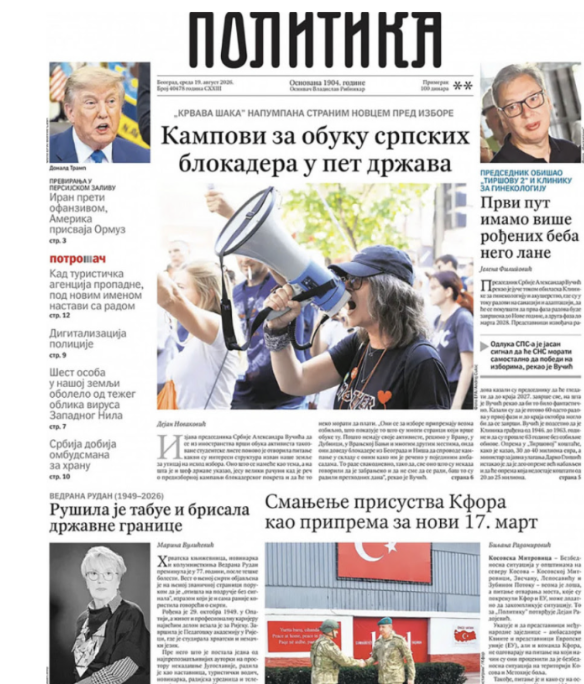
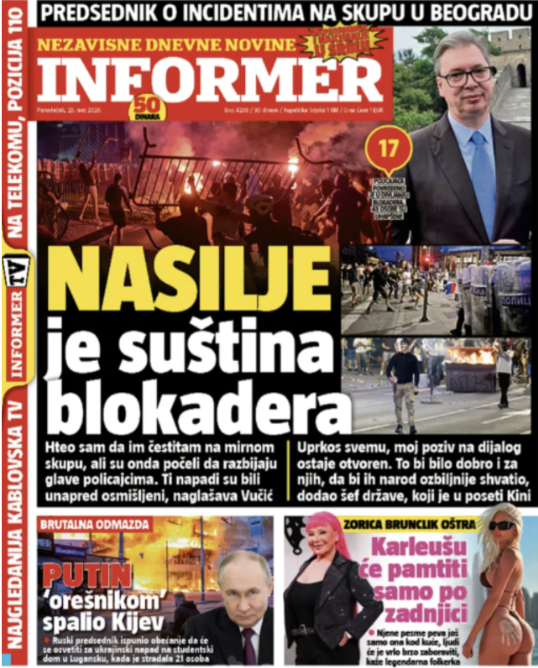

Examples. Politika, 19 August: a headline about "training camps for Serbian blockaders in five countries". Informer, 25 May: a headline about "violence as the essence of the blockaders"
Within the same narrative frame, the media continuously portrayed opposition actors as a source of destabilisation and violence, and the authorities as the guarantor of peace, stability and progress, constructing an image of "two Serbias" - one that destroys and another that protects the state.
That pattern has not remained directed at the Student Movement as a whole, but is transferred to individuals connected with it. In that respect one example stands out: Vladan Đokić, Rector of the University of Belgrade, publicly recognised as one of the more prominent individuals associated with the Student Movement. Pressure on the Rector intensified further at the end of March, when Informer television covered live the arrival of officers of the Criminal Police Directorate at the Rectorate of the University of Belgrade and broadcast footage of their entry into the building and their encounter with Đokić. Danas (2026) ‘Ulazak pripadnika UKP u Rektorat uživo prenošen u programu Informera (VIDEO)’ https://link.crta.rs/x1
Content analysis of media portals and social media identified six dominant narratives aimed at discrediting Đokić: 1) that he was "installed" by the Serbian Progressive Party; 2) that he is under the influence of foreign services and embassies; 3) that he bears responsibility in the case of the death of a female student; The body of a student of the Faculty of Philosophy in Belgrade was found on 17 March 2025 near the „4. april“ student hall of residence, after she had been reported missing. 4) that he is using the student revolt to advance his own political ambitions; 5) that he belongs to a wealthy elite; and 6) that he embodies irresponsibility, corruption and incompetence.
Since April CRTA Election Observation Mission has recorded at least 70 items on media portals repeating claims that the other side will not recognise the election results, that it is preparing violence or an attempt to destabilise the state, with the largest number of such pieces published in August. Responsibility for possible post-election violence and destabilisation is attributed in advance to the authorities' political opponents and to other critical actors. Thus the Speaker of the National Assembly of the Republic of Serbia, Ana Brnabić, claimed that if the election result were close "the blockaders will create violence in the streets", and later that they were "preparing an alibi for not recognising electoral defeat", while President Aleksandar Vučić and SNS President Miloš Vučević stated that the authorities would recognise the results whatever they were, adding that they had not heard the same readiness "from the other side". The narrative of possible post-election violence and destabilisation was further amplified in August by a statement from the Russian ambassador to Serbia, Aleksandr Botsan-Kharchenko, who warned of the risk that, whatever the election results, a "colour revolution" scenario would be set in motion after the vote. 021 (2026) ‘Bocan-Harčenko: EU hoće novog lidera na čelu Srbije - moguća obojena revolucija posle izbora’ https://link.crta.rs/x0
That pattern has not remained directed at the Student Movement as a whole, but is transferred to individuals connected with it. In that respect one example stands out: Vladan Đokić, Rector of the University of Belgrade, publicly recognised as one of the more prominent individuals associated with the Student Movement. Pressure on the Rector intensified further at the end of March, when Informer television covered live the arrival of officers of the Criminal Police Directorate at the Rectorate of the University of Belgrade and broadcast footage of their entry into the building and their encounter with Đokić. Danas (2026) ‘Ulazak pripadnika UKP u Rektorat uživo prenošen u programu Informera (VIDEO)’ https://link.crta.rs/x1
Content analysis of media portals and social media identified six dominant narratives aimed at discrediting Đokić: 1) that he was "installed" by the Serbian Progressive Party; 2) that he is under the influence of foreign services and embassies; 3) that he bears responsibility in the case of the death of a female student; The body of a student of the Faculty of Philosophy in Belgrade was found on 17 March 2025 near the „4. april“ student hall of residence, after she had been reported missing. 4) that he is using the student revolt to advance his own political ambitions; 5) that he belongs to a wealthy elite; and 6) that he embodies irresponsibility, corruption and incompetence.
Since April CRTA Election Observation Mission has recorded at least 70 items on media portals repeating claims that the other side will not recognise the election results, that it is preparing violence or an attempt to destabilise the state, with the largest number of such pieces published in August. Responsibility for possible post-election violence and destabilisation is attributed in advance to the authorities' political opponents and to other critical actors. Thus the Speaker of the National Assembly of the Republic of Serbia, Ana Brnabić, claimed that if the election result were close "the blockaders will create violence in the streets", and later that they were "preparing an alibi for not recognising electoral defeat", while President Aleksandar Vučić and SNS President Miloš Vučević stated that the authorities would recognise the results whatever they were, adding that they had not heard the same readiness "from the other side". The narrative of possible post-election violence and destabilisation was further amplified in August by a statement from the Russian ambassador to Serbia, Aleksandr Botsan-Kharchenko, who warned of the risk that, whatever the election results, a "colour revolution" scenario would be set in motion after the vote. 021 (2026) ‘Bocan-Harčenko: EU hoće novog lidera na čelu Srbije - moguća obojena revolucija posle izbora’ https://link.crta.rs/x0
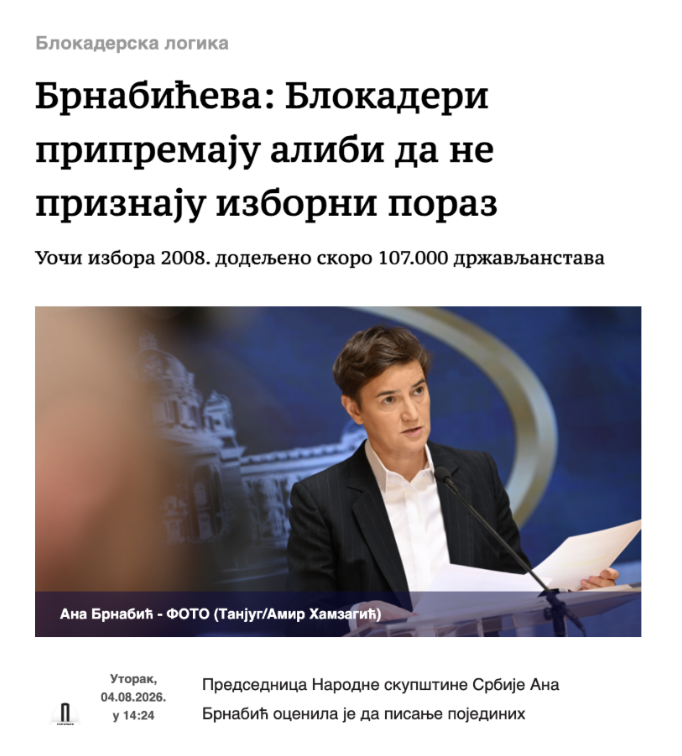
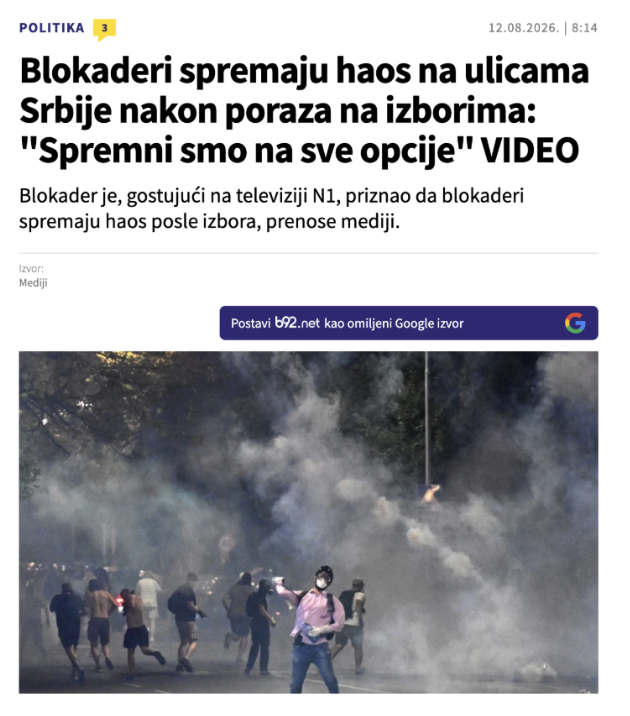
Examples.The narrative of not recognising electoral defeat, Politika, 4 August 2026. The narrative of violence announced after the elections, B92, 12 August 2026
Artificial intelligence: a new tool of media manipulation
The use of artificial intelligence
Deepfake technology was first misused as early as 2023, in the months before the parliamentary elections, when TV Pink broadcast fake audio and video content about the opposition. In 2024 the Higher Court in Belgrade prohibited its further broadcast.
in media content has begun to spread in various ways, which is all the more concerning at a moment when REM is non-operational and is not performing its regulatory function. Since June 2026 Happy television has introduced AI presenters into its news programming, which were labelled as products of artificial intelligence only subsequently, after criticism from media and journalists' associations.
021.rs (2026) 'TV Hepi označila AI voditelje u vestima posle kritika UNS-a' https://www.021.rs/info/srbija/448901/tv-hepi-oznacila-ai-voditelje-u-vestima-posle-kritika-uns-a
Since May, at least six pieces of video content created using artificial intelligence have been recorded on Informer's various platforms, some of which were used to discredit those who hold different views, but also members of the ruling coalition who were at that moment expressing dissonant views in public. The absence of a clear label within the video content itself increases the risk that audiences will read AI-generated material as authentic, particularly when it is shared on beyond the context of the original post.
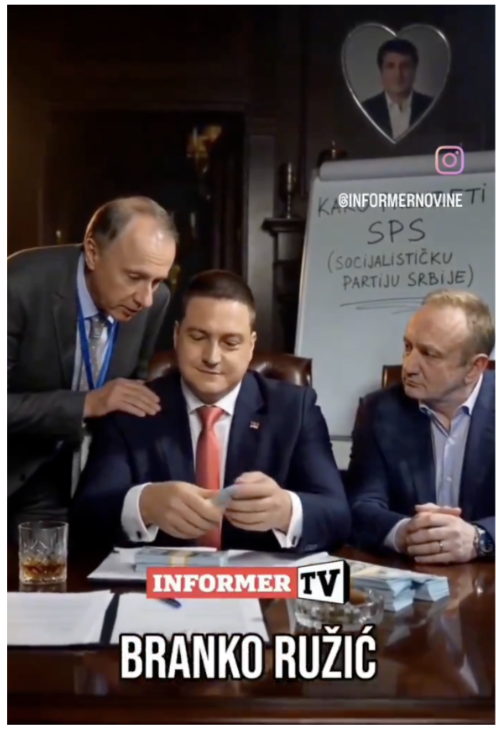
Example: An AI video on Informer insinuating a secret agreement among opposition actors.