

The pre-election environment and the conditions for political competition
Activities of the student bloc, opposition parties and other political initiatives have made the political offer more visible to the public - this is what emerges from the observation of the activities of political and other actors carried out over four months of the election year, from May to August 2026. The authorities, for their part, built their advantage through extensive use of public office, public institutions and public resources, and through the announcement and promotion of economic support programmes for citizens in a period of intense speculation about elections. Pressures connected with employment and social entitlements, and incidents directed at politically engaged citizens, limited free and safe political participation.
The first half of the election year was marked by intense and comprehensive political mobilisation, in which activity on the ground increasingly took on the features of an election campaign even though no campaign had officially begun. Alongside their regular party work, the ruling parties made abundant use of the advantage that holding power affords them. Their activities were marked by cases of public institutions and resources being used for political purposes, and by conduct that raises concerns as to its lawfulness. More than 1,200 activities of public officials were recorded across Serbia during the observation period. The most active among them was President Aleksandar Vučić, and the number of his activities rose particularly during August. Direct payments and other financial benefits to citizens were also announced, with a total value reaching almost €1 billion and exceeding the combined amounts recorded ahead of the 2022 and 2023 electoral cycles. These patterns further blurred the line between the state and the ruling party. The Student Movement carried out activities across Serbia aimed at mobilising citizens and developing its own electoral infrastructure, while opposition parties also increased their presence on the ground. Political activity unfolded in an atmosphere of rising tension and frequent incidents, from restrictions on access to political events to physical clashes and police interventions.
The first half of the election year was marked by intense and comprehensive political mobilisation, in which activity on the ground increasingly took on the features of an election campaign even though no campaign had officially begun. Alongside their regular party work, the ruling parties made abundant use of the advantage that holding power affords them. Their activities were marked by cases of public institutions and resources being used for political purposes, and by conduct that raises concerns as to its lawfulness. More than 1,200 activities of public officials were recorded across Serbia during the observation period. The most active among them was President Aleksandar Vučić, and the number of his activities rose particularly during August. Direct payments and other financial benefits to citizens were also announced, with a total value reaching almost €1 billion and exceeding the combined amounts recorded ahead of the 2022 and 2023 electoral cycles. These patterns further blurred the line between the state and the ruling party. The Student Movement carried out activities across Serbia aimed at mobilising citizens and developing its own electoral infrastructure, while opposition parties also increased their presence on the ground. Political activity unfolded in an atmosphere of rising tension and frequent incidents, from restrictions on access to political events to physical clashes and police interventions.
The activities of political actors before the elections were called
The protest mobilisation of the student bloc gradually took on the character of a more serious political organisation. Between May and August, student activities were recorded in half of the municipalities and towns in Serbia - more than 80 of them - as well as in the diaspora. The intensity of activity rose continuously throughout the period, with a sharp jump in August, when more activities were recorded than in May and June combined
Intensity of recorded activities by month (1 May-31 August 2026)
Breakdown by type of activity
Meetings / door-to-door 52%Gatherings, protests and marches 24%Stands and bazaars 15%Public discussions 9%
Three dominant themes
Students organised local gatherings,
Ozonpress (2026), Milanovčani danima bez vode, večeras izlaze na ulice, https://www.ozonpress.net/drustvo/milanovcani-danima-bez-vode-veceras-izlaze-na-ulice/
conversations
Glas Šumadije (2026), „Veliki studentski bazar - od Morave do Ibra" u subotu u Kragujevcu, Aranđelovcu, Lapovu, Rači, Kraljevu, https://www.glassumadije.rs/veliki-studentski-bazar-od-morave-do-ibra-u-subotu-u-kragujevcu-arandjelovcu-lapovu-raci-kraljevu/.
with citizens, public discussions
020media, mikserbalkan (2026), U okviru Mikser festivala u Kulturnom centru Novi Pazar danas je održana tribina Mikser talks- ,,Jedan svijet,jedna borba". https://www.instagram.com/p/DZM3PpUCO2b/, 5 June
and other public events devoted to the elections, healthcare, education, environmental protection and local issues. The most widespread was the "A Student in Every Village" campaign,
studenti_ukg (2026), „Dok nas neki drugi dele mi se svakog vikenda upoznajemo 💚💛", https://www.instagram.com/p/Dax3rbHipKe/?img_index=7/, 14 July
aimed at visiting smaller settlements and talking directly with citizens, including door-to-door canvassing. Training sessions
gavriloandric (2026), „Radi se punom parom!", https://www.instagram.com/p/DaxxE86CO8N/?img_index=6, 14 July
were also organised for potential polling board members.
The Student Movement sought to broaden its activity by linking the students' demands The tragedy at the railway station in Novi Sad, in which 16 people died, together with the escalation of violence against students and demonstrators, set in motion [...] to the problems of various professional and social groups and by supporting their initiatives. It supported studenti_u_blokadi (2026), „Podrška Goranu Perišiću i svim pobunjenim radnicima!", https://www.instagram.com/p/DYZ8sMoCh8D/?img_index=2, 16 May employees who had drawn attention to political pressure and irregularities in their workplaces, including dismissed workers of the state electricity company EPS and candidates in the elections to the Medical Chamber. At the protest of 23 May Instagram staranica Studenata u blokadi, Protest na Slaviji, 23.5.2026, https://www.instagram.com/p/DZDJfhninv5/?img_index=1 in Belgrade, programme guidelines were presented Radio Sto Plus (2026), Studenti na Slaviji predstavili deo političkog programa, nakon skupa incidenti i hapšenja, https://www.radiostoplus.com/studenti-na-slaviji-predstavili-deo-politickog-programa-nakon-skupa-incidenti-i-hapsenja/ in the fields of healthcare, education, social policy and labour rights, which were subsequently promoted at stands. Over the summer the circle widened to farmers (a public discussion on agriculture in Novi Sad, a campaign to help with the fruit harvest, the "Agrarian Reform" initiative), cultural workers (a call to boycott the EXPO tender) and university staff under financial pressure. The movement also continued with mobilisation and local activities, such as the Festival of Freedom studenti.kosjeric (2026), „Drugi dan festivala slobode otvoren", https://www.instagram.com/p/DZPrtPJqSSO/, 6 June in Kosjerić, student bazaars, the production of materials for protests, and environmental campaigns. The attitude of student groups towards the opposition varied between local settings, as the elections of 29 March also showed: in some municipalities joint student-opposition lists were formed, while in others the students ran on their own.
The Student Movement sought to broaden its activity by linking the students' demands The tragedy at the railway station in Novi Sad, in which 16 people died, together with the escalation of violence against students and demonstrators, set in motion [...] to the problems of various professional and social groups and by supporting their initiatives. It supported studenti_u_blokadi (2026), „Podrška Goranu Perišiću i svim pobunjenim radnicima!", https://www.instagram.com/p/DYZ8sMoCh8D/?img_index=2, 16 May employees who had drawn attention to political pressure and irregularities in their workplaces, including dismissed workers of the state electricity company EPS and candidates in the elections to the Medical Chamber. At the protest of 23 May Instagram staranica Studenata u blokadi, Protest na Slaviji, 23.5.2026, https://www.instagram.com/p/DZDJfhninv5/?img_index=1 in Belgrade, programme guidelines were presented Radio Sto Plus (2026), Studenti na Slaviji predstavili deo političkog programa, nakon skupa incidenti i hapšenja, https://www.radiostoplus.com/studenti-na-slaviji-predstavili-deo-politickog-programa-nakon-skupa-incidenti-i-hapsenja/ in the fields of healthcare, education, social policy and labour rights, which were subsequently promoted at stands. Over the summer the circle widened to farmers (a public discussion on agriculture in Novi Sad, a campaign to help with the fruit harvest, the "Agrarian Reform" initiative), cultural workers (a call to boycott the EXPO tender) and university staff under financial pressure. The movement also continued with mobilisation and local activities, such as the Festival of Freedom studenti.kosjeric (2026), „Drugi dan festivala slobode otvoren", https://www.instagram.com/p/DZPrtPJqSSO/, 6 June in Kosjerić, student bazaars, the production of materials for protests, and environmental campaigns. The attitude of student groups towards the opposition varied between local settings, as the elections of 29 March also showed: in some municipalities joint student-opposition lists were formed, while in others the students ran on their own.
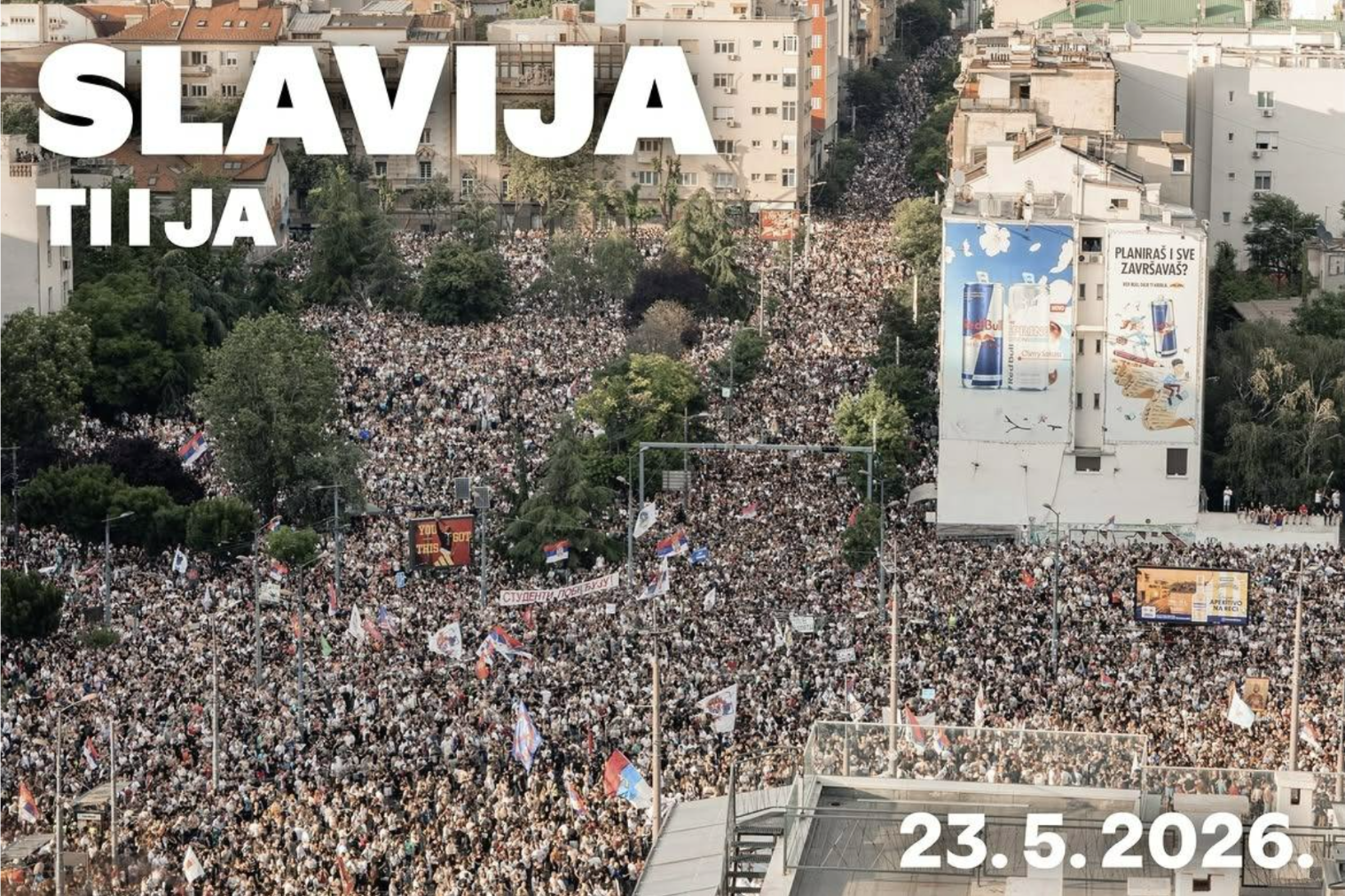

Photograph 1: The student protest of 23 May 2026 (Source: Students in Blockade)
To the student bloc's growing visibility the Serbian Progressive Party responded with the "Serbia Is Winning" campaign, whose name recalled the students' slogan "Students Are Winning". The similarity of names, messages and methods of promotion - banners, stickers, stands and field activities - may have made it harder for citizens to tell the two campaigns apart. Appropriating the slogan may also have had a broader polarising effect: by setting "Serbia" against "the students", the political conflict was further framed as a division between two opposing camps.
The Serbian Progressive Party's intensive field work confirmed the already observed practice of an almost permanent campaign. Over four months, from May to the end of August, more than 2,600 SNS activities were recorded, with a sharp jump in August (close to two-fifths of all activities were recorded in August). Activities took place predominantly through stands, sns_bajinabasta (2026), „Danas se družimo na štandu opštinskog odbora Srpske napredne stranke Bajina Bašta", https://www.instagram.com/p/DamyiAnDFVH/?img_index=1, 10 July meetings of party branches, sns_smed_palanka (2026), „Održan sastanak aktivista MO SNS Donji grad", https://www.instagram.com/p/Db_XxIPiC-w/?img_index=1, 13 August the tidying of public spaces, sns_vozdovac (2026), „Ulepšavamo i popravljamo ono što nesavesna i bahata manjina uništava. Tako Srpska napredna stranka radi svakog dana i na svim nivoima. Ujedinjena Srbija je lepša i bolja i zato ćemo pobediti", https://www.instagram.com/p/DcEunWWxs17/, 15 August door-to-door canvassing, sns_kragujevac (2026), „Razgovor sa građanima od vrata do vrata najlepši deo stranačkih aktivnosti, čujete kritike, predloge ali i pohvale za ono što je urađeno", https://www.instagram.com/p/DYKavAqjYDQ/?img_index=5, 10 May home visits snsbelapalanka (2026), „Goran Miljković obišao porodicu koja je dobila kuću kroz program Ministarstva", https://www.instagram.com/p/DZaiY9Qgrkd/?img_index=2, 10 June and conversations with citizens (Graphic 5). Party activists, local officials and state officials took part in them, and public discussions, sns_pozarevac (2026), post announcing an educational public discussion on women's health, „Značaj prevencije u ginekologiji“, organised by the Požarevac city branch of SNS at the Youth Centre in Kostolac, addressed by a specialist in gynaecology and obstetrics. 20 May. rallies sns_zagubica (2026), post announcing a get-together for pensioners at the OLYMPIC restaurant in Joašanica, held by the Žagubica municipal branch of SNS together with the President of the Municipality and his assistant. 25 May. and events aimed at various social groups were also organised.
The Serbian Progressive Party's intensive field work confirmed the already observed practice of an almost permanent campaign. Over four months, from May to the end of August, more than 2,600 SNS activities were recorded, with a sharp jump in August (close to two-fifths of all activities were recorded in August). Activities took place predominantly through stands, sns_bajinabasta (2026), „Danas se družimo na štandu opštinskog odbora Srpske napredne stranke Bajina Bašta", https://www.instagram.com/p/DamyiAnDFVH/?img_index=1, 10 July meetings of party branches, sns_smed_palanka (2026), „Održan sastanak aktivista MO SNS Donji grad", https://www.instagram.com/p/Db_XxIPiC-w/?img_index=1, 13 August the tidying of public spaces, sns_vozdovac (2026), „Ulepšavamo i popravljamo ono što nesavesna i bahata manjina uništava. Tako Srpska napredna stranka radi svakog dana i na svim nivoima. Ujedinjena Srbija je lepša i bolja i zato ćemo pobediti", https://www.instagram.com/p/DcEunWWxs17/, 15 August door-to-door canvassing, sns_kragujevac (2026), „Razgovor sa građanima od vrata do vrata najlepši deo stranačkih aktivnosti, čujete kritike, predloge ali i pohvale za ono što je urađeno", https://www.instagram.com/p/DYKavAqjYDQ/?img_index=5, 10 May home visits snsbelapalanka (2026), „Goran Miljković obišao porodicu koja je dobila kuću kroz program Ministarstva", https://www.instagram.com/p/DZaiY9Qgrkd/?img_index=2, 10 June and conversations with citizens (Graphic 5). Party activists, local officials and state officials took part in them, and public discussions, sns_pozarevac (2026), post announcing an educational public discussion on women's health, „Značaj prevencije u ginekologiji“, organised by the Požarevac city branch of SNS at the Youth Centre in Kostolac, addressed by a specialist in gynaecology and obstetrics. 20 May. rallies sns_zagubica (2026), post announcing a get-together for pensioners at the OLYMPIC restaurant in Joašanica, held by the Žagubica municipal branch of SNS together with the President of the Municipality and his assistant. 25 May. and events aimed at various social groups were also organised.
Intensity of SNS activities by month (1 May-31 August 2026)
Three most frequent activities
Three dominant themes
The slogan "Serbia Is Winning",
miloševučević (2026), „Pre godinu dana, na veliki praznik Petrovdan, blokaderi su palili i rušili, i hteli da bace Srbiju na kolena. Danas, na Petrovdan, narod im poručuje - pobedili smo! I uvek ćemo pobeđivati ujedinjeni u borbi za našu Srbiju!", https://www.instagram.com/p/DasUkXRCICa/?utm_source=ig_web_copy_link&igsh=NTc4MTIwNjQ2YQ%3D%3D&img_index=14, 12 July
used from the middle of May on banners, at stands and at party rallies, remained in circulation after the name of the candidate list "United Serbia"
milosvucevic (2026), „Ponosan i srećan sa našim divnim ljudima u Starim i Novim Ledincima. Dugujemo im neizmernu zahvalnost na svemu što su izdržali, što smo zajedno sačuvali i grad i državu", https://www.instagram.com/p/DcWn-Z5CCZW/?utm_source=ig_web_copy_link&igsi=NTc4MTIwNjQ2YQ%3D%3D&img_index=10, 22 August
was presented at the Serbian Progressive Party's rally in Belgrade on 27 June. In the activities that followed, "United Serbia" began to predominate as the ruling party's main slogan, both in promotional content and in announcements of a possible list under the name "Aleksandar Vučić - United Serbia".
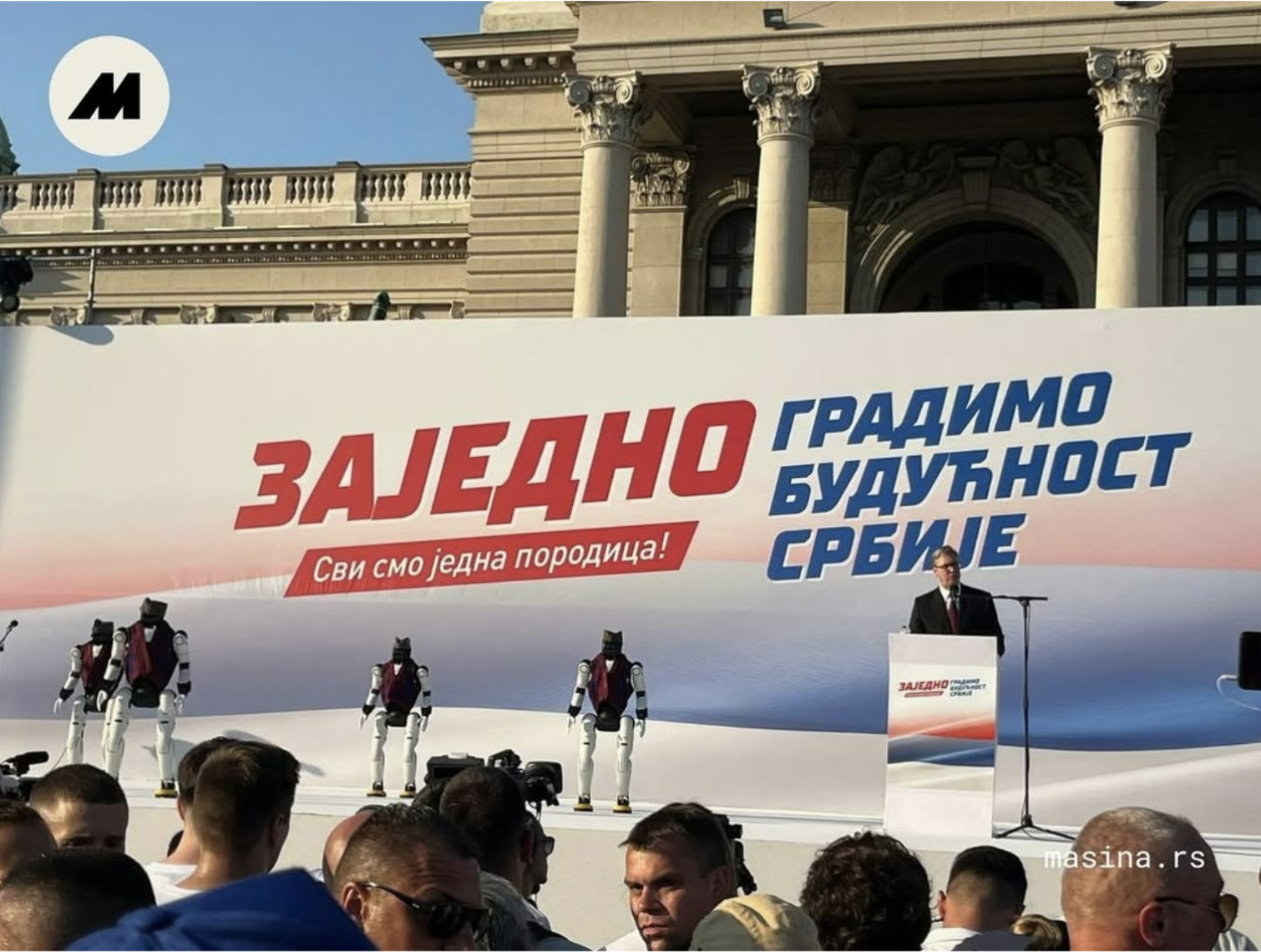
Photograph 2: The Serbian Progressive Party rally, 27 June 2026 (Source: Mašina)
Party activity remained closely bound up with the work of state and local institutions, accompanied by allegations of pressure and of the misuse of public resources. Public works, infrastructure projects, social benefits and other measures financed from public funds were promoted on SNS's social media channels, often with public officials taking part. Allegations were also recorded of employees being deployed and the resources of public enterprises used to organise party events, and of pressure being put on employees.
Opposition parties were active, but without a common pattern of activity. Their activities were recorded in at least 50 municipalities, and among the more visible actors were the Party of Freedom and Justice, the People's Movement of Serbia, Serbia Centre and the Green-Left Front. These were largely decentralised activities concerning local issues, conducted through stands, meetings, statements and initiatives critical of the authorities' record. Differences between the parties are also becoming visible in their attitude towards the student bloc, including the question of supporting its future electoral bid. As of the closing of this report, the Green-Left Front, Danas (2026), ZLF ponovio: Podržaćemo studentsku listu na izborima, https://www.danas.rs/vesti/politika/zlf-studentska-lista/ the Democratic Party, Demokratska stranka (2025), Демократска странка пружа подршку студентском захтеву за изборе, https://www.ds.org.rs/news/4579 the Serbian Movement Dveri Danas (2026), Dveri donele odluku: Podržavaju studente, https://www.danas.rs/vesti/politika/dveri-podrska-studentima/ and the Social Democratic Party N1 (2026), Predsedništvo SDS potvrdilo odluku o podršci studentskoj listi na predstojećim izborima, https://n1info.rs/vesti/predsednistvo-sds-potvrdilo-odluku-o-podrsci-studentskoj-listi-na-predstojecim-izborima/ (extra-parliamentary parties) had announced that they would support the Student List at the coming elections.
Opposition parties were active, but without a common pattern of activity. Their activities were recorded in at least 50 municipalities, and among the more visible actors were the Party of Freedom and Justice, the People's Movement of Serbia, Serbia Centre and the Green-Left Front. These were largely decentralised activities concerning local issues, conducted through stands, meetings, statements and initiatives critical of the authorities' record. Differences between the parties are also becoming visible in their attitude towards the student bloc, including the question of supporting its future electoral bid. As of the closing of this report, the Green-Left Front, Danas (2026), ZLF ponovio: Podržaćemo studentsku listu na izborima, https://www.danas.rs/vesti/politika/zlf-studentska-lista/ the Democratic Party, Demokratska stranka (2025), Демократска странка пружа подршку студентском захтеву за изборе, https://www.ds.org.rs/news/4579 the Serbian Movement Dveri Danas (2026), Dveri donele odluku: Podržavaju studente, https://www.danas.rs/vesti/politika/dveri-podrska-studentima/ and the Social Democratic Party N1 (2026), Predsedništvo SDS potvrdilo odluku o podršci studentskoj listi na predstojećim izborima, https://n1info.rs/vesti/predsednistvo-sds-potvrdilo-odluku-o-podrsci-studentskoj-listi-na-predstojecim-izborima/ (extra-parliamentary parties) had announced that they would support the Student List at the coming elections.
Actors that have announced they will contest the elections.
On the basis of the public announcements recorded so far, a number of political actors have confirmed that they will contest the coming elections. Although the Socialist Party of Serbia initially announced that it would run "independently", separately from SNS, Ivica Dačić specified that United Serbia (Jedinstvena Srbija) and the Greens of Serbia would, as previously, also appear on that list. United Serbia subsequently confirmed its decision to contest the elections in coalition with SPS. In the meantime SPS signed a memorandum
Nova.rs (2026), SPS i SDP potpisali Memorandum o saradnji, https://nova.rs/vesti/politika/sps-i-sdp-potpisali-memorandum-o-saradnji/
with the Social Democratic Party of Serbia expressing readiness to cooperate in the coming electoral process, while any joint bid will be governed by a separate coalition agreement after the elections are called and after decisions by the parties' bodies. On 6 September the Serbian Radical Party announced that it would take part on the "United Serbia" list formed around SNS, while on 7 September the "We - the People's Strength" movement confirmed the People's Party's earlier announcement of a joint bid. Running independently was also announced by the Alliance of Vojvodina Hungarians,
021.rs (2026), Pastor: SVM na izbore izlazi samostalno, primarni cilj nam nisu ministarska mesta, https://www.021.rs/info/srbija/451440/pastor-svm-na-izbore-izlazi-samostalno-primarni-cilj-nam-nisu-ministarska-mesta
the Strength of Serbia Movement - BK,
JUGpress (2026), I Bogoljub Karić u predizbornoj kampanji u Leskovcu, https://jugpress.com/i-bogoljub-karic-u-predizbornoj-kampanji-u-leskovcu/
the Roma Union of Serbia
Glas Zaječara (2026), Unija Roma Srbije: Samostalni izlazak na izbore, https://www.glas-zajecara.com/drustvo/unija-roma-srbije-samostalni-izlazak-na-izbore-41331
and the Sandžak Democratic Party,
sdpsandzak (2026), „Glavni odbor Sandžačke demokratske partije, kojim je predsedavao predsednik Samir Lekić, na sednici održanoj u subotu 15.08.2026. razmatrao je i usvojio odluke o principima i načinu učešća na predstojećim parlamentarnim izborima", https://www.instagram.com/reels/DcEAqrwoTIV/, 15 August
while participation was also announced by the People's Movement of Serbia,
Narodni pokret Srbije (2026), Zbijamo redove, jačamo lokalne odbore i nastavljamo borbu za interes građana, https://nps.org.rs/vesti/zbijamo-redove-jacamo-lokalne-odbore-i-nastavljamo-borbu-za-interes-gradana/
the Democratic Union of Roma,
Fonet (2026), DUR će učestvovati na izborima, https://fonet.rs/politika/Srbija/36843008/dur-ce-ucestvovati-na-izborima-.html
the Movement of Socialists,
021.rs (2026), Vulin: Pokret socijalista izlazi na izbore na listi gde EU neće moći ni da nas postavi, ni skloni, https://www.021.rs/info/srbija/449794/vulin-pokret-socijalista-izlazi-na-izbore-na-listi-gde-eu-nece-moci-ni-da-nas-postavi-ni-skloni
War Veterans for Serbia,
Savez ratnih veterana Srbije (2026), Saopštenje za javnost, https://savezratnihveteranasrbije.rs/saopstenje020826/
the Party of Freedom and Justice,
Insajder (2026), Borko Stefanović: Potrebna smena vlasti uz jasno opredeljenje gde i kuda idemo, https://insajder.net/vesti/borko-stefanovic-potrebna-smena-vlasti-uz-jasno-opredeljenje-gde-i-kuda-idemo-video
the "Dad, This Is For You" movement
cale_ovo_je_za_tebe_ (2026), „Zvanično saopštenje Pokreta „Ćale, ovo je za tebe" povodom predstojećih parlamentarnih izbora! ✊", https://www.instagram.com/p/DbiO2Netvyh/, 2 August
and the Workers' Party.
Danas (2026), „Ne želimo da budemo za jednokratnu upotrebu": Radnička partija izlazi na predstojeće izbore, https://www.danas.rs/vesti/politika/radnicka-partija-izbori/
Broader coalitions have also been formed or announced: the Fraternal Alliance 381 - Together for Our State,
UNS Press centar (2026), Formiranje predizborne koalicije „Bratski savez 381 - Zajedno za našu državu" i predstavljanje političke platforme „Manifest 381", https://presscentar.uns.org.rs/announcements/7197/formiranje-predizborne-koalicije-bratski-savez-381--zajedno-za-nasu-drzavu-i-predstavljanje-politicke-platforme-manifest-381.html
bringing together several minority parties, and the minority coalition Snaga,
N1 (2026), Stranka budućnosti i razvoja najavila učešće na izborima kao deo manjinske koalicije SNAGA, https://n1info.rs/vesti/stranka-buducnosti-i-razvoja-najavila-ucesce-na-izborima-kao-deo-manjinske-koalicije-snaga/
which includes the Party of the Future and Development; the People's Party
Danas (2026), Gajić: Sa Nestorovićem na parlamentarne izbore, saglasni o važnim temama, https://www.danas.rs/vesti/politika/gajic-sa-nestorovicem-na-parlamentarne-izbore-saglasni-o-vaznim-temama/
announced that it would run in coalition with the We - the People's Strength movement and with citizens' groups and associations from outside Belgrade, while the NADA coalition
N1 (2026), Miloš Jovanović: Koalicija NADA na listi autentične desnice, otvoreni za srodne partnere, https://n1info.rs/vesti/milos-jovanovic-koalicija-nada-na-listi-autenticne-desnice-otvoreni-za-srodne-partnere/
announced that it would contest the elections on a list of the "authentic right", open to like-minded partners. These announcements already contain indications that the question of the authenticity of lists will be present at the coming elections too. For example, War Veterans for Serbia is registered as a political party of the Slovak national minority. At the 2024 local elections it ran in coalition with another minority party under the name "The Voice of the People Is the Strength of the People", which gave no indication of the list's minority character and could have misled voters as to who stood behind it. Also in 2024, appeals were lodged over suspected forged signatures on the list of the "Dad, This Is For You" movement, after individuals named on the list denied that they had signed it.
State and party: the institutional advantage of those in power
The blurring of the line between the state and the ruling party was a defining feature of the observation period: public office, public services, public benefits and public resources were used for political promotion and mobilisation. The authorities' political visibility was built not through formal party activity but primarily through the frequent presence of officials in institutions, companies, at construction sites and at various events, and through direct contact with citizens.
Public office in the service of political promotion
Given the pronounced presence of state and local officials, it was difficult to tell whether the activities being carried out across Serbia were those of the party or of the institutions. By the end of August, 2,190 appearances by senior state officials had been recorded across the country, in more than 1,200 individual or group activities.
The intensity of state officials' appearances rose through the summer, peaking in August - in that month alone more than 400 activities involving them were recorded. In a single week, from 17 to 23 August, almost a third of all officials' activities for August were recorded, with 56 officials taking part. Officials' presence is markedly concentrated: every fourth activity took place in Belgrade, and the largest numbers of activities outside the capital were recorded in the Rasina, Zlatibor and Šumadija districts.
The intensity of state officials' appearances rose through the summer, peaking in August - in that month alone more than 400 activities involving them were recorded. In a single week, from 17 to 23 August, almost a third of all officials' activities for August were recorded, with 56 officials taking part. Officials' presence is markedly concentrated: every fourth activity took place in Belgrade, and the largest numbers of activities outside the capital were recorded in the Rasina, Zlatibor and Šumadija districts.
Activities of senior state officials by district (1 May-31 August 2026)
State officials most often visited companies and institutions (179 activities), celebrations (171), cultural, entertainment and other events (132), meetings and sessions (124), commemorations and ceremonies (108), works in progress (88), formal signings and handovers of contracts (74) and formal openings (60).
By contrast, activities that were clearly organised by the Serbian Progressive Party or by one of the parties of the ruling coalition - rallies, stands, door-to-door canvassing - involved officials only sporadically.
By contrast, activities that were clearly organised by the Serbian Progressive Party or by one of the parties of the ruling coalition - rallies, stands, door-to-door canvassing - involved officials only sporadically.
The President of the Republic at the centre of continuous promotion of those in power
The President of the Republic of Serbia, Aleksandar Vučić, appeared 173 times at various events in 68 municipalities and towns in Serbia over the four-month period, and thus stood out as the most active senior state official. As many as 76 per cent of all those places he visited on a three-week tour in August. More than two-thirds of his activities were recorded after 10 August, as part of that tour. The intensification of these activities coincides in time with his announcement of 16 August that he would call the elections within 15 to 25 days.
Intensity of Aleksandar Vučić's activities
Recorded activities from 7 May to 31 August 2026
173Total activities
43Most active week
11810-31 August
68.2%Share, 10-31 August
Geographically, the presidential tour's activities were directed towards central, western and southern Serbia: 91 activities in Šumadija and western Serbia, 45 in southern and eastern Serbia, 24 in Belgrade and only 13 in Vojvodina.
The most intensive days were organised as multi-day regional tours. The peak was recorded on 22 August, when the President of Serbia visited eight municipalities in the Pčinja and Jablanica districts - Vranje, Leskovac, Bujanovac, Preševo, Surdulica, Vladičin Han, Vlasotince and Trgovište - and took part in 16 activities in total. The pattern was repeated: a visit to a company or institution, a tour of infrastructure works, a visit to a household, and an address to assembled citizens.
The most intensive days were organised as multi-day regional tours. The peak was recorded on 22 August, when the President of Serbia visited eight municipalities in the Pčinja and Jablanica districts - Vranje, Leskovac, Bujanovac, Preševo, Surdulica, Vladičin Han, Vlasotince and Trgovište - and took part in 16 activities in total. The pattern was repeated: a visit to a company or institution, a tour of infrastructure works, a visit to a household, and an address to assembled citizens.
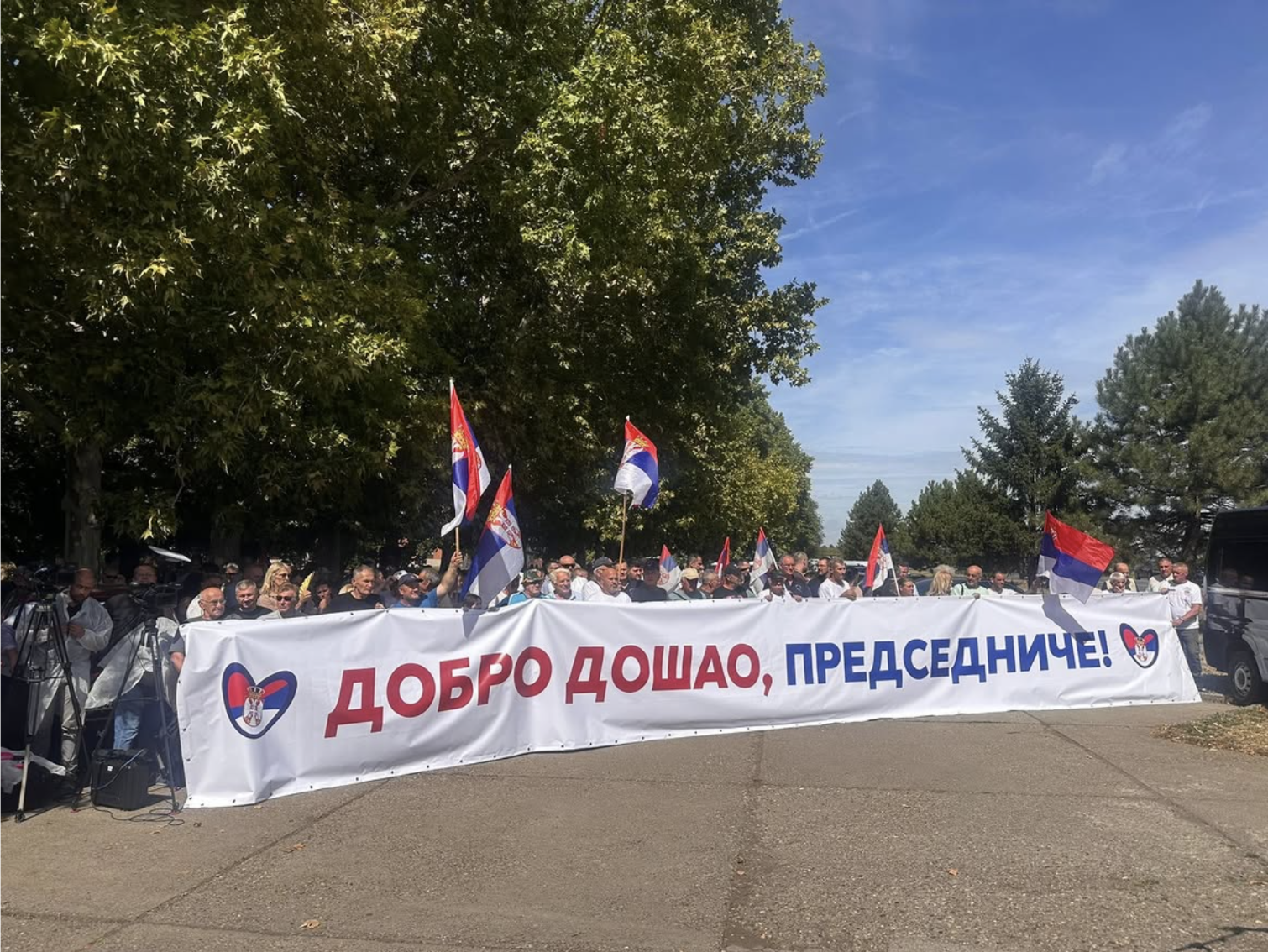
Photograph: The welcome
palilula_sns (2026), „🇷🇸🇷🇸🇷🇸", https://www.instagram.com/p/Dc3PoE6ITJz/, 4 September
** for the President of Serbia, Aleksandar Vučić, in Bačka Topola.
INFOBLOK (2026), „Kažu prošao je Vučić, baš nas briga šta je obećao" Predsednik u Bačkoj Topoli dobio pohvale, a onda otkrio veliku tajnu - To je najbolja taktika!, https://infoblok.rs/kazu-prosao-je-vucic-bas-nas-briga-sta-je-obecao-predsednik-u-backoj-topoli-dobio-pohvale-a-onda-otkrio-veliku-tajnu-to-je-najbolja-taktika/
4 September 2026**
Thematically, infrastructure and the economy predominated, with family and tradition forming a third block. The most frequent were visits
buducnostsrbijeav (2026), „Došao sam pre svega da čujem vas, jer mi je važno da znamo šta još možemo da uradimo za ljude koji ovde žive i rade", https://www.instagram.com/p/Db29jguFyth/?utm_source=ig_web_copy_link&igsh=NTc4MTIwNjQ2YQ%3D%3D, 10 August
to companies and institutions, tours
buducnostsrbijeav (2026), „Ljudi u ovom kraju nisu imali put, a sada se radi ozbiljan put koji će im mnogo značiti", https://www.instagram.com/p/Db5pfSRF6NW/?utm_source=ig_web_copy_link&igsh=NTc4MTIwNjQ2YQ%3D%3D, 11 August
of works in progress, visits to households
buducnostsrbijeav (2026), „Nema lepšeg prizora od dečjeg osmeha i jedne lepe, brojne porodice", https://www.instagram.com/reel/DaIRZ-GOzAh/?utm_source=ig_web_copy_link&igsh=NTc4MTIwNjQ2YQ%3D%3D, 28 June
and celebrations.
rtvkraljevoiibarskenovosti (2026), „Više od 4.000 ljudi na Narodnom veselju u Oplanićima koje je posetio predsednik Srbije Aleksandar Vučić", https://www.instagram.com/reels/DaEHnJ7MPZB/, 26 June
The President's visit to a local community often consisted of a series of events in which the authorities' achievements, local projects and public investment were linked directly to the President's personal presence.
One example recorded on 10 August in Nova Varoš stands out in particular, when a woman stated N1 (2026), (VIDEO) "Ako skupim određeni broj glasova, dobiću posao - a nisam": Pitanje za Vučića u Novoj Varoši, https://n1info.rs/vesti/vucic-glasovi-posao/ in front of the President and local officials that she had been promised employment if she gathered a certain number of votes for the 2020 elections, and that the promise had not been kept. Her statement points to a clientelist understanding of the relationship between citizens and political actors, in which party engagement and the securing of votes are expected in exchange for access to employment. It is particularly concerning that the object of such an exchange is a job, decisions about which may rest with institutions or with holders of public office.
That the recorded activities have the features of an intensive pre-election campaign conducted through the presidential office, even though the elections have not yet been called, is further indicated by the organised distribution of a letter from the President to the home addresses of pensioners and recipients of social benefits across Serbia. The Republic Fund for Pension and Disability Insurance (the PIO Fund) and Post of Serbia were involved in producing the letter and distributing it. Content analysis of the letter shows a political, pre-election tone. "I want to say to you that every person, every pensioner, every one of you has and will have the same right as every other citizen to decide to whom to give their [...]" It was delivered to recipients through Post of Serbia. According to information obtained from employees of that public enterprise, the client commissioning the work was the PIO Fund. CRTA Election Observation Mission received information from interlocutors that postal workers, when delivering the letters, were also tasked with collecting from recipients - along with their name and surname - telephone numbers and signatures giving consent to receive further communications. Since the purpose, the manner of use and the retention period for the collected data are not clearly stated, this practice raises questions about the lawfulness and transparency of their processing, and about the possibility that the contact details may be used for further political messaging. A subsequent statement by Post of Serbia "In compliance with the Law on Personal Data Protection, users who give consent to electronic delivery of items through the e-Postman system are enabled [...]" confirming that these data were collected does not, however, provide a clear answer as to what purpose it is to serve, since it invokes the creation of a database for the e-Post service, which is still being set up. Yet the fact that citizens found the letters in their letterboxes with no information whatsoever about that service or any invitation to leave their contact details subsequently, and that it is not known whether the same information is collected when other post is delivered, does not suggest a systematic approach to building a database of such importance. Nor is any information publicly available as to who bore the cost of distributing the letters - the PIO Fund or Post of Serbia. In either case, the President's political promotion would have been carried out using the capacity and funds of public institutions. It is particularly problematic that the messages are directed at pensioners and socially vulnerable citizens, while personal data are collected from them without any clear explanation of what they will be used for.
Although only two Serbian Progressive Party rallies were formally recorded - the rally in front of the National Assembly of the Republic of Serbia on 27 June and the "United Serbia" rally in Užice on 29 August - the appearance of the President of the Republic of Serbia, together with the placement of recognisable political and promotional content, including the announcement of the name of the future candidate list and calls on citizens to vote for it, raise suspicions that funds intended for a political party's regular operations were spent for purposes other than intended in order to run a campaign before it was called, and suspicions of misuse of public office and public resources.
CRTA submitted to the Agency for Prevention of Corruption an initiative for the active monitoring of the Serbian Progressive Party's political activities, on the suspicion that the party is running an election campaign before elections have been called and that it has spent funds intended for regular operations for purposes other than intended. The occasion was the "United Serbia" rally held in Užice on 29 August 2026, at which, judging by material published on the party's official accounts, considerable sums were invested in the stage, sound system, video screens and security, together with organised bus transport of supporters from across Serbia, food and, according to some accounts, daily allowances paid out. The message "United Serbia Aleksandar Vučić" was displayed on the podium, on the screens and on supporters' T-shirts, while immediately before the rally Aleksandar Vučić called on voters to vote for the "United Serbia" list, and at the rally itself spoke of victory at the elections - which, under the statutory definition, constitutes an election campaign activity. Since funds for regular operations may be used for a campaign only if they are first paid into a dedicated account, which is not opened before the elections are called, CRTA is asking the Agency to gather evidence on the costs of the rally and how they were paid - including its broadcast on TV Pink and TV Informer, which constitutes either a cost or a non-monetary donation - and, once the candidate list has been confirmed, to establish whether the misdemeanour under Article 42 of the Law on Financing of Political Activities has been committed, for which the prescribed penalty is between RSD 200,000 and RSD 2,000,000, to file a request to initiate misdemeanour proceedings, and to inform the public accordingly.
After President Vučić, the most active was Minister Adrijana Mesarović, with 145 appearances in 71 towns and municipalities, the widest geographical coverage of any official. She is followed by Ministers Darko Glišić (88) and Dragan Glamočić (72), Prime Minister Đuro Macut (67) and Minister Nikola Selaković (65). Alongside SNS officials, among the most active are also representatives of coalition partners: Ivica Dačić and Đorđe Milićević (SPS) and Milica Đurđević Stamenkovski (Zavetnici).
The President's visit to a local community often consisted of a series of events in which the authorities' achievements, local projects and public investment were linked directly to the President's personal presence.
One example recorded on 10 August in Nova Varoš stands out in particular, when a woman stated N1 (2026), (VIDEO) "Ako skupim određeni broj glasova, dobiću posao - a nisam": Pitanje za Vučića u Novoj Varoši, https://n1info.rs/vesti/vucic-glasovi-posao/ in front of the President and local officials that she had been promised employment if she gathered a certain number of votes for the 2020 elections, and that the promise had not been kept. Her statement points to a clientelist understanding of the relationship between citizens and political actors, in which party engagement and the securing of votes are expected in exchange for access to employment. It is particularly concerning that the object of such an exchange is a job, decisions about which may rest with institutions or with holders of public office.
That the recorded activities have the features of an intensive pre-election campaign conducted through the presidential office, even though the elections have not yet been called, is further indicated by the organised distribution of a letter from the President to the home addresses of pensioners and recipients of social benefits across Serbia. The Republic Fund for Pension and Disability Insurance (the PIO Fund) and Post of Serbia were involved in producing the letter and distributing it. Content analysis of the letter shows a political, pre-election tone. "I want to say to you that every person, every pensioner, every one of you has and will have the same right as every other citizen to decide to whom to give their [...]" It was delivered to recipients through Post of Serbia. According to information obtained from employees of that public enterprise, the client commissioning the work was the PIO Fund. CRTA Election Observation Mission received information from interlocutors that postal workers, when delivering the letters, were also tasked with collecting from recipients - along with their name and surname - telephone numbers and signatures giving consent to receive further communications. Since the purpose, the manner of use and the retention period for the collected data are not clearly stated, this practice raises questions about the lawfulness and transparency of their processing, and about the possibility that the contact details may be used for further political messaging. A subsequent statement by Post of Serbia "In compliance with the Law on Personal Data Protection, users who give consent to electronic delivery of items through the e-Postman system are enabled [...]" confirming that these data were collected does not, however, provide a clear answer as to what purpose it is to serve, since it invokes the creation of a database for the e-Post service, which is still being set up. Yet the fact that citizens found the letters in their letterboxes with no information whatsoever about that service or any invitation to leave their contact details subsequently, and that it is not known whether the same information is collected when other post is delivered, does not suggest a systematic approach to building a database of such importance. Nor is any information publicly available as to who bore the cost of distributing the letters - the PIO Fund or Post of Serbia. In either case, the President's political promotion would have been carried out using the capacity and funds of public institutions. It is particularly problematic that the messages are directed at pensioners and socially vulnerable citizens, while personal data are collected from them without any clear explanation of what they will be used for.
Although only two Serbian Progressive Party rallies were formally recorded - the rally in front of the National Assembly of the Republic of Serbia on 27 June and the "United Serbia" rally in Užice on 29 August - the appearance of the President of the Republic of Serbia, together with the placement of recognisable political and promotional content, including the announcement of the name of the future candidate list and calls on citizens to vote for it, raise suspicions that funds intended for a political party's regular operations were spent for purposes other than intended in order to run a campaign before it was called, and suspicions of misuse of public office and public resources.
CRTA submitted to the Agency for Prevention of Corruption an initiative for the active monitoring of the Serbian Progressive Party's political activities, on the suspicion that the party is running an election campaign before elections have been called and that it has spent funds intended for regular operations for purposes other than intended. The occasion was the "United Serbia" rally held in Užice on 29 August 2026, at which, judging by material published on the party's official accounts, considerable sums were invested in the stage, sound system, video screens and security, together with organised bus transport of supporters from across Serbia, food and, according to some accounts, daily allowances paid out. The message "United Serbia Aleksandar Vučić" was displayed on the podium, on the screens and on supporters' T-shirts, while immediately before the rally Aleksandar Vučić called on voters to vote for the "United Serbia" list, and at the rally itself spoke of victory at the elections - which, under the statutory definition, constitutes an election campaign activity. Since funds for regular operations may be used for a campaign only if they are first paid into a dedicated account, which is not opened before the elections are called, CRTA is asking the Agency to gather evidence on the costs of the rally and how they were paid - including its broadcast on TV Pink and TV Informer, which constitutes either a cost or a non-monetary donation - and, once the candidate list has been confirmed, to establish whether the misdemeanour under Article 42 of the Law on Financing of Political Activities has been committed, for which the prescribed penalty is between RSD 200,000 and RSD 2,000,000, to file a request to initiate misdemeanour proceedings, and to inform the public accordingly.
After President Vučić, the most active was Minister Adrijana Mesarović, with 145 appearances in 71 towns and municipalities, the widest geographical coverage of any official. She is followed by Ministers Darko Glišić (88) and Dragan Glamočić (72), Prime Minister Đuro Macut (67) and Minister Nikola Selaković (65). Alongside SNS officials, among the most active are also representatives of coalition partners: Ivica Dačić and Đorđe Milićević (SPS) and Milica Đurđević Stamenkovski (Zavetnici).
Photograph: The President of the Republic of Serbia, Aleksandar Vučić, talking with citizens in Novi Pazar. In the background is the party banner Serbia Is Winning. 24 August 2026.
buducnostsrbijeav (2026), „Mnogo toga važnog za Novi Pazar i ovaj kraj kreće da se radi odmah. Već za desetak dana počinjemo radove na novim putevima, uredićemo i ulaz u grad, a zatim krećemo i u izgradnju potpuno nove škole u Deževi", https://www.instagram.com/p/Dca5Vtdjl_-/?utm_source=ig_web_copy_link&igsi=NTc4MTIwNjQ2YQ%3D%3D&img_index=4, 24 August
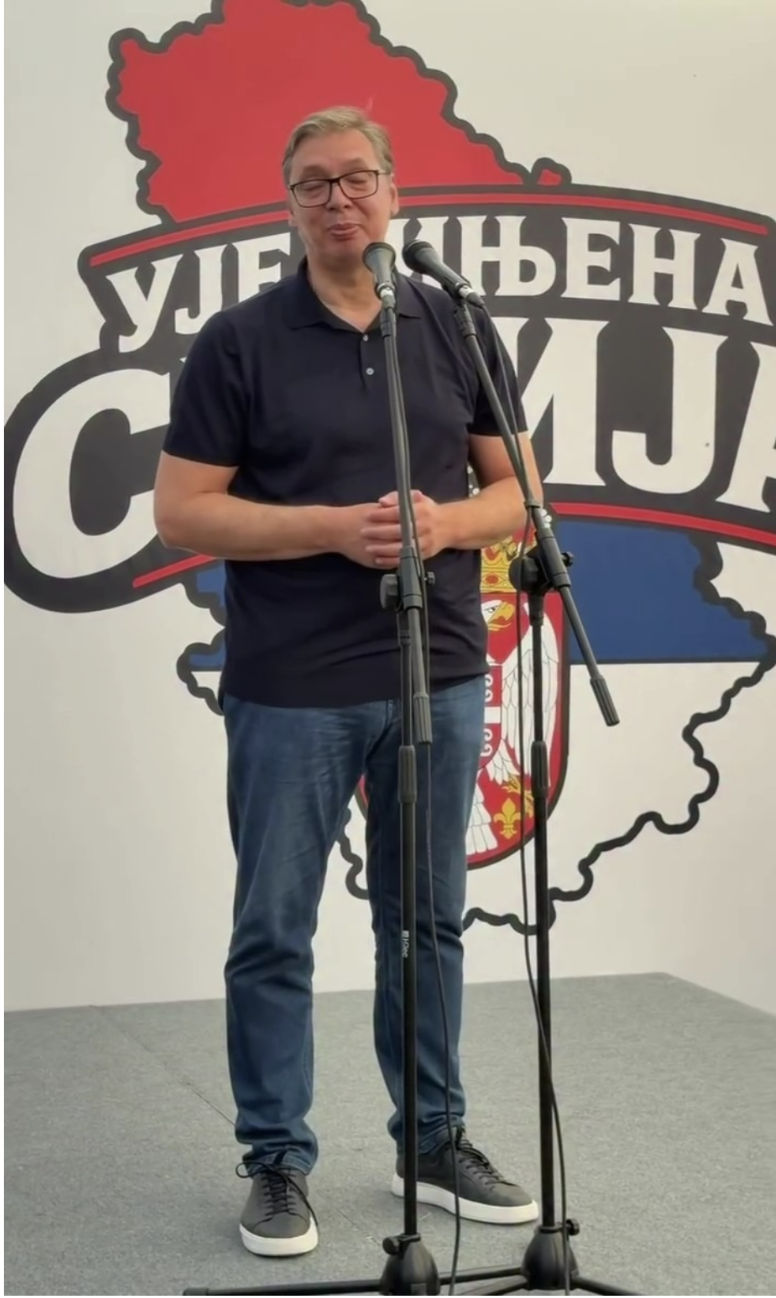
Photograph: The President of the Republic of Serbia, Aleksandar Vučić, addressing the citizens of Belegiš. Behind him is the recognisable party slogan United Serbia. 8 August 2026.
buducnostsrbijeav (2026), „Najviše volim da razgovaram sa vama i da čujem šta imate da kažete. Ništa lepše od toga nema", https://www.instagram.com/reel/Dbyar3vO-s0/, 8 August
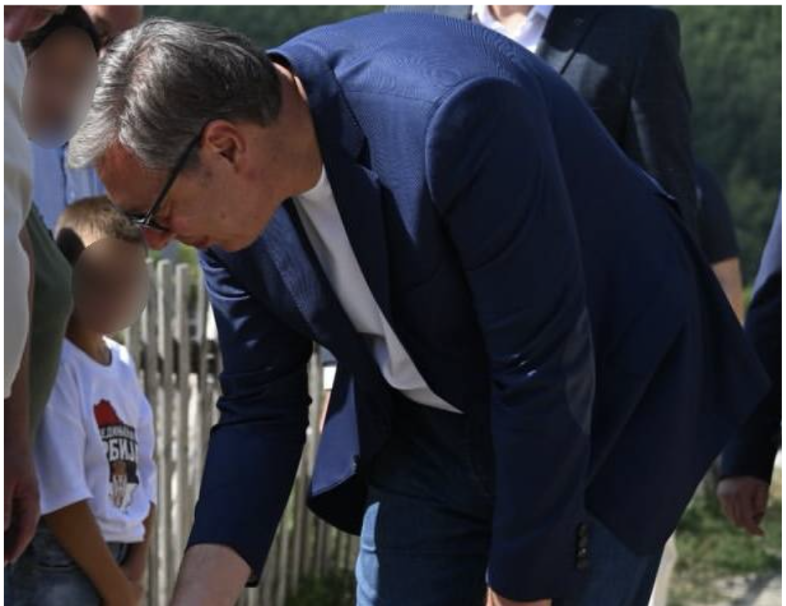
Photograph: The President of the Republic of Serbia, Aleksandar Vučić, visited the Bugarić family and talked with residents in the village of Vranovina, Deževa. A child in a United Serbia T-shirt can be seen in the photograph. 24 August 2026.
buducnostsrbijeav (2026), „U Deževi ima dece, ima mladih i ima života, i zbog toga sam danas istinski srećan. Oko 250 đaka pohađa školu i zato ćemo napraviti potpuno novu školu za decu iz ovog i okolnih sela", https://www.instagram.com/p/DcasVFdDu_-/?utm_source=ig_web_copy_link&igsi=NTc4MTIwNjQ2YQ%3D%3D&img_index=2, 24 August
Misuse of public institutions and resources for party purposes
A particularly pronounced form of the intertwining of state and party was pressure on public sector employees to support SNS activities.
Among the 110 recorded cases with elements of pressure are allegations of employees being brought to party rallies in an organised manner, as part of which lists of employees were drawn up, quotas set, telephone calls made and "recommendations" to attend issued.
In addition, over the four-month period CRTA Election Observation Mission recorded 366 cases with elements of clientelism - exclusively among the activities of the Serbian Progressive Party. On average, every seventh recorded SNS activity bore traces of clientelism.
CRTA observers also recorded 213 cases with elements of misuse of public office and public resources.
For the SNS rally in Belgrade on 27 June, the "Sloboda" factory in Čačak was, according to interlocutors of the CRTA Election Observation Mission, asked to provide 500 workers, with employees offered paid days off while workers engaged through contracts and agencies were threatened with the loss of their jobs. Allegations were also recorded that employees in PIO Fund branch offices were called upon to attend the same rally, and that workers at "Zastava oružja" were recommended to attend an SNS event in Lapovo. An allegation CRTA (2026), „U poseti Topličkom okrugu predsednik Srbije naišao je i na građanina koji tvrdi da je dobio otkaz jer nije 'bio na mitingu'", https://x.com/CRTArs/status/2090073636698751320, 19 August by a citizen, during Vučić's visit to the Toplica district on 19 August, that he had lost his job because he had not gone to a rally could be heard in the live television broadcast.
Pressure was not limited to attendance at rallies.
At the public utility company JKSP "Zaječar", employees were, according to sources, telephoned and pressed to sign up as "safe votes". Employees of the Centre for Social Work in Inđija were assigned to teams that visited recipients of social assistance, women victims of domestic violence and agricultural households, gathered data on political support and recorded "capillary votes". According to the same source, undecided citizens and those who did not support President Vučić were threatened with the suspension of assistance and subsidies. At SNS premises in Zaječar, conversations were also held about the continued engagement of trainees, workers on temporary and occasional contracts, and public enterprise employees whose contracts had expired.
Among the prominent activities with elements of clientelism, one case stands out in Čačak, where the local branch of the Serbian Progressive Party provides material assistance in a targeted way to citizens in socially vulnerable categories (elderly people living alone and families in difficult housing conditions) as part of the party campaign "Good Neighbour". sns_cacak (2026), „Danas je u Petnici, u organizaciji GrO SNS Čačak i MO Petnica - Brezovice - Rajac, član GrO Milan Bojović posetio porodicu Miladinović", https://www.instagram.com/p/DcGSzL_iGjJ/?img_index=1, 16 August The assistance as a rule consists of household appliances (refrigerators, televisions, cookers) and is presented as the personal contribution of individual members of the ruling party's municipal branch.
Among the 110 recorded cases with elements of pressure are allegations of employees being brought to party rallies in an organised manner, as part of which lists of employees were drawn up, quotas set, telephone calls made and "recommendations" to attend issued.
In addition, over the four-month period CRTA Election Observation Mission recorded 366 cases with elements of clientelism - exclusively among the activities of the Serbian Progressive Party. On average, every seventh recorded SNS activity bore traces of clientelism.
CRTA observers also recorded 213 cases with elements of misuse of public office and public resources.
For the SNS rally in Belgrade on 27 June, the "Sloboda" factory in Čačak was, according to interlocutors of the CRTA Election Observation Mission, asked to provide 500 workers, with employees offered paid days off while workers engaged through contracts and agencies were threatened with the loss of their jobs. Allegations were also recorded that employees in PIO Fund branch offices were called upon to attend the same rally, and that workers at "Zastava oružja" were recommended to attend an SNS event in Lapovo. An allegation CRTA (2026), „U poseti Topličkom okrugu predsednik Srbije naišao je i na građanina koji tvrdi da je dobio otkaz jer nije 'bio na mitingu'", https://x.com/CRTArs/status/2090073636698751320, 19 August by a citizen, during Vučić's visit to the Toplica district on 19 August, that he had lost his job because he had not gone to a rally could be heard in the live television broadcast.
Pressure was not limited to attendance at rallies.
At the public utility company JKSP "Zaječar", employees were, according to sources, telephoned and pressed to sign up as "safe votes". Employees of the Centre for Social Work in Inđija were assigned to teams that visited recipients of social assistance, women victims of domestic violence and agricultural households, gathered data on political support and recorded "capillary votes". According to the same source, undecided citizens and those who did not support President Vučić were threatened with the suspension of assistance and subsidies. At SNS premises in Zaječar, conversations were also held about the continued engagement of trainees, workers on temporary and occasional contracts, and public enterprise employees whose contracts had expired.
Among the prominent activities with elements of clientelism, one case stands out in Čačak, where the local branch of the Serbian Progressive Party provides material assistance in a targeted way to citizens in socially vulnerable categories (elderly people living alone and families in difficult housing conditions) as part of the party campaign "Good Neighbour". sns_cacak (2026), „Danas je u Petnici, u organizaciji GrO SNS Čačak i MO Petnica - Brezovice - Rajac, član GrO Milan Bojović posetio porodicu Miladinović", https://www.instagram.com/p/DcGSzL_iGjJ/?img_index=1, 16 August The assistance as a rule consists of household appliances (refrigerators, televisions, cookers) and is presented as the personal contribution of individual members of the ruling party's municipal branch.
"Good Neighbour" campaign, 17 August 2026.
sns_cacak (2026), „Akcija 'Dobar komšija' bila je danas u Ostri, gde su koordinator rejona Vladan Milić, članica Glavnog odbora Biljana Jakovljević i članica Gradskog odbora Milica Dačić posetili porodicu Anđelić i, tom prilikom, uručili im skroman poklon", https://www.instagram.com/p/DcJM-CoCHFJ/, 17 August
The Women's Union of the Smederevo City Branch of the Serbian Progressive Party and the Smederevo Health Centre organised preventive health checks and a conversation with citizens in Badljevica. 20 May 2026. Srpska Napredna Stranka Smederevo (2026), https://www.facebook.com/photo/?fbid=1293393659649386&set=pcb.1293393946316024, 20 May
Several cases of party work intertwining with public services, particularly in healthcare, were recorded during the observation period.
The most striking examples were recorded in Čačak, Српска Напредна Странка Чачак (2026), Превентивни ултразвучни прегледи дојке организовани су и у просторијама странке на Љубић кеју, 30 April 2026, https://www.facebook.com/cacak.sns/posts/1284006110525079 where preventive ultrasound examinations were organised on Serbian Progressive Party premises, and in Smederevo, sns_smederevo (2026), post stating that the Smederevo city branch of SNS, „in cooperation with the Smederevo Health Centre“, organised preventive health checks for residents of the village of Seone. 11 May. where the party's city branch organised preventive health checks "in cooperation with the Health Centre" and distributed promotional party material. A similar pattern was recorded in Bela Crkva, sns_bela_crkva (2026), ОО Српске напредне странке у Белој Цркви организовао је Базар здравља као превентивни вид подршке очувању здравља наших суграђана. https://www.instagram.com/p/DaQU830CtSR/?img_index=1, 1 July where medical staff of the community health centre carried out blood pressure and blood sugar measurements and cardiological examinations as part of a "Health Bazaar" announced by the local SNS branch. In Zemun sns_mo_altina (2026), Брига о здрављу је најважнија инвестиција. https://www.instagram.com/reels/DbOYnQhCF0H/, 25 July the party organised door-to-door medical examinations, visiting citizens and examining them in their homes, while in Bela Palanka snsbelapalanka (2026), ОРГАНИЗОВАНИ ПРЕВЕНТИВНИ ЛЕКАРСКИ ПРЕГЛЕДИ У ТАМЊАНИЦИ. https://www.instagram.com/p/Daa6PhqgmKn/?img_index=1, 5 July preventive examinations were organised by the community health centre and the municipality, and the campaign was promoted on the Serbian Progressive Party's official profile.
The Women's Union of the Smederevo City Branch of the Serbian Progressive Party and the Smederevo Health Centre organised preventive health checks and a conversation with citizens in Badljevica. 20 May 2026. Srpska Napredna Stranka Smederevo (2026), https://www.facebook.com/photo/?fbid=1293393659649386&set=pcb.1293393946316024, 20 May
Several cases of party work intertwining with public services, particularly in healthcare, were recorded during the observation period.
The most striking examples were recorded in Čačak, Српска Напредна Странка Чачак (2026), Превентивни ултразвучни прегледи дојке организовани су и у просторијама странке на Љубић кеју, 30 April 2026, https://www.facebook.com/cacak.sns/posts/1284006110525079 where preventive ultrasound examinations were organised on Serbian Progressive Party premises, and in Smederevo, sns_smederevo (2026), post stating that the Smederevo city branch of SNS, „in cooperation with the Smederevo Health Centre“, organised preventive health checks for residents of the village of Seone. 11 May. where the party's city branch organised preventive health checks "in cooperation with the Health Centre" and distributed promotional party material. A similar pattern was recorded in Bela Crkva, sns_bela_crkva (2026), ОО Српске напредне странке у Белој Цркви организовао је Базар здравља као превентивни вид подршке очувању здравља наших суграђана. https://www.instagram.com/p/DaQU830CtSR/?img_index=1, 1 July where medical staff of the community health centre carried out blood pressure and blood sugar measurements and cardiological examinations as part of a "Health Bazaar" announced by the local SNS branch. In Zemun sns_mo_altina (2026), Брига о здрављу је најважнија инвестиција. https://www.instagram.com/reels/DbOYnQhCF0H/, 25 July the party organised door-to-door medical examinations, visiting citizens and examining them in their homes, while in Bela Palanka snsbelapalanka (2026), ОРГАНИЗОВАНИ ПРЕВЕНТИВНИ ЛЕКАРСКИ ПРЕГЛЕДИ У ТАМЊАНИЦИ. https://www.instagram.com/p/Daa6PhqgmKn/?img_index=1, 5 July preventive examinations were organised by the community health centre and the municipality, and the campaign was promoted on the Serbian Progressive Party's official profile.
Complaints to the Agency for Prevention of Corruption in cases of the officials' campaign
Between May and the end of August 2026, CRTA submitted seven complaints to the Agency for Prevention of Corruption on the suspicion of breaches of provisions of the Law on Prevention of Corruption and the Law on Financing of Political Activities. Those complaints pointed to various forms of connection between public officials and state bodies and the activities of the ruling Serbian Progressive Party (SNS) - from the use of official communication channels, through the engagement of public officials in party activities, to the organisation of a large number of events intended to mobilise citizens politically.
Two complaints against the director of the Centre for Social Work in Stara Pazova, Oliver Ristić, and against the Serbian Progressive Party, on the suspicion of breaches of the Law on Prevention of Corruption and the Law on Financing of Political Activities, [...]
As of the closing of this report the Agency had not acted on a single complaint.
On the basis of knowledge gained through long-term observation, other proceedings were also initiated on the suspicion that public and institutional resources were being used for political activities. In June 2026 CRTA submitted requests for access to information of public importance to the city Centre for Social Work and to the Savski Venac police station in connection with the case of a minor resident of the children's home in Zvečanska Street, in respect of whom there was information that he had left the institution after organising, for a cash payment, residents' attendance at an SNS rally at the Arena - as stated in a document that had appeared in public. The Centre for Social Work refused the request, after which CRTA appealed to the Commissioner, while the Savski Venac police station replied that it held no data on the case.
An illustrative example is the complaint concerning more than 60 SNS activities organised during May and June 2026 across the country - "folk festivities", "people's assemblies", "get-togethers with pensioners" and "before and after" exhibitions. The complaint sought a check on how they were financed, that is, a determination of the source of the funds, and drew particular attention to the linking of public bodies' achievements with SNS's political activity.
In addition, CRTA submitted a request for access to information to the Red Cross of Serbia over indications that the Red Cross organisation in Inđija had taken part in a promotional SNS event in July by setting up its stand. The Red Cross of Serbia confirmed the Inđija organisation's participation, stating that the event had been organised by the municipality.
These cases point to a continuous intertwining of party activities with the work of public institutions, and to the fact that such practice appears across different fields - from social protection and the work of human rights organisations to the operations of local self-government bodies.
The activities described raise suspicions of breaches of the Law on Prevention of Corruption, namely Article 40, which governs the protection of the public interest and prohibits the use of public office to obtain a benefit; Article 47, which governs restrictions on public officials advising citizens; and Article 50, which governs officials' participation in political activities and prohibits the use of meetings held in an official capacity to promote a political entity. Breaches of the Law on Financing of Political Activities are also possible, namely of Article 6, which prescribes equal conditions for the provision of public services and goods to political entities, and Article 23, which prohibits the use of public resources for political purposes during the election campaign. In addition, attention was drawn to possible breaches of Article 25 of the Law on Social Protection, which prohibits discrimination against beneficiaries on the basis of political affiliation, and of Article 4 of the Law on Political Parties, which prohibits the direct exercise of power by a political party or the subordination of public authority to it.
On the basis of knowledge gained through long-term observation, other proceedings were also initiated on the suspicion that public and institutional resources were being used for political activities. In June 2026 CRTA submitted requests for access to information of public importance to the city Centre for Social Work and to the Savski Venac police station in connection with the case of a minor resident of the children's home in Zvečanska Street, in respect of whom there was information that he had left the institution after organising, for a cash payment, residents' attendance at an SNS rally at the Arena - as stated in a document that had appeared in public. The Centre for Social Work refused the request, after which CRTA appealed to the Commissioner, while the Savski Venac police station replied that it held no data on the case.
An illustrative example is the complaint concerning more than 60 SNS activities organised during May and June 2026 across the country - "folk festivities", "people's assemblies", "get-togethers with pensioners" and "before and after" exhibitions. The complaint sought a check on how they were financed, that is, a determination of the source of the funds, and drew particular attention to the linking of public bodies' achievements with SNS's political activity.
In addition, CRTA submitted a request for access to information to the Red Cross of Serbia over indications that the Red Cross organisation in Inđija had taken part in a promotional SNS event in July by setting up its stand. The Red Cross of Serbia confirmed the Inđija organisation's participation, stating that the event had been organised by the municipality.
These cases point to a continuous intertwining of party activities with the work of public institutions, and to the fact that such practice appears across different fields - from social protection and the work of human rights organisations to the operations of local self-government bodies.
The activities described raise suspicions of breaches of the Law on Prevention of Corruption, namely Article 40, which governs the protection of the public interest and prohibits the use of public office to obtain a benefit; Article 47, which governs restrictions on public officials advising citizens; and Article 50, which governs officials' participation in political activities and prohibits the use of meetings held in an official capacity to promote a political entity. Breaches of the Law on Financing of Political Activities are also possible, namely of Article 6, which prescribes equal conditions for the provision of public services and goods to political entities, and Article 23, which prohibits the use of public resources for political purposes during the election campaign. In addition, attention was drawn to possible breaches of Article 25 of the Law on Social Protection, which prohibits discrimination against beneficiaries on the basis of political affiliation, and of Article 4 of the Law on Political Parties, which prohibits the direct exercise of power by a political party or the subordination of public authority to it.
The state's one-off financial measures and targeted support programmes
The CRTA Election Observation Mission assesses that a large-scale misuse of economic policy in Serbia is under way, which - in its exceptional character, the absence of expert debate and its implementation in the middle of the election campaign - indicates that its purpose is to create an unfair electoral advantage in favour of those in power. In the form of so-called helicopter money, almost €1 billion in cash will, as announced, be paid out to citizens in September 2026. This money will be disbursed through just two of the several announced economic measures directed at citizens over the coming months: (1) a one-off assistance package for pensioners and the socially vulnerable, and (2) payments of almost two decades of profit on shares from the Shareholder Fund to all adult citizens.
Under the draft special law, which entered the parliamentary procedure on 21 August and was adopted at an extraordinary session of the National Assembly on 31 August, entitlement to [...]
Suspicion that this is an economic measure motivated by the coming elections is also raised by the fact that similar one-off financial packages were the practice in earlier electoral cycles as well. Even so, the two current measures stand out in that their amount exceeds the total sum paid out in cash to various groups of citizens in Serbia ahead of the 2022 and 2023 electoral cycles (Graphic 8).
Suspicion that this is an economic measure motivated by the coming elections is also raised by the fact that similar one-off financial packages were the practice in earlier electoral cycles as well. Even so, the two current measures stand out in that their amount exceeds the total sum paid out in cash to various groups of citizens in Serbia ahead of the 2022 and 2023 electoral cycles (Graphic 8).
The measures announced in 2026 exceed previous election cycles
Estimated amounts in millions of euros · 2026: direct payments and other financial benefits
The CRTA Election Observation Mission also recorded that state representatives, including President Vučić, announced and promoted these economic measures at the same time as they announced potential election dates.
Beyond the almost €1 billion in cash, in the period after 18 August alone, several further measures directed at a broad range of citizens and at particular social groups were announced or legislatively prepared: an increase in the minimum wage Blic Biznis (2026), the Minister of Finance, Siniša Mali, said that the Government of Serbia proposes raising the minimum wage in Serbia by 9.2 per cent from 1 January next year, from €550 to €600, because no consensus was reached at the Social and Economic Council, so the Government will take the final decision at one of its forthcoming sessions. 18 August. to around €600, an above-average pay rise Blic Biznis (2026), Predsednik Srbije Aleksandar Vučić najavio je da će zaposleni u ustanovama socijalne zaštite i centrima za socijalni rad dobiti veće povećanje plata nego svi ostali zaposleni u javnom sektoru. https://www.blic.rs/biznis/moj-novcanik/vucic-najavio-povecanje-plata-socijalnim-radnicima/jxt314q, 4 September for employees in social protection, an additional jecazaric (2026), 🇷🇸 Građani Srbije mogu da ocekuju dobre vesti - veća izdvajanja za meru koja postoji u Ministarstvu za brigu o porodici i demografiju. https://www.instagram.com/p/DcYL0oPsYQa/, 23 August RSD 200 million for subsidies to mothers buying a first home, and financial support sns_srbija (2026), Председник Србије Александар Вучић изјавио је данас да ће држава обезбедити финансијску подршку за пето и шесто дете. https://www.instagram.com/p/DcOexe2gt9O/?img_index=1, 19 August for a fifth and sixth child. Although these measures are of differing kinds, their clustering within just a few days in August means that the lowest-paid employees, social protection workers, families with children, the socially vulnerable, pensioners, veterans and practically the entire adult population were covered by new state benefits or promises precisely in the period of intense announcements that elections would be called.
Beyond the almost €1 billion in cash, in the period after 18 August alone, several further measures directed at a broad range of citizens and at particular social groups were announced or legislatively prepared: an increase in the minimum wage Blic Biznis (2026), the Minister of Finance, Siniša Mali, said that the Government of Serbia proposes raising the minimum wage in Serbia by 9.2 per cent from 1 January next year, from €550 to €600, because no consensus was reached at the Social and Economic Council, so the Government will take the final decision at one of its forthcoming sessions. 18 August. to around €600, an above-average pay rise Blic Biznis (2026), Predsednik Srbije Aleksandar Vučić najavio je da će zaposleni u ustanovama socijalne zaštite i centrima za socijalni rad dobiti veće povećanje plata nego svi ostali zaposleni u javnom sektoru. https://www.blic.rs/biznis/moj-novcanik/vucic-najavio-povecanje-plata-socijalnim-radnicima/jxt314q, 4 September for employees in social protection, an additional jecazaric (2026), 🇷🇸 Građani Srbije mogu da ocekuju dobre vesti - veća izdvajanja za meru koja postoji u Ministarstvu za brigu o porodici i demografiju. https://www.instagram.com/p/DcYL0oPsYQa/, 23 August RSD 200 million for subsidies to mothers buying a first home, and financial support sns_srbija (2026), Председник Србије Александар Вучић изјавио је данас да ће држава обезбедити финансијску подршку за пето и шесто дете. https://www.instagram.com/p/DcOexe2gt9O/?img_index=1, 19 August for a fifth and sixth child. Although these measures are of differing kinds, their clustering within just a few days in August means that the lowest-paid employees, social protection workers, families with children, the socially vulnerable, pensioners, veterans and practically the entire adult population were covered by new state benefits or promises precisely in the period of intense announcements that elections would be called.
Polarisation of political and social space in local communities
During the first half of the election year, political polarisation increasingly spilled over from political debate into everyday life, turning public spaces, institutions and in some cases citizens' private property into sites of political conflict and pressure. CRTA Election Observation Mission recorded 85 cases of threats, verbal clashes and physical attacks, which indicates that these are not isolated occurrences but a pattern and a trend that marked the period.
The largest number of incidents was recorded in periods when the authorities and the opposition, or citizens' assemblies, carried out activities on the ground in the same municipality on the same day. Of the 85 recorded incidents in total, 63 per cent occurred in such circumstances. The period from 8 to 22 May stands out in particular, when 32 incidents were recorded around the organisation of the authorities' stands on the one hand and blockades and marches by citizens' assemblies on the other, at the same locations.
The largest number of incidents was recorded in periods when the authorities and the opposition, or citizens' assemblies, carried out activities on the ground in the same municipality on the same day. Of the 85 recorded incidents in total, 63 per cent occurred in such circumstances. The period from 8 to 22 May stands out in particular, when 32 incidents were recorded around the organisation of the authorities' stands on the one hand and blockades and marches by citizens' assemblies on the other, at the same locations.
Verbal conflicts, threats and physical attacks by week (7 May-31 August 2026)
13 MayInđija - car belonging to a family that supports the students set on fire
19-20 MaySlavija (Belgrade), Valjevo, Bor, Užice - clashes around stands
18 JuneBelgrade - journalist Veran Matić attacked in front of the National Assembly
27 JuneBelgrade - flat raided and resident detained over a banner
27 JulyNovi Sad and Bačka Palanka - cars driven into participants in marches
6 AugustBelgrade - Professor Stevan Filipović beaten
11 AugustKraljevo - stones and eggs thrown at the Pride caravan
18 AugustLazarevac - Kreni-promeni premises smashed
29 AugustUžice - activist beaten at an SNS rally
31 AugustŠid - SNS MP attacked citizens
Increasingly frequent escalations of political conflict in local communities were particularly visible. In several places supporters of the authorities and citizens gathered around the student campaign "Students Are Winning" found themselves in the same space, after which verbal clashes, scuffles and physical incidents occurred, often in the presence of the police. In Novi Sad
Autonomija (2026), a police cordon in riot equipment positioned itself between two opposing groups near the Master Centre of the Novi Sad Fair, after supporters of the authorities threw plastic bottles and other objects at citizens; the police did not check anyone's identity or detain anyone. 15 May.
a police cordon separated two groups after an incident in which one man was injured, while similar tensions were recorded in Užice, Valjevo and at Slavija.
The most serious escalation was recorded on 29 August in Užice, Insajder (2026), the activist Branko Nikolić of the organisation „Da ne dišemo Duboko“ said that a group of around 15 people on Partizan Square in Užice, having had their identities checked by plain-clothes officers, were attacked by a group of 20 to 30 people in black T-shirts, in which two citizens were injured and one was detained and kept in hospital. 29 August. ahead of the "United Serbia" rally. According to statements by participants and media reports from the scene, the clash broke out when the rally's stewards attempted to move citizens out of the outdoor seating areas of cafés on Partizan Square, after which several people in black T-shirts physically attacked the assembled citizens. At least two people were injured, while the police intervened only after the clash had broken out. Recordings and reports from the event Mašina (2026), at one point the ruling party's rally stewards attempted to close the outdoor seating areas of cafés near the stage in Užice, and when citizens refused to move several of them were physically attacked, with the police responding only after a man had been knocked to the ground and repeatedly punched and kicked. 29 August. point to a particularly serious security risk that arises when gatherings of political opponents are held in the same space and the separation of participants and the protection of citizens are not ensured in good time.
Public space became one of the objects of political conflict. Stands, banners, stickers and gathering places were the occasion for confrontations, with the dispute also turning on who may be politically present and visible. The message "Students Are Winning" was the occasion for incidents Nova.rs (2026), footage appeared on Instagram from Mladenovac showing two people attempting to remove a „Studenti pobeđuju“ banner from the entrance of the café „Istorija“ with an angle grinder, having first cut the power to the premises, until two students interrupted them and took away their ladder. 9 June. in several places, while in Bujanovac Vranjenews (2026), the municipal inspectorate in Bujanovac fined three activists of the informal group „Bujanovac uz studente“ RSD 10,000 each for putting up stickers and writing „Studenti pobeđuju“ graffiti during an action held on 29 April; the activists state that their identities were not checked and they were not detained, and that they regard the fine as a form of pressure on the student movement. 21 May. three activists were fined (RSD 10,000 each) for putting up stickers bearing that message. In Knjaževac Mašina (2026), the head of the election campaign team of the „Knjaževac uz studente“ list, Sandra Živković, said she was attacked by a man she had tried to film while he was tearing down her list's posters during repeat elections at polling station no. 8 in Knjaževac, after which the President of the Municipality filed a complaint against her and her colleagues before they had reached the police. 30 April. a representative of the "Knjaževac with the Students" list was attacked while filming posters being torn down.
The picture of conflict is not one-directional. Local branches of the Serbian Progressive Party reported incidents against their members and activists to the public: an attack on activists at an info stand on Severni Bulevar in Belgrade, a third act of vandalism in a month against the party's premises in Dobanovci, and threats against the mayor of Novi Sad. However, given the contradictory and insufficient information available to CRTA observers and to the public, these events could not be confirmed.
The most serious escalation was recorded on 29 August in Užice, Insajder (2026), the activist Branko Nikolić of the organisation „Da ne dišemo Duboko“ said that a group of around 15 people on Partizan Square in Užice, having had their identities checked by plain-clothes officers, were attacked by a group of 20 to 30 people in black T-shirts, in which two citizens were injured and one was detained and kept in hospital. 29 August. ahead of the "United Serbia" rally. According to statements by participants and media reports from the scene, the clash broke out when the rally's stewards attempted to move citizens out of the outdoor seating areas of cafés on Partizan Square, after which several people in black T-shirts physically attacked the assembled citizens. At least two people were injured, while the police intervened only after the clash had broken out. Recordings and reports from the event Mašina (2026), at one point the ruling party's rally stewards attempted to close the outdoor seating areas of cafés near the stage in Užice, and when citizens refused to move several of them were physically attacked, with the police responding only after a man had been knocked to the ground and repeatedly punched and kicked. 29 August. point to a particularly serious security risk that arises when gatherings of political opponents are held in the same space and the separation of participants and the protection of citizens are not ensured in good time.
Public space became one of the objects of political conflict. Stands, banners, stickers and gathering places were the occasion for confrontations, with the dispute also turning on who may be politically present and visible. The message "Students Are Winning" was the occasion for incidents Nova.rs (2026), footage appeared on Instagram from Mladenovac showing two people attempting to remove a „Studenti pobeđuju“ banner from the entrance of the café „Istorija“ with an angle grinder, having first cut the power to the premises, until two students interrupted them and took away their ladder. 9 June. in several places, while in Bujanovac Vranjenews (2026), the municipal inspectorate in Bujanovac fined three activists of the informal group „Bujanovac uz studente“ RSD 10,000 each for putting up stickers and writing „Studenti pobeđuju“ graffiti during an action held on 29 April; the activists state that their identities were not checked and they were not detained, and that they regard the fine as a form of pressure on the student movement. 21 May. three activists were fined (RSD 10,000 each) for putting up stickers bearing that message. In Knjaževac Mašina (2026), the head of the election campaign team of the „Knjaževac uz studente“ list, Sandra Živković, said she was attacked by a man she had tried to film while he was tearing down her list's posters during repeat elections at polling station no. 8 in Knjaževac, after which the President of the Municipality filed a complaint against her and her colleagues before they had reached the police. 30 April. a representative of the "Knjaževac with the Students" list was attacked while filming posters being torn down.
The picture of conflict is not one-directional. Local branches of the Serbian Progressive Party reported incidents against their members and activists to the public: an attack on activists at an info stand on Severni Bulevar in Belgrade, a third act of vandalism in a month against the party's premises in Dobanovci, and threats against the mayor of Novi Sad. However, given the contradictory and insufficient information available to CRTA observers and to the public, these events could not be confirmed.
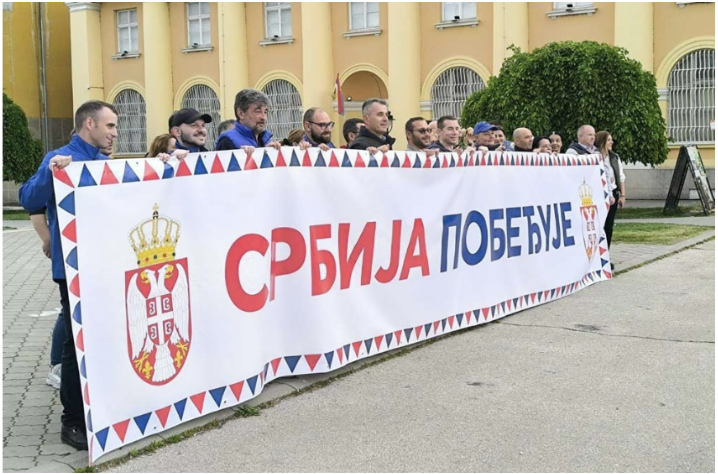
Photographs: The Serbia Is Winning banner, Zaječar,** and the Students Are Winning banner, Valjevo**
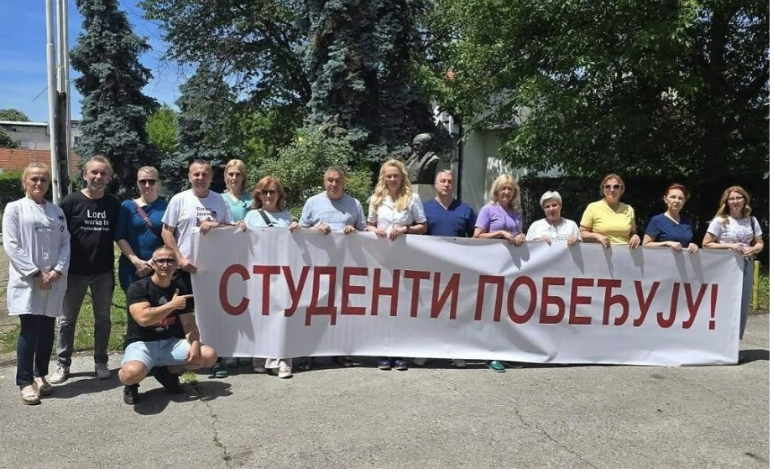
The recorded cases show that political conflict also reaches into the private sphere and the personal safety of politically engaged citizens. In Inđija
Nova.rs (2026), the student Nikola Runić from Inđija said his car was set on fire the day after he took part in the „Studenti pobeđuju“ action, and the police confirmed that footage showed a masked man dousing the vehicle and setting it alight; the editor of the IN medija portal states that people were brought into the town to prohibit the display of banners. 16 May.
the car of a family that supports the student protests, and whose son is active in them, was set on fire, while in other places pressures were recorded connected with employment, education and political engagement. It was not only political activists who were subjected to pressure and incidents: among the targets were journalists, teachers, pupils and other citizens. In Zrenjanin
021.rs (2026), the Journalists' Association of Serbia condemned the attack on the editor of the portal „Volim Zrenjanin“, Aleksandar Blanuša, in front of SNS stands in Zrenjanin; he said that party activists and supporters pushed him, tripped him and tried to snatch his phone while he was attempting to get a statement from the mayor. 9 May.
a journalist was obstructed and physically attacked while reporting from SNS stands, while in Belgrade
BBC na srpskom (2026), at the „Slavija“ protest in Belgrade, which according to the estimate of the Public Assemblies Archive drew between 180,000 and 190,000 people, a group of masked young men threw pyrotechnics at the police, who responded with tear gas; 23 people were arrested for attacking police officers. 23 May.
incidents were recorded after a student protest.
Political tensions also entered local institutions. In Knjaževac knjazevac_uz_studente (2026), Odbornici GG "Knjaževac uz studente - čista lista - dr Ivan Milošević" došli su na sednicu Skupštine opštine sazvanu u starom sazivu da pitaju Marka Stojanovića dokle će da se bahate. https://link.crta.rs/xn, 15 May tensions arose between the President of the Municipality of Knjaževac and a representative of the student list during a session of the local assembly, while a session of the Užice City Assembly Glas zapadne Srbije (2026), the session of the Užice City Assembly was interrupted after tear gas was set off, immediately after the opposition councillor Vladan Sinđić had been ordered to leave the session for obstructing the assembly's work; the Speaker of the Assembly, Danijela Vasiljević, said that the tear gas could not have come from the governing side because their councillors were sitting on the opposite side of the chamber. 22 May. was interrupted after tear gas was set off.
An environment of this kind, in which political engagement increasingly carries a risk to personal safety, limits citizens' ability to take part freely in political life and has a direct effect on the conditions for political competition.
Political tensions also entered local institutions. In Knjaževac knjazevac_uz_studente (2026), Odbornici GG "Knjaževac uz studente - čista lista - dr Ivan Milošević" došli su na sednicu Skupštine opštine sazvanu u starom sazivu da pitaju Marka Stojanovića dokle će da se bahate. https://link.crta.rs/xn, 15 May tensions arose between the President of the Municipality of Knjaževac and a representative of the student list during a session of the local assembly, while a session of the Užice City Assembly Glas zapadne Srbije (2026), the session of the Užice City Assembly was interrupted after tear gas was set off, immediately after the opposition councillor Vladan Sinđić had been ordered to leave the session for obstructing the assembly's work; the Speaker of the Assembly, Danijela Vasiljević, said that the tear gas could not have come from the governing side because their councillors were sitting on the opposite side of the chamber. 22 May. was interrupted after tear gas was set off.
An environment of this kind, in which political engagement increasingly carries a risk to personal safety, limits citizens' ability to take part freely in political life and has a direct effect on the conditions for political competition.
Spyware on the telephones of at least 14 students, activists and opposition officials
On 2 September 2026 the Share Foundation published the findings of a forensic analysis, conducted with Citizen Lab and Amnesty International, confirming that since the beginning of the year at least 14 people in Serbia had been targeted with commercial spyware
Share Fondacija (August 2026): “Studenti i opozicioni političari na meti špijunskog softvera, https://sharefoundation.info/share-fondacija-studenti-i-opozicioni-politicari-na-meti-spijunskog-softvera/
- participants in the Student Movement, activists of opposition parties, one member of parliament (Radomir Lazović, who links the surveillance to the coordination of the opposition during the local elections and to contacts with EU institutions) and one city councillor. Two tools were identified: Pegasus, made by the Israeli NSO Group and installed by a "zero-click" method requiring no interaction from the victim, and a redesigned version of the domestic NoviSpy, which requires physical access to the telephone. Both give access to messages, contacts and data, and allow the microphone and camera to be switched on remotely; the server infrastructure reportedly leads to the Security Information Agency (BIA). Neither tool has any legal basis for use in Serbia, and installing spyware on another person's telephone is a criminal offence. The new findings do not reveal a new problem so much as the absence of any consequence for the old one: two years after the first forensic confirmation, the practice has continued and has extended to the Student Movement and to elected representatives, without any institutional response.