Sharp polarisation and unequal conditions for electoral competition marked the first half of the campaign across Serbia. The use of public office and public resources for party promotion, the discrediting of opponents and accounts of support being made conditional showed a continuity of the problems seen in the pre-election period and in earlier electoral cycles.
The campaign took on a pronounced referendum character. United Serbia built its support around Aleksandar Vučić, the governing record and promises of stability, while the Student List emphasised the fight against corruption and the depoliticisation of institutions. The other lists were considerably less visible on the ground. With some confirmed candidate lists, a disproportion was observed between the signatures collected and the activities carried out, which were almost absent, and this raised the question of the authenticity of their electoral role. A number of minority parties campaigned for the parliamentary elections and for the elections to the national minority councils at the same time.
The findings point to patterns rather than to isolated incidents. Almost every fourth observer report contained a possible breach or manipulation of the law (702 cases) in more than 90 cities and municipalities.
The institutional advantage of those in power was used directly to win party support. Senior officials used their official visibility to promote the ruling list, and publicly funded works and services were promoted through party channels. Over the three weeks of the campaign there were 321 recorded cases with elements of misuse of public office or public resources.
Extraordinary payments of public funds to citizens, announced earlier, were made during the campaign itself and were used to promote those in power. Citizens, pensioners and socially vulnerable groups received almost one billion euros in total. The scale, the timing and the promotional use of these payments further supported CRTA's earlier assessment that such measures serve to create an unfair electoral advantage in favour of those in power.
The discrediting of the Student List and of opposition voices was a prominent part of the campaign of the ruling lists. Through appearances by officials, through the media and through various campaign activities, they were portrayed as violent individuals, criminals and enemies of the state, while support for those in power was at the same time equated with the protection of society. Observer reports recorded 203 cases with elements of negative campaigning, obstruction or violence; almost every fourth concerned physical violence or verbal threats. The attacks affected a range of political and electoral actors, and the obstruction of journalists and observers undermined independent observation of the campaign.
In 122 cases, CRTA's observers recorded suspicions of pressure, clientelism, the buying of support or the misuse of personal data. Signatures, “safe votes” and participation in the campaign were sought alongside threats to people's employment, while jobs, assistance, money and public works were offered in return for support. The accounts involving socially vulnerable families and residents of homes for the elderly are of particular concern.
Field campaigning by electoral actors: organisation, activities and messages
United Serbia and the Student List were the most visible on the ground and represented the two main poles of the electoral race, giving the campaign a referendum character. The ruling list presents the elections as confirmation of the existing direction in which the state is being run, while the Student List is gathering support for a change of government and for freeing institutions from party influence.
The campaigns of the remaining candidate lists are considerably less visible and narrower in territorial reach. For most of these actors, the first part of the campaign was largely taken up with collecting signatures and presenting their candidacies. The activities of some minority lists were visible primarily in places where they have a stable local infrastructure. For a number of minority parties, the parliamentary campaign ran in parallel with preparations for the elections to the national minority councils, so that activities, messages and the mobilisation of the same electorate partly overlapped across two electoral levels.
With certain other lists, several indicators raise doubts about the authenticity of the candidacy and about its actual electoral role: above all, the disproportion between the signatures collected and weak campaign activity, an unclear programme offer, and accounts of organisational or personnel links with other political actors.
What follows is an overview of the field activities of the candidate lists, of their main messages, of the ways in which they addressed voters and of the geographical reach of their campaigns.
1. Aleksandar Vučić - United Serbia
The first major coordinated campaign activity was organised on 11 September, when the collection of signatures for the submission of the candidacy began almost simultaneously across the country. See the chapter “Conduct of the elections”. After the list was submitted, the campaign continued through stands, meetings of local party branches, conversations with citizens and receptions for citizens, door-to-door canvassing, visits to families, farms, companies and associations, the refurbishment of playgrounds and parks, and attendance at local events.
Chart 7.1. United Serbia: daily pattern of documented activities
United Serbia: daily pattern of documented activities
Source: CRTA Election Observation Mission, observer field reports, 9-30 September 2026; database export 5 October 2026. Total 937 reports.
Chart 7.2. United Serbia: the most frequent forms of documented activity in the first half of the election campaign
United Serbia: most frequent forms of documented activity in the first half of the election campaign
Source: CRTA Election Observation Mission, observer field reports, 9-30 September 2026.
The main campaign messages were unity, stability, continuity and the governing record, while a rounded electoral programme was presented less often. [ Aleksandar Vučić presented the election programme of United Serbia at a rally in the Arena on 3 October, https://link.crta.rs/13f Local projects and infrastructure works were used as confirmation of the ability of those in power to continue the existing direction of governance. More specific economic messages were addressed to pensioners, farmers and business people, while young people and women appeared more often as groups for party mobilisation than as the subject of specially developed policies. The themes of the environment and of care for children were also present.
The contrast with the leading opposition Student List shaped both the messages and the mobilisation methods of “United Serbia”. Some activities were reactive in character, as a direct response to previously announced student campaign points and gatherings, with the membership being mobilised and party stands set up nearby. Representatives of the list linked the students and their supporters to blockades, violence, foreign interests and a “colour revolution”. Negative campaigning, “plaster” activities and the targeting of political opponents are dealt with in more detail in a separate chapter.
2. Ivica Dačić - A Factor of Stability
3. Student List - Students Are Winning
The Student List's campaign began with a rally in Novi Sad, where several candidates were presented - while all of its candidates were known once the list was confirmed on 15 September. The campaign to collect signatures for the submission of the list was followed by the coordinated presentation of the document “The student plan - We know how” (“Studentski plan - Mi znamo kako”), and then by the spread of stands, of door-to-door canvassing, of the “A student in every village” (“Student u svakom selu”) action and of the “Guardians of the Constitution” (“Čuvari Ustava”) cycling tour. The citizens' group was founded on 9 September, the regional presentation of the “Studentski plan” began on 15 September and the cycling tour on 17 September, https://link.crta.rs/111
Chart 7.3. Student List: daily pattern of documented activities
The Student List: daily pattern of documented activities
Source: CRTA Election Observation Mission, observer field reports, 9-30 September 2026; database export 5 October 2026. Total 289 reports.
Chart 7.4. Student List: the most frequent forms of documented activity
The Student List: most frequent forms of documented activity
Source: CRTA Election Observation Mission, observer field reports, 9-30 September 2026.
The anti-corruption framing was supplemented by an emphasis on the candidates' expertise and on concrete solutions. The programme covered institutional reforms, media freedom and the depoliticisation of the public sector, but also economic, social, education, health and agricultural policies. The plan contains 11 points arranged in three parts: “Serbia or the mafia” (“Srbija ili mafija”), “Knowledge is power” (“U znanju je moć”) and “Serbia grows with us” (“Srbija raste sa nama”): https://link.crta.rs/138 The campaign was not systematically directed at individual demographic groups, but adapted to different settings and forms of participation. Separate actions were aimed at villages and smaller settlements, at voters outside Serbia, at volunteers and at future election controllers, while young people, women, pensioners and professional groups are less often singled out as separate target groups. The participatory character of the campaign was also reflected in the fact that citizens themselves made and wore “Students Are Winning” T-shirts, hoodies and tote bags.
4. Rasim Ljajić - Ljudski (SDP - CDP)
5. Alliance of Vojvodina Hungarians - Dr Bálint Pásztor
6. Usame Zukorlić (SPP) Movement for Unification
7. Russian Party - Serbia in BRICS - Slobodan Nikolić
8. Authentic Right - Dr Miloš Jovanović (Novi DSS - MONARHISTI - Srpska koalicija NADA - Nacionalno demokratska alternativa - NOVA DEMOKRATSKA STRANKA SRBIJE - POKRET ZA KRALJEVINU SRBIJU) - ODVAŽNO SRPSKI!
9. European Serbia - Marinika Tepić - Zdravko Ponoš (STRANKA SLOBODE I PRAVDE, SRBIJA CENTAR - SRCE, SOLIDARNOST)
10. SDA of Sandžak - Guardians of Sandžak
11. Bogoljub Karić - Movement Strength of Serbia - BK
12. Liberal Green Party - For a Free and Cleaner Serbia
13. I Choose Justice - I Choose the Future - Coalition SNAGA - Prof. Dr Ferid Bulić - Vasilios Proveleggios - Stranka budućnosti i razvoja/Stranka budućnosti i razvoja-Građanska stranka Grka Srbije
14. Party of Russian-Serbian Unity - Russians and Serbs Brothers Forever
15. Dad, This Is for You - Petar Đurić - Prime Minister of Serbia
16. Vladimir Gajić - Alternative for Serbia - NARODNA STRANKA, BUNT-Prava Srbija - БУНТ- Настоящая Сербия
17. Albanian Coalition
18. Mother Serbia - GRUDA
Recurrence of contested practices in the election campaign
The findings show regularities that go beyond individual incidents:
State and party: the institutional advantage of those in power
While between 9 and 30 September almost every third recorded activity connected with the ruling “Aleksandar Vučić - United Serbia” candidate list pointed to a possible manipulation or breach of the law, every fifth concerned the misuse of public resources and public office. These phenomena were recorded in 66 cities and municipalities.
The most frequent type of misuse capable of misleading voters about the relationship between the state and the party concerned the linking of the achievements of institutions to party credit.
Chart 7.5. Almost a third of the recorded activities of the ruling list contain possible misuse or manipulation of the law, and almost every fifth concerns possible misuse of public office and public resources
Almost a third of the recorded activities of the ruling list involve possible misuse or manipulation of the law
Source: CRTA Election Observation Mission, observer field reports, 9-30 September 2026.
CRTA's observers also recorded a 70 per cent increase in cases with elements of misuse of public office and public resources between the first and the third week of the campaign.
Chart 7.6. Recorded cases with elements of misuse of office and resources rising week by week
Recorded cases with elements of misuse of office and resources rose week on week
Source: CRTA Election Observation Mission, observer field reports, 9-30 September 2026.
Chart 7.7. Party appearances follow the official visibility of national officials
Party appearances track the official visibility of national officials
Source: CRTA Election Observation Mission, observer field reports, 9-30 September 2026; database export 5 October 2026.
These phenomena point to the persistence of practices that blur the line between state and party in elections and that, by misleading voters, create an impermissible institutional advantage for those in power. After the 2022, 2023 and 2024 elections, the OSCE/ODIHR pointed to the blurring of the line between state and party in Serbia. Following the 2022 elections it recommended that the use of public office and public resources in the campaign be prevented, that the official and campaign activities of office-holders be clearly separated, that public sector employees be protected from political pressure and that effective action on violations be ensured. It identified similar problems after the 2023 elections, and in its report on the 2024 local elections it again warned of practices that give an advantage to those in power. OSCE/ODIHR, Final Report on the 2022 Presidential and Early Parliamentary Elections in Serbia (Warsaw, 19 August 2022); OSCE/ODIHR, Final Report on the 2023 Early Parliamentary Elections in Serbia (Warsaw, 28 February 2024); OSCE/ODIHR, Final Report on the 2024 Local Elections in Serbia (Warsaw, 30 August 2024).
Intertwining of the candidate list and institutions in the campaign
Chart 7.8. The most frequent forms of misuse of public resources in observer reports
Most frequent forms of misuse of public resources in observer reports
Source: CRTA Election Observation Mission, observer field reports, 9-30 September 2026.
The intertwining of institutions and the campaign was also visible in the engagement of public sector employees at party events, and in suspicions that the vehicles and equipment of public enterprises were used for the purposes of those activities. In Sombor, on 15 September, the directors of the “Soko” sports centre and of the “Mika Antić” children's home were present at the SNS stand during working hours; on the same day, in Kljajićevo, a lorry of the public utility company “Čistoća” was filmed, with boxes being carried from it into party premises.
Freedom of choice under control: pressure and the conditioning of political support
Over the three weeks, CRTA's observation mission recorded 122 reports in 40 cities and municipalities that raise suspicions of pressure, clientelism, the buying of support or the misuse of personal data. Almost every second recorded activity (within this set) involved possible vote-buying or clientelism (59), more than every third involved political pressure (44), and every fifth a possible misuse of personal data (24).
In half of the cases in which it was possible to identify the actor, these activities were linked to the Serbian Progressive Party (SNS) and to the list “United Serbia”. Accounts of contested signature collection and of the use of personal data were associated with Russian Party - Srbija u BRIKS-u, while the offering of money for a support signature was associated with the citizens' group Uglješa Grgur and with the list of Bogoljub Karić. A. L., “Karić's Pokret snaga Srbije collected signatures for a candidate list in Novi Sad: eyewitnesses claim that 7,000 dinars was paid per signature, the party denies it”, Danas, 22 September 2026, accessed 5 October 2026, https://link.crta.rs/12s. CRTA, One and a half thousand dinars for a signature for a candidate list? (Belgrade: CRTA, 2026), https://link.crta.rs/12t.
The “Srbija Kargo a.d.” case: testimony on political pressure and misuse
Employees gave testimony to CRTA about the organised giving of support signatures for the list “Aleksandar Vučić - United Serbia” under the supervision of managers, with identity cards scanned repeatedly at several points (Savski venac, Čukarica) and with the data of some employees used in their absence. The testimony covers coerced attendance at party rallies and marches, during and outside working hours (in the afternoons and at weekends, with photographs sent to managers as proof of attendance); work in the SNS call centre (Mali Mokri Lug); threats of dismissal and of reduced pay for refusing to take part; the rewarding of political obedience (bonuses of between two and 20 per cent and paid overtime); and the selection of employees for dismissal according to political loyalty. One female employee was, according to her testimony, offered that she would be “spared” if she agreed to take part.
The employees also reported the use of company resources for party activities (official vehicles, laptops and premises), with suspicions that calls to voters were being organised on those premises. They pointed to political influence over personnel decisions and to invoices being accepted without supporting documentation. As they describe it, the company has in practice completely changed its line of work and been turned into an organisation for party activity, in which employment and pay are made conditional on political engagement.
Pressure through the workplace
| Type of institution | Some of the cases recorded in the field |
|---|---|
| Health care | Centar za medicinsku biohemiju Kliničkog centra Srbije in Belgrade - demands that employees sign support for the candidacy; Zavod za urgentnu medicinu in Novi Sad - signatures and the collection of “safe votes”; Dom zdravlja in Smederevska Palanka - the organised arrival of employees to sign support for the candidacy. |
| Public enterprises | EDS and EPS in Smederevska Palanka - employees called on to sign support for the candidacy; the company “Sloboda” in Čačak - signatures and the collection of “capillary votes” (votes gathered one by one through personal networks); JKP “Parking servis” in Mladenovac - employees engaged to visit households in door-to-door canvassing; JKP “Vodokanal” in Sombor - a demand that employees attend a |
| party event. | |
| Administration/services | Poreska uprava in Mladenovac - an account of pressure on employees to sign support for the candidacy; Policijska uprava in Užice - testimony by a female employee about lists of “safe votes”; the branch of Nacionalna služba za zapošljavanje in Čačak - calling subsidy recipients and recording their electoral preference; Sekretarijat za socijalnu zaštitu Beograda - accounts of threats against empl |
| do not attend rallies. | |
| Schools and culture | Škola “Radomir Lazić” in Azanja - testimony about a contract not being renewed; OŠ “Radoje Domanović” in Manojlovce - an account that the head teacher lost his post because he had not signed support for the candidacy; Kulturni centar in Smederevska Palanka - employees arriving to sign support for the candidacy; Gradska biblioteka in Užice - testimony by a female employee about calls for her to |
| take part in party activity. |
Electoral clientelism
According to some testimony, a job, the completion of public works, money or household appliances were offered in exchange for a vote or a support signature. In Užice, an account was recorded that promised cash assistance was being made conditional on a support signature, and in Mladenovac that households which do not support the SNS were left out of the distribution of firewood. In the same municipality, according to an interlocutor's account, socially vulnerable families were offered household appliances in exchange for a vote, with activists asked to submit lists of vulnerable households.
Other observations concern the distribution of assistance and gifts during the campaign. In Čonoplja near Sombor an account was recorded of cured meat products being handed out, while in Čačak, through the SNS action “Good neighbour” (“Dobar komšija”), an oven was given to a family. In Draškovac near Leskovac the head of the local community office handed out “We care about you” (“Brinemo o vama”) packages bearing the logo of the City of Leskovac; according to the source, the recipients included financially well-off local residents, while only a small number of socially vulnerable people received assistance.
Accounts of possible misuse of personal data
Selected cases of pressure, conditioning and the recording of political support in the first three weeks of the campaign
- In Mladenovac it was reported that an employee of JKP “Parking servis” visited selected households, presented himself as acting on behalf of the SNS and asked questions about support for Aleksandar Vučić and about local problems. According to information submitted to an observer, the answers were recorded on previously prepared lists, and the employees were engaged for these visits by the acting director of the company, in part during working hours.
- At the Institute for Emergency Medicine in Novi Sad, a female employee stated that administrative staff and some of the medical staff were sent towards the end of the working day to Sremski Karlovci to sign support for the candidacy of the list “United Serbia”. According to her testimony, identity cards were taken from employees and an internal list was drawn up, while some staff were also asked to secure “safe votes”. She stated that employees on fixed-term contracts were particularly exposed to the threat of their contracts not being renewed.
- On 22 September, CRTA's observation mission also published audio testimony from a female employee of the Postal Savings Bank (Poštanska štedionica). She stated that employees were required to sign support for the SNS list and to take part in rallies and other campaign activities, including staying at the camp in front of the Presidency. In her words, obedience was rewarded and refusal had consequences.
- In Kragujevac, the mother of a child with cystic fibrosis was removed from a parents' Viber group immediately after she posted on social media a photograph from the queue to sign support for the Student List.
- According to testimony from a female employee at the branch of the National Employment Service in Čačak, some employees were given the task of calling business people who use state incentives. Alongside questions about their business, they asked them whether they would vote for list number one and sorted the answers by colour.
- A recording of a party meeting (of the SNS) in Mladenovac captured a conversation about packages, household appliances and rewards for activists. The source further stated that household appliances had been offered to socially vulnerable families in exchange for a vote.
- In Niš, a female observer recorded the offering of 1,500 dinars for a support signature for the citizens' group Uglješa Grgur.
- In Novi Sad, a suspicion of payment for support signatures for the list of Bogoljub Karić was also recorded. On 20 September an observer recorded the organised transport of citizens to the signing and statements by participants about an expected or postponed cash payment.
Polarisation, obstruction and security incidents
Threats to the freedom to campaign: police actions against the list “Student List - Students Are Winning”
Since the elections were called, CRTA's observation mission has recorded two cases of action by the police, that is by economic crime inspectors, against the candidate list “Student List - Students Are Winning”. The accounts obtained by CRTA indicate politically motivated action by the police, which gives rise to a reasonable suspicion of a grave misuse of public resources, that is of the apparatus of coercion. These cases are without precedent in earlier parliamentary elections.
The police actions appear to have a political motive behind them. On 16 September, officers of the Economic Crime Department came to a warehouse in which the candidate list's promotional material was stored. According to accounts from the students and their lawyers, they had no court warrant and left without entering the premises.118 Two weeks later, on 1 October, the police in Belgrade stopped a van transporting the list's electoral material. The driver was fined for improper parking, the vehicle was sent for an extraordinary technical inspection, and a threat was made to remove its number plates. The inspectors who had taken part in the entry to the warehouse also appeared at the scene.119 The Ministry of the Interior has so far not publicly explained the legal basis for, or the reason behind, these actions.
Under the OSCE Copenhagen Document (para. 7.7), the state is obliged to ensure that “neither administrative action nor intimidation” prevents candidates from campaigning freely.
The fact that at least 10 recordings of intercepted conversations of the Student List were broadcast on the cable television channel Informer in the first half of the campaign also points to intimidation. This case is dealt with in detail in the chapter on the media.
118 Insajder, “Students in Blockade: police officers came to our warehouse without a warrant”, https://link.crta.rs/12v
119 Students Are Winning, “The police are stopping vehicles transporting our pre-election material”, https://link.crta.rs/12w
Chart 7.9. Obstruction leads at the start, negative campaigning and violence grow as the campaign goes on
Obstruction leads at the start, while negative campaigning and violence grow as the campaign goes on
Source: CRTA Election Observation Mission, observer field reports, 9-30 September 2026.
The halting of the student campaign in Bosnia and Herzegovina
Both leading lists - “United Serbia” and the Student List - also directed their campaigns at voters in Bosnia and Herzegovina, with visible differences in the conditions for political activity. The student campaign's attempt to reach voters met with obstruction, police interventions and an attack on activists. After police action in Brčko, activists being taken in for questioning in Doboj and an attack in Višegrad, the organisers halted the campaign and cancelled their announced visit to Banjaluka on 25 September.
Activities aimed at this electorate had previously drawn on the institutional and party infrastructure available to those in power. At the beginning of August, Aleksandar Vučić toured the Republika Srpska and returnee communities in the Federation of BiH, meeting local leaderships, promoting Serbia's assistance and delivering messages about the forthcoming elections. On 26 August, CRTA published a recording of a telephone call from Banjaluka in which a woman, presenting herself as calling on behalf of the SNS, offers a visit by a mobile team to scan a Serbian identity card and register the person to vote. The recording raised questions about the origin of the personal data and about unlawful party mediation in the registration of voters.
Discrediting and targeting of political opponents, journalists, observers and citizens
Political opponents were portrayed as violent individuals, criminals, separatists or representatives of foreign interests. The label “blokaderi” (blockaders), the term used by those in power for the demonstrators, was repeated in party posts, in officials' appearances and in media content, often in place of the name of the candidate list. Contesting the opponents' political offer was extended to discrediting their candidates and presenting their political engagement as a threat to society.
Discrediting messages were also conveyed through an organised campaign in different places. The travelling exhibition “Black box” (“Crna kutija”), or “Blockaders' Serbia” (“Blokaderska Srbija”), was shown in Kragujevac, Kraljevo and Subotica. Recordings, photographs and objects from earlier protests and blockades were used to present the student and civic movement as a source of violence and disorder. The opening in Kraljevo was attended by the Minister of Economy Adrijana Mesarović and the mayor Predrag Terzić, as well as by employees of the city administration. Portal KRUG, post on the Facebook platform, 22 September 2026, archived 2 October 2026, https://link.crta.rs/121
In the video campaign “I am a ćacika too” (“I ja sam ćacika”), women in short video clips took over the pejorative label “ćacika/ćaci” (used by supporters of the student movement for supporters of those in power) while publicly declaring their support for the list “Aleksandar Vučić - United Serbia”. The campaign was recorded in at least 17 cities and municipalities, from Novi Sad to Bor, Zaječar and Priboj. SNS Zaječar (@sns_zajecar), post on the Instagram platform, 24 September 2026, archived 3 October 2026, https://link.crta.rs/12d. SNS OO Majdanpek (@sns_oo_majdanpek), post on the Instagram platform, 24 September 2026, archived 3 October 2026, https://link.crta.rs/12e. In some of the clips the declaration of support was accompanied by direct discrediting of the opposing side: at a stand at the Futoška pijaca market in Novi Sad the opponents were presented as an option that “calls for violence, for rape and violence against women, and makes threats”, while a post at national level states that the opponents “threatened rape... and targeted their children”. Women ministers and senior women officials also took part in this action. Sara Pavkov (@sarapavkov), post on the Instagram platform, 23 September 2026, archived 3 October 2026, https://link.crta.rs/12f. Đurić Nevena (@djuric_nevena), post on the Instagram platform, 23 September 2026, archived 3 October 2026, https://link.crta.rs/12g. Jelena Žarić Kovačević (@jecazaric), post on the Instagram platform, 23 September 2026, archived 3 October 2026, https://link.crta.rs/12h.
In Kikinda, printed material was recorded being put into letterboxes in which critics of those in power and supporters of the Student List are targeted with accusations and insulting descriptions that encourage hostility towards them. A separate page is devoted to each targeted person, with the common message that their “hands are bloody”. Those covered include prosecutors, university professors, politicians, journalists, lawyers and civic activists, presented through accusations of crime, of hostility towards the Serbian people and of responsibility for the deaths of citizens. The Prosecutor for Organised Crime Mladen Nenadić was labelled a “protector of criminals”, the Rector of the University of Belgrade Vladan Đokić the “blokaderi's candidate for prime minister”, and Zlatko Kokanović and Sulejman Ugljanin haters of Serbs, that is of the Serbian people. The journalist Žaklina Tatalović was presented as a “half-trained journalist and blokaderka”, Professor Jovo Bakić as a “false intellectual”, Ivanka Popović was presented as a blokaderka ready “to hand over Kosovo and Metohija, the Republika Srpska, Sandžak, Vojvodina”, and Dragan Đilas as a “snake-oil salesman and a thief”.
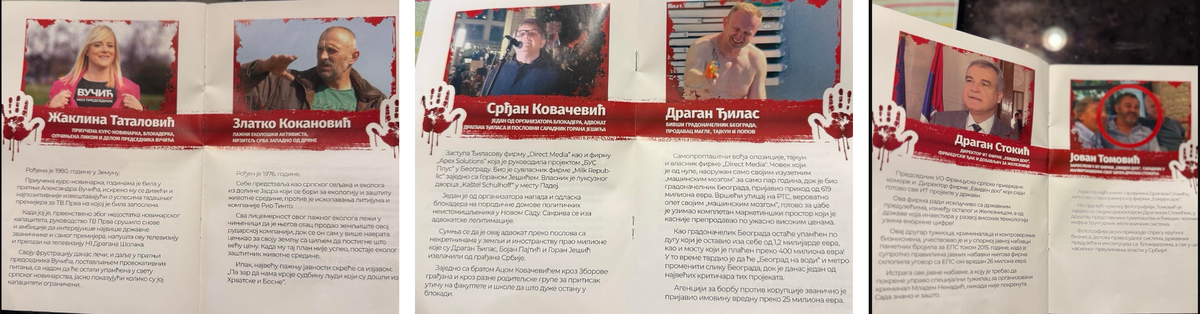

In several cases, insulting and satirical content directed against representatives of those in power was also recorded, including a photomontage about Aleksandar Vučić by the Novi Sad citizens' assemblies. Zborovi Novi Sad (@zborovinovisad), post on the Instagram platform, 30 September 2026, archived 3 October 2026, https://link.crta.rs/12b.
Obstruction of political opponents' activities in the field
The most visible pattern is the setting up of SNS stands at the places and times previously announced by the Student List. In some places such activities passed off without conflict; in others they involved occupying the space, drowning out speakers with loudspeakers, insulting chanting and following the opponents' gathering after it had changed location.
Selected cases of obstruction of political opponents' activities in the field
- In Kraljevo, on 19 September, SNS stands were set up roughly half an hour before announced student activities at five locations. The mayor, the head of the administrative district and the directors of public enterprises were present at them.
- In a message from an internal SNS group in Ćuprija, members were called on to gather in as large numbers as possible because of a “blokaderi” stand being held, with times and locations that matched the announced activities of the Student List.
- In Paraćin, on 25 September, SNS supporters occupied the space set aside for the reception of the cyclists, and then moved their stands to the new location chosen by the organisers. The reception was finally held at the original place, with a police cordon and chants of “ustaše” (Ustasha, the Second World War fascist movement) directed at the participants. Two days later, the space for the presentation of the Student List's candidates was occupied about an hour and a half before the gathering was due to begin. The police directed the organisers to another location, where the gathering was held without incident.
- In Aleksinac, according to the testimony of one of them, the organisers changed the place of the reception and shortened the cyclists' stay in order to avoid conflict, but SNS supporters appeared at the new place as well.
- In Niš, on 24 September, the reception for the cyclists was moved from Trg kralja Aleksandra to the area in front of the National Theatre after another political gathering was announced. SNS stands were set up at the new location as well. Observer findings describe the presence of motorcyclists with covered faces, the revving of engines, heckling and the lighting of flares, which disrupted the speeches and the course of the reception. The presence of the mayor of Niš, Dragoslav Pavlović, was also recorded.
Threats, intimidation and physical attacks
Those involved in the incidents were not only unidentified individuals, but also candidates, party activists and public office-holders.
Selected cases of threats, intimidation and physical clashes during the campaign
- In Smederevska Palanka (11 September), a female observer directly recorded a scuffle between the municipal president Nikola Vučen and a participant in a protest march who had stuck a student sticker on the window of party premises.
- In Sombor, on 21 September, a participant in the cycling tour stated that the president of the Sombor Sports Association Miloš Mijić insulted him and lunged at him with his fists as he cycled past. According to the same testimony, the cyclists had agreed beforehand to pass as far as possible from the assembled SNS supporters and without stopping.
- In Sombor, on 22 September, it was recorded that party and public officials, directors of public enterprises and employees of public services met the student cyclists at the exit from the city. The observer report and the accompanying recordings describe insulting heckling, including the shouting of “ustaše” by a female employee of the mayor's office. 127
- The case recorded on 29 September near the Futoška pijaca market in Novi Sad stands out in particular. About an hour after the student stand was set up, a group of SNS activists appeared, among them the candidate for MP Vukašin Đoković. The published recording shows his attempt to snatch a “Students Are Winning” flag, after which a physical clash followed.128
- Later the same evening, after another student banner was snatched, a physical confrontation took place. An observer directly saw men gathered on the side of the students and citizens catch up with the person who had taken the banner, knock him down onto the street and kick him. Another clash then followed at the SNS stand. The police intervened, and the Student List's lead candidate Ilija Srdanović called on those present to disperse. 129
- In Belgrade, on 28 September, Tatjana Mićić, a councillor of the Kreni-Promeni movement, stated that the mayor Aleksandar Šapić had physically attacked her and her husband during an encounter in the street. Šapić denied that he had hit her and said that he had pushed her away. The prosecution office confirmed that it had ordered the collection of information and medical examinations, and that injuries had been established on Mićić and her husband. 130
- Tomislav Veljković from Rača received death threats over a social network, following earlier public targeting by the local SNS branch.
- The Student List candidate Jovo Bakić also announced that he had received death threats.
- In Kula, the organisation Mladi Kula stated that Vukašin Đoković had threatened one of their activists, mentioning his family, his address and a possible “ambush”.131
Konjarnik: competition for public space and rising tension in the campaign
In Konjarnik, the competition for public space grew from parallel campaign activities into verbal clashes and incidents, with those gathered separated by a police cordon. At the junction of Ustanička and Vojislava Ilića, on 29 September, one Student List stand and two SNS stands were recorded, with no contact between the groups. By 1 October, SNS activists were recorded throwing lighters at cars that were sounding their horns in support of the Student List, after which the local citizens' assembly asked for police protection for its evening gatherings. The SNS presence was increased on 4 October, with tents and motorcyclists, and the following day its stands were set up at the place where the citizens' assembly gathers. A police cordon separated the two groups; according to a source from the citizens' assembly, the gathering was accompanied by verbal attacks from both sides and by SNS supporters throwing lighters, to which the police did not react.
The tension was further carried over into the media space: Informer presented the events as an attack by violent “blokaderi” on peaceful SNS supporters, singling out Dijana Hrka in particular. Such a presentation of a local conflict contributes to the wider campaign narrative in which opponents of those in power are labelled as violent.132
The tension escalated on 6 October, when physical incidents and attacks on citizens took place. Among the attackers, a person was identified who, in Bor on 29 March, had lunged at a CRTA lawyer.
127 Сомборски Ћацији (SomborskiCaciji), post on the Facebook platform, 22 September 2026, archived 2 October 2026, https://link.crta.rs/125.
128 Zbor građana MZ Prva vojvođanska brigada (@zbor_pvb_ns), post on the Instagram platform, 30 September 2026, archived 2 October 2026, https://link.crta.rs/12x .
129 Zborovi Novog Sada (@zborovinovisad), post on the Instagram platform, 29 September 2026, archived 2 October 2026, https://link.crta.rs/127.
130 Kreni promeni (@kreni.promeni), post on the Instagram platform, 28 September 2026, archived 2 October 2026, https://link.crta.rs/128.
131 Beta, “Mladi Kula: a candidate from the SNS list attacked our activist and also mentioned an ambush”, N1, 24 September 2026, accessed 2 October 2026, https://link.crta.rs/129.
132 Ekipa politike, “Blokaderi ran riot in Konjarnik: they threatened SNS supporters, and then Dijana Hrka appeared (VIDEO)”, Informer, 4 October 2026, accessed 6 October 2026, https://link.crta.rs/13b
Recorded cases of attacks on representatives and activists of the ruling list:
- In Kula, on 25 September, a man damaged an SNS stand with an axe and, according to a police statement reported in the media, struck a party activist with the handle. 133
- In Niš, on 29 September, an SNS activist was injured during door-to-door canvassing. The following day the police announced that they had arrested Goran Jovanović, the honorary consul of Austria in Niš, on suspicion of endangerment by a dangerous implement in a fight or quarrel. According to the statement of the Ministry of the Interior, the suspect, holding a metal bar, headbutted a 53-year-old activist who, together with another person, had tried to survey him. The injured man was treated at the University Clinical Centre in Niš, and the suspect was remanded in custody for up to 48 hours.134
- The police in Niš also acted on threats made against Vladimir Lazarević on social networks during his appearance at an SNS rally.
- In Mirijevo, on 29 September, according to media information, an 81-year-old SNS member was injured while a stand of the ruling list was being set up. According to those accounts, an unknown person pushed him into a moving vehicle.
133 A. I. / B. B., “Vreme” learns: who is the man who attacked an SNS stand with an axe in Kula, Vreme, 25 September 2026, accessed 25 September 2026, https://link.crta.rs/12a
134 Dnevnik, “HANDCUFFS FOR THE HONORARY CONSUL OF AUSTRIA Suspected of headbutting an SNS activist who came into his yard to survey him”, Dnevnik, 30 September 2026, accessed 3 October 2026, https://link.crta.rs/12c
Journalists were exposed to threats and physical obstruction while reporting on the campaign.
- In Kraljevo, the journalist Nenad Simović was filmed being pulled by the arm in which he was holding his camera, with a demand that he leave the SNS stand because he had no accreditation.
- In Niš, several men surrounded the journalist Magdalena Kostić while she was filming a party stand and demanded that she move away from the public space.
- In Zaječar, a journalist reporting from an SNS point was threatened with the words “I will break your glasses”.
- ANEM also reported that threats of physical violence had reached the editor of the Žig info portal, Željko Matorčević, from the account of an assistant to the president of the municipality of Grocka.
- A journalist from Istinomer received threats in Viber messages.
- The N1 journalist Mladen Savatović was subjected to insults, threats and an attempted physical attack while filming a building in Savski venac over suspicions of the registration of phantom voters, and the police, despite being called and having announced that they were coming, did not appear.
- NUNS pointed to the intimidation and obstruction of the journalist Mejrema Nokić at an SNS rally in Novi Pazar, and to the publication of personal data of citizens and journalists in Čačak on lists linked to “capillary votes” for the SNS, with the markings “PROTIV” (against) and “blokaderi”.
Vulnerable groups as targets of campaign promotion and conditioning
Children in electoral messages
The presence of children was linked to party identity and to direct electoral messages.
- In Šabac, a photograph was published of a child in a “United Serbia” T-shirt behind a party stand.
- In the action “On the campaign trail with Miloš”, a recording was published of a child showing Miloš Vučević a drawing of him and Aleksandar Vučić.
- In Bor, as part of the video campaign “I am a ćacika too”, a woman with a newborn child called on people to vote for the ruling list. 135
- In Zaječar, on 20 September, children took part in a sports event at Popova plaža, during which Miloš Vučević called for support for the ruling list. According to testimony from parents, consent to photograph the children was sought for the promotion of sport, with no indication that the event would have party content.
- In a promotional recording published on 26 September, Miloš Vučević and Adrijana Mesarović prepared pancakes for children in a van bearing “United Serbia” insignia. 136
135 SNS Bor (@sns_bor), post on the Instagram platform, 25 September 2026, archived 3 October 2026, https://link.crta.rs/12i.
136 Miloš Vučević (@milosvucevic), post on the Instagram platform, 25 September 2026, archived 3 October 2026, https://link.crta.rs/12j.
Older citizens and residents in accommodation and care
Accounts from Gornji Milanovac and Belgrade raise suspicions that the position of residents of homes for the elderly and their personal data are being used for electoral purposes.
In Gornji Milanovac, according to information submitted to CRTA's observation mission, the director of a private home announced that a polling station would be set up in the institution and demanded that residents hand over their identity cards, under the threat that their contracts would be terminated. The source stated that a large proportion of the residents have advanced dementia and expressed the suspicion that voting would be organised without their having requested it themselves.
In Belgrade, the owner of a home for the elderly stated that he had received a call asking him to submit residents' personal data in order to set up a polling station in the home. The person who contacted him presented herself as a representative of the municipality, although, according to his testimony and to the evidence he made available for inspection, several months earlier she had invited the same owner, on behalf of a political party, to a meeting at the party's premises (those of the SNS).
The recorded cases raise suspicions of pressure on people in accommodation and care, and of the possible use of their documents without consent, a practice that was also recorded in earlier electoral cycles.
Socially vulnerable families and the distribution of assistance
In Mladenovac, a recording of a party meeting captured a conversation about the distribution of packages and household appliances and about rewards for activists. The source further stated that household appliances had been offered to socially vulnerable families in exchange for a vote, together with a request that a list of vulnerable households be submitted. The same account mentions voters being recorded according to whether their vote is considered safe or whether they need further persuading.
In Užice, according to testimony from the association “Anđeli”, recipients of assistance were told that they would not receive the promised state assistance of 6,000 dinars if they did not give a support signature.
The Roma community and local intermediaries
The engagement, for the purposes of one candidate list, of a person who mediates in the exercise of rights and in access to institutional support blurs the line between public service and party mobilisation.