Brief

Amendments to Key Judicial Laws: Systemic Changes Without Public Consultation

On 28 January 2026, the National Assembly of the Republic of Serbia adopted a set of five laws introducing extensive amendments to the judicial framework. The adopted changes primarily reshape the public prosecution system in ways that significantly weaken its autonomy and internal safeguards.
02.02.2026.
24 MINUTES READ
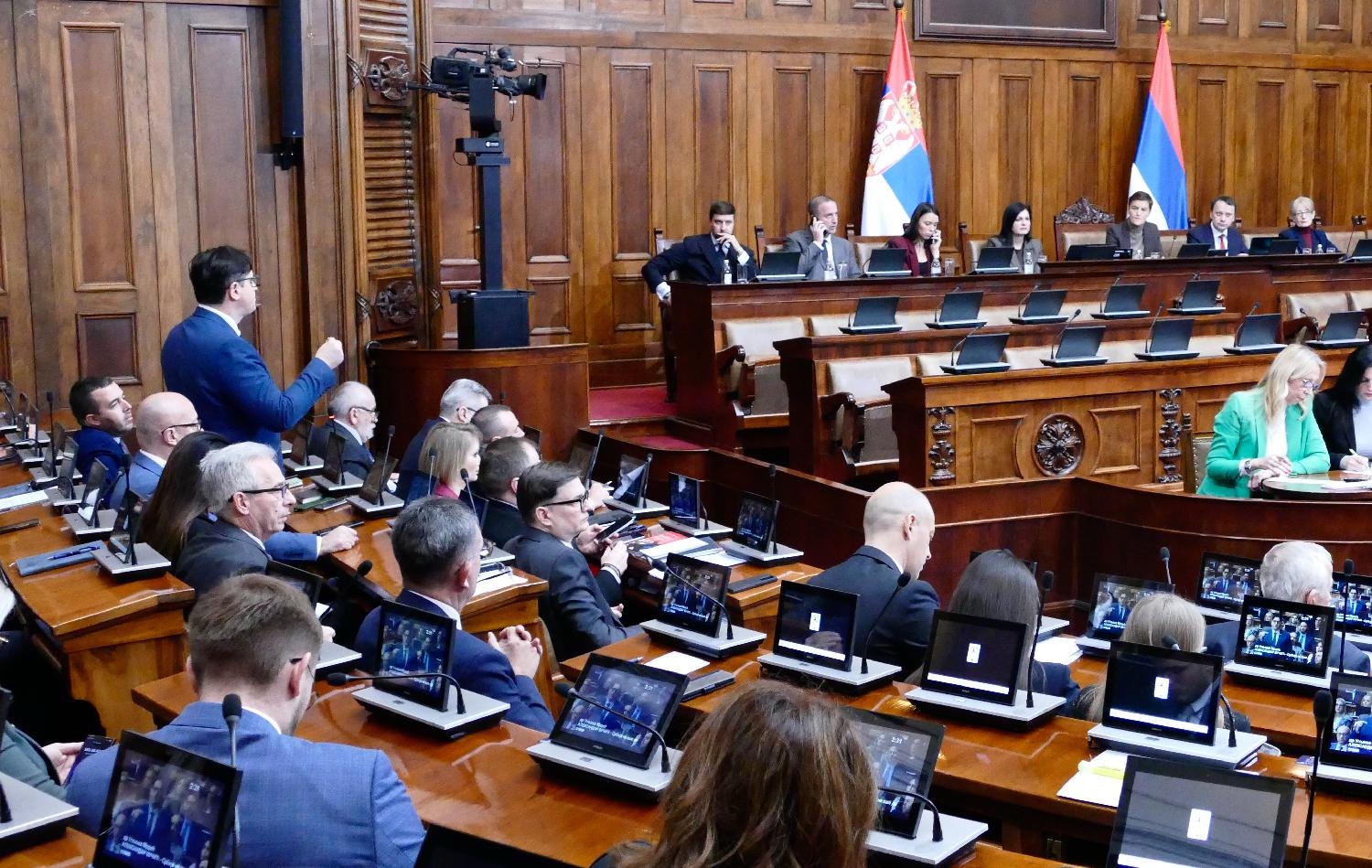
Serbian Parliament

In this article

This article in one minute
The amendments substantially reduce the role and authority of the Supreme Public Prosecutor and the Supreme Public Prosecutor’s Office, including by removing key competences and introducing mandatory consent of the Ministry of Justice for conducting international cooperation. Specialized prosecutorial bodies are particularly affected. The prosecution service for high-tech crime is downgraded from a distinct institutional unit to a special department within the Higher Public Prosecutor’s Office in Belgrade, with its head appointed and supervised by the Belgrade Chief Public Prosecutor. In parallel, transitional provisions provide for the withdrawal of seconded prosecutors within 30 days of the law’s entry into force, which poses a direct risk to the functioning of the Prosecutor’s Office for Organized Crime. The Prosecutor’s Office for Organized Crime handles the most sensitive and complex criminal cases in Serbia, including major organized crime and drug trafficking cases, as well as high-profile corruption proceedings involving senior public officials. These include, among others, the recently initiated case against Minister Nikola Selaković related to the “General Staff” affair, proceedings concerning former ministers Goran Vesić and Tomislav Momirović in connection with the Novi Sad railway station canopy case, and other large-scale organized crime investigations. In practice, the withdrawal of seconded prosecutors and the reorganization of prosecutorial competences would require the reassignment of ongoing cases to new prosecutors, with a substantial risk that proceedings would have to be restarted or significantly delayed. This creates a serious threat to the continuity, effectiveness and legal certainty of the most sensitive criminal proceedings in the country. These changes were adopted through an urgent parliamentary procedure, without public debate, without opinions from the High Judicial Council and the High Prosecutorial Council, and without consultation with the Venice Commission. Taken together, the amendments represent a step back from previously established constitutional and international standards on prosecutorial independence and create serious risks of institutional weakening and political influence over the prosecution service.

I. Context in which the amendments and supplements to the laws were proposed and adopted

On 28 January 2026, the National Assembly adopted five draft laws amending key pillars of the judicial system of the Republic of Serbia, including the organization of courts, the public prosecution service, the High Prosecutorial Council, the status of judges, and the organization of the prosecution service for high-tech crime. These are extensive and systemic amendments that directly affect the independence of the judiciary and the autonomy of the public prosecution service. President Aleksandar Vučić promulgated the said laws on 30 January, and the laws enter into force on 7 February 2026.

Despite the importance and scope of the amendments, the laws were submitted into parliamentary procedure by Member of Parliament Uglješa Mrdić and the parliamentary group of the Serbian Progressive Party, and not by the Government, thereby avoiding the obligation to conduct a public debate. The drafts were considered under an urgent procedure at sessions of the National Assembly held from 14 to 28 January 2026, without obtaining opinions from the High Judicial Council and the High Prosecutorial Council, and without consultations with the Venice Commission of the Council of Europe.

Instead of an open professional debate, the public space in recent weeks has seen an intensification of public attacks, discrediting and pressure on judges and prosecutors by holders of executive and legislative power, including the President of the Republic.

Key issues

  • Establishment of the Fourth Basic Court in Belgrade, based on the needs of the EXPO 2027 project, which represents a precedent in legislative policy
  • Abolition of the independent commission of the High Prosecutorial Council that decides on the rights of prosecutors (upon objections)
  • Weakening of the position of the Supreme Public Prosecutor and the Supreme Public Prosecutor’s Office, through the abolition of powers and the introduction of mandatory consent of the Ministry of Justice for conducting international cooperation tasks
  • Strengthening of the competences of chief public prosecutors, particularly the Chief Public Prosecutor of the Higher Public Prosecutor’s Office in Belgrade
  • Degradation of the specialized prosecution service for high-tech crime, which is reduced to a special department of the Higher Public Prosecutor’s Office in Belgrade
  • Introduction of a mandate of up to three years for an acting chief public prosecutor
  • Possibility of re-election of court presidents, thereby ensuring continuity of certain personnel
  • Withdrawal of seconded prosecutors within 30 days from the entry into force of the law, thereby affecting the Prosecutor’s Office for Organized Crime
In addition, the legislative solutions contain certain nomotechnical errors and inconsistencies regarding court jurisdictions. 
A particular problem is presented by the amendment according to which seconded acting prosecutors will be withdrawn from prosecution offices 30 days after the law enters into force.


The table on harmonization with European Union law has not been completed, which confirms that the reform is not being carried out within the framework of the European integration process, and that the amendments and supplements from the draft laws violate basic international principles from United Nations documents relating to the work of the judiciary.

Photo: Fonet/Ognjen Stevanović

Background

On 22 December, Uglješa Mrdić submitted to parliamentary procedure proposals for five laws amending and supplementing judicial laws. On that occasion, he stated that “part of the prosecution service and part of the judiciary have alienated themselves and been taken over from the state of Serbia,” and that “the laws should return true autonomy to the prosecution service and true independence to the judiciary and ensure better organization of work of both the judiciary and the prosecution service.” He additionally stated that the set of laws would be placed on the parliamentary agenda together with the report of the Committee on Judiciary, Public Administration and Local Self-Government on the rejection of the annual reports on work submitted by the Supreme Public Prosecutor for the years 2020, 2021, 2022, 2023 and 2024.

The following draft regulations were submitted to the National Assembly: the Draft Law on Amendments and Supplements to the Law on Seats and Territorial Jurisdiction of Courts and Public Prosecutor’s Offices; the Draft Law on Amendments and Supplements to the Law on Public Prosecution; the Draft Law on Amendments to the Law on the High Prosecutorial Council; the Draft Law on Amendments and Supplements to the Law on the Organization and Jurisdiction of State Authorities for the Fight against High-Tech Crime; and the Draft Law on Amendments to the Law on Judges.

In connection with the announced amendments to judicial laws, on 7 December 2025 a protest of legal professionals was held in front of the Constitutional Court. One of the reasons was, among others, the announcement of legislative amendments according to which the Public Prosecutor’s Office for Organized Crime would be placed under the jurisdiction of the Higher Prosecutor’s Office in Belgrade.

Statements by members of the ruling party that regulations on the reorganization of the judiciary would be adopted met with numerous criticisms from the professional public. Amendments to judicial laws are coming in a period of major pressure on the judiciary and significant professional and political turmoil.

The Belgrade Bar Association expressed “concern that the set of proposed amendments and supplements to judicial laws in fact annuls the established standards of judicial independence and the autonomy of public prosecutor’s offices” in a statement dated 30 December 2025.

An extraordinary session of the National Assembly was scheduled for 14 January 2026, and the proposals of the said laws were placed on the agenda, for adoption under an urgent procedure.

II. Key Proposed Amendments

1. Law Amending the Law on Seats and Jurisdictions of Courts and Public Prosecutors’ Offices

1.1 Establishment of the Fourth Basic Court in Belgrade

Several new solutions are prescribed, among which the most significant is the establishment of the Fourth Basic Court and the Fourth Basic Public Prosecutor’s Office in Belgrade.

Under the provisions of the previously applicable Law on Seats and Territorial Jurisdiction of Courts and Public Prosecutor’s Offices, the jurisdiction of the Third Basic Court in Belgrade was established for the territory of the city municipalities of Zemun, New Belgrade, and Surčin. However, the introduction of the Fourth Basic Court was proposed for the territory of the municipality of New Belgrade — so that the municipalities of Zemun and Surčin would remain within the territorial jurisdiction of the Third Basic Court. Through amendments, the proposed solution was changed — in the adopted Law it is prescribed that the Third Basic Court in Belgrade has jurisdiction over the territory of the city municipality of New Belgrade, while the Fourth Basic Court will have jurisdiction over the municipalities of Surčin and Zemun.

In the explanation of the amendments, it is stated that “this law represents a necessary and systemically justified step towards relieving the burden on Belgrade courts and public prosecutor’s offices, ensuring conditions for efficient proceedings and preparing the judicial system for a significant increase in the number of cases, especially in light of the upcoming EXPO 2027 activities.” It is emphasized that one of the reasons for establishing the new Fourth Basic Court is the overload of the existing Third Basic Court in Belgrade, and that the “upcoming international event EXPO 2027 conditions an exceptionally intensive development in the territory of the city municipality of Surčin, which will be the central location of most infrastructure, urban planning, residential, business and commercial projects,” and that “Surčin will in the coming years become one of the most judicially burdened areas in Serbia.”
Photo: Fonet, Er Srbija

1.2 Courts in Surdulica and Kosjerić

The Law, in a separate point, prescribes the establishment of the Basic Public Prosecutor’s Office in Surdulica.

It also provides for the introduction of a separate court unit in Kosjerić, within the Basic Court in Požega (which has so far also had territorial jurisdiction over the said municipality).

2. Law on Amendments and Supplements to the Law on Public Prosecution

In the reasons for adopting the Law, it was stated that “it is necessary that certain solutions … be amended in order to create conditions for more efficient work of the public prosecution service and additional harmonization with constitutional and other statutory provisions.”

The regulation contains several major substantive amendments, which relate to the position of the Chief Public Prosecutor and the Supreme Public Prosecutor.

2.1. Abolition of the High Prosecutorial Council commission for deciding on objections

The amendments prescribe that objections against a mandatory instruction for work and action in an individual case, objections against a decision on substitution, and objections against a decision on devolution are decided by the Chief Public Prosecutor of the immediately higher public prosecutor’s office. In this way, the special commission is abolished, which under the previous Law on the High Prosecutorial Council decided on objections as a separate working body of the Council. The procedure for deciding on the said objections has been revised and terminological changes have been made — the word “commission” has been replaced by the word “body”.

In addition, it is prescribed that objections against acts adopted by the Supreme Public Prosecutor are decided by the Collegium of the Supreme Public Prosecutor’s Office at a special session closed to the public.

2.2. Reduction of the scope of powers of the Supreme Public Prosecutor’s Office

The most extensive amendments relate to changes in the competences of the Supreme Public Prosecutor’s Office.

The authority of the Supreme Public Prosecutor to adopt a decision on temporary secondment has been abolished, and such assignment has been placed within the scope of work of the High Prosecutorial Council, with the obligation of the Council to previously obtain the opinion of the chief public prosecutor of the public prosecutor’s office to which the secondment is carried out.

A special limitation is established in the provision prescribing the scope of work of the Supreme Public Prosecutor’s Office. Under the previous Law, the Supreme Public Prosecutor’s Office was competent to conduct international cooperation tasks of importance for the public prosecution service. However, it is now envisaged that the prosecution service may conduct international cooperation tasks only with the consent of the Ministry competent for justice.

Also, the authority of the Supreme Public Prosecutor to adopt a decision on the secondment of a public prosecutor to another or lower prosecution office has been transferred to the competence of the High Prosecutorial Council.

2.3. Strengthening of the competences of the Chief Public Prosecutor

Under the previous Law on Public Prosecution, if the function of the Supreme Public Prosecutor or a Chief Public Prosecutor ceased, the High Prosecutorial Council appointed an acting office-holder. The acting Supreme Public Prosecutor was appointed for a period of up to one year. The new law, however, provides for a solution under which the acting Chief Public Prosecutor is appointed for a period of (up to) three years, with the possibility of reappointment to the same position.

In addition, although the old Law prescribed that the High Prosecutorial Council decides on objections against decisions on the annual schedule of work in a public prosecutor’s office (within the provision “Plan and programme of work of the public prosecutor’s office”), it is now prescribed that such objections are decided by the immediately higher Chief Public Prosecutor.

2.4. Abolition of certain competences of the Prosecutorial Collegium

Two out of six competences of the Prosecutorial Collegium have been deleted from its scope of work, namely:
  • issuing opinions on the draft report on the work of the public prosecutor’s office for the previous year; and
  • issuing opinions on the draft plan and programme of work of the public prosecutor’s office for the following year.
Photo: Fonet/Оgnjen Stevanović

3. Law on Amendments to the Law on the High Prosecutorial Council

One of the working bodies of the High Prosecutorial Council has been abolished - the commission for deciding on objections against mandatory instructions for work and action in an individual case, objections against decisions on substitution, and objections against decisions on devolution. At the same time, for the purpose of harmonization with that solution, the provision granting the Council the authority to elect members of the commission was removed.

In the explanation of the adopted law, it is stated that the amendments are necessary in order to harmonize with the interventions in the Law on Public Prosecution, that is, with the solutions according to which matters previously within the competence of the commission are decided by the higher Chief Public Prosecutor, instead of a working body of the Council.

4. Law on Amendments and Supplements to the Law on the Organization and Jurisdiction of State Authorities for the Fight against High-Tech Crime

The previous Law provided that a special department for the fight against high-tech crime was established within the Higher Public Prosecutor’s Office in Belgrade, under the name “Special Public Prosecutor’s Office”. The said term “Special Public Prosecutor’s Office” has been replaced with the term “Special Department”, thereby emphasizing that the prosecution service for high-tech crime is an integral part of the Higher Public Prosecutor’s Office.

Likewise, the earlier regulation provided that the Special Public Prosecutor was appointed by the Supreme Public Prosecutor, from among prosecutors of the higher, appellate, special, or Supreme Public Prosecutor’s Office. However, the new law states that the head of the Special Department is appointed by the Chief Public Prosecutor of the Higher Public Prosecutor’s Office in Belgrade, from among public prosecutors of the higher or appellate prosecution service, and that the head is accountable to the Chief Public Prosecutor for their work.

The influence of the Chief Public Prosecutor is further reinforced by the provision according to which regulating the work of the Special Department falls within their competence, as well as by the article prescribing that the head of the Special Department or the Chief Public Prosecutor may address the Supreme Public Prosecutor with a request for a case to be transferred to the competence of the Special Department.

5. Law on Amendments to the Law on Judges

Only one amendment was proposed, which enables a court president to be elected once again to the same function. Under the current Law on Judges, a court president is elected for a period of five years, without the possibility of re-election.

In the explanation, it is stated that the new solution “is based on the need to ensure continuity in performing one of the most important managerial functions in the judicial system,” and that “enabling an additional mandate for court presidents represents an instrument for strengthening efficiency, stability and continuity of internal court management.”
Photo: Zoran Drekalović

III. Shortcomings of the new solutions, risks and dangers

1) Establishment of a Court for an Ad Hoc Project

In the formal explanation of the regulation, it is emphasized that one of the main reasons for establishing the Fourth Basic Court in Belgrade is to enable the Third Basic Court to take over cases that would arise from the EXPO 2027 project.

Preventive establishment of courts, and especially for the purpose of a short-term government project, which is recognized in the public as a populist measure, is absolutely unacceptable from the perspective of law and legislative policy.

2)  Limitations and abolition of powers of the Supreme Public Prosecutor

Through the constitutional amendments of 2022, referring to the recommendations of the Venice Commission, the position of the highest public prosecutor was strengthened. For that reason, terminological changes were also introduced, so that instead of “Republic Public Prosecutor,” the authority was named “Supreme Public Prosecutor.”

However, through the set of judicial laws proposed by Uglješa Mrdić, the influence of the Supreme Public Prosecutor on the public prosecution organization and the powers of the Supreme Public Prosecutor’s Office within the judiciary are significantly reduced.

These are the following amendments:

- the authority of the Supreme Public Prosecutor to adopt a decision on temporary secondment is abolished;

- the obligation is introduced for the said prosecution office to obtain the consent of the Ministry of Justice for conducting international cooperation tasks;

- it is made impossible for a prosecutor from the Supreme Prosecutor’s Office to become the head of the Special Department for High-Tech Crime;

- it is prescribed that cases from this prosecution office may be transferred to the Special Department for High-Tech Crime.

The question arises as to what the ratio legis of the said amendments is and whether the motive for introducing the listed solutions is of a political nature.

3) Abolition of the commission for deciding on objections

Through the amendments, the special independent commission within the High Prosecutorial Council, which was competent to decide on objections against mandatory instructions for work and action in an individual case, objections against decisions on substitution, and objections against decisions on devolution, has been abolished.

In this way, as stated in the urgent appeal to the United Nations, prosecutors are deprived of an effective legal remedy and a procedure for deciding on their rights before an independent body.

4) Strengthening of the position of the Chief Public Prosecutor

The set of laws contains numerous new powers and rights of the Chief Public Prosecutor.

These are: 

- deciding on objections that were within the competence of the Council’s commission (which is abolished);

- deciding on objections against decisions on the annual schedule of work;

- appointing the head of the Special Department for High-Tech Crime (the competence of the Chief Public Prosecutor of the Higher Public Prosecutor’s Office in Belgrade);

- establishment of a mandate of up to three years for an acting Chief Public Prosecutor (whereby the provision allowing a court president to be appointed to the function for two mandates has the same objective).

The said amendments undermine the independence of the judiciary and enable centralization of power within the public prosecution organization (primarily through the Higher Public Prosecutor’s Office in Belgrade). In addition, by extending the mandate of the acting Chief Public Prosecutor and enabling an additional mandate for court presidents, a negative impact is exerted on the culture of turnover of (temporary) office-holders.

5) Downgrading of the specialized prosecution service for high-tech crime to the level of a special department of the Higher Public Prosecutor’s Office

The Special Public Prosecutor’s Office for High-Tech Crime is precisely categorized as a special department within the Higher Public Prosecutor’s Office, at the head of which there is not a Special Prosecutor, but a head appointed by the Chief Public Prosecutor of the Higher Public Prosecutor’s Office in Belgrade.

In this way, as stated in the urgent appeal to the Special Rapporteur, a risk of concentration of powers within a single prosecution office is created.

Such a solution also enables that in future amendments the Public Prosecutor’s Office for Organized Crime could be reorganized in the same manner, which would in substance lead to the abolition of the Prosecutor’s Office for Organized Crime.

6) Normative and nomotechnical shortcomings

Although territorial jurisdiction and the seat of the Basic Court in Surdulica for the territory of the municipalities of Bosilegrad, Vladičin Han and Surdulica had already been prescribed in point 60, the Law on Amendments and Supplements did not recognize the provision of the old law (in the new point 53a), nor did it envisage the amendment of the existing provision which was accordingly necessary. This shortcoming in the Draft was remedied in the process of adopting amendments.

In addition, the Law prescribes that the First Basic Court in Belgrade is competent for international legal assistance for the territories of the First, Second and Third Basic Courts. However, the amendments did not envisage revising this provision in accordance with the establishment of the Fourth Basic Court.

IV. Positive Developments and Potential Improvements

The legislative solutions from the set of judicial laws do not contain positive developments or potential improvements.

The establishment of a separate court unit in Kosjerić may be considered a neutral provision; however, it has not been explained why the proposer opted for introducing a court unit precisely in that municipality, but not in others in which the same logistical need may exist.

Uglješa Mrdić speaking at the National Assembly. Photo: Fonet

V. Adoption in the National Assembly

The proposals of the five laws were adopted at the session of the National Assembly held on 28 January 2026, within the 6th extraordinary sitting.

For the Draft Law on Amendments and Supplements to the Law on Seats and Territorial Jurisdiction of Courts and Public Prosecutor’s Offices, a total of 168 members of parliament voted, of whom 136 supported the Draft, 32 voted against, while 5 members did not vote.

The Draft Law on Amendments and Supplements to the Law on Public Prosecution was supported by 138 out of a total of 176 members who voted, while 38 members voted against and one did not vote.

Regarding the Draft Law on Amendments to the Law on the High Prosecutorial Council, 174 present members voted, of whom 138 voted in favor and 36 against the Draft.

Finally, for the Draft Law on Amendments and Supplements to the Law on the Organization and Jurisdiction of State Authorities for the Fight against High-Tech Crime, out of a total of 176 present members, 138 voted in favor, 36 against, while two members did not vote.

VI. Promulgation and entry into force

After the adoption of the laws, in the further procedure—which implied that the adopted laws were forwarded to the President of the Republic, who within seven days (under the urgent procedure) may promulgate them by decree or return them to the National Assembly for reconsideration (suspensive veto)—Aleksandar Vučić promulgated the adopted laws by decree.

On the same day, 30 January 2026, the laws were published in the Official Gazette (No. 9/26).

All five laws enter into force on the eighth day following publication in the Official Gazette, i.e. on 7 February 2026. The Law on Amendments and Supplements to the Law on Seats and Territorial Jurisdiction of Courts and Public Prosecutor’s Offices, however, will begin to be applied as of 1 July 2026.

VII. Amendments

On 19 January 2026, a session of the Committee on Judiciary, Public Administration and Local Self-Government was held, at which the draft laws were considered in detail. The Committee decided on the acceptance of submitted amendments to six proposed regulations.

Forty-one amendments were submitted to the Draft Law on Amendments and Supplements to the Law on Seats and Territorial Jurisdiction of Courts and Public Prosecutor’s Offices, of which eight amendments were accepted. None of the 15 amendments submitted by members of parliament to the Draft Law on Amendments to the Law on the High Prosecutorial Council were accepted, and the same applied to 50 amendments submitted to the Draft Law on Amendments and Supplements to the Law on the Organization and Jurisdiction of State Authorities for the Fight against High-Tech Crime. Out of 59 amendments to the Draft Law on Amendments and Supplements to the Law on Public Prosecution, two amendments were accepted, while nine amendments submitted to the Draft Law on Amendments to the Law on Judges were not accepted.

From the above it follows that out of 174 submitted amendments, only ten solutions were adopted, for two proposed regulations.

The two accepted amendments to the Draft Law on Amendments and Supplements to the Law on Public Prosecution, submitted by Uglješa Mrdić, caused the strongest reaction in the public. Namely, the provision was specified according to which the acting Chief Public Prosecutor is appointed for a period of a maximum of three years, whereby, if the High Prosecutorial Council does not appoint an acting office-holder until its decision, this is done directly by the immediately higher Chief Public Prosecutor, for a mandate lasting until the decision of the High Prosecutorial Council, and at most for one year.

Furthermore, a paragraph is introduced according to which a public prosecutor who has been temporarily seconded to another public prosecutor’s office or to a public prosecutor’s office of special jurisdiction ceases to be seconded within 30 days from the day the law enters into force.

On the basis of such a provision, prosecution offices (including the Public Prosecutor’s Office for Organized Crime) would remain without a certain number of acting prosecutors.

On that occasion, the Prosecutor’s Office for Organized Crime issued a statement stating that it considers that the adoption of the said solution would undermine the work of the prosecution office and paralyze the special court. The statement emphasizes that the prosecution office has 11 seconded prosecutors, which is why the amendment would affect the reduction of operational capacities; that there are 567 defendants in cases handled by seconded prosecutors (which would result in the blocking of cases involving the most dangerous criminal groups); and that the change of the system would lead to delays and prolongation of proceedings, with the possibility of violating the right to a trial within a reasonable time. The Prosecutor’s Office for Organized Crime adds that the amendment is contrary to the standards of the Council of Europe and the Venice Commission.

In addition to the above, the following solutions were also incorporated into the laws: acting Chief Public Prosecutors continue to perform their functions until the appointment of Chief Public Prosecutors, and at most three years from the entry into force of the law; and public notaries appointed for the territory of the Third Basic Court continue to perform their duties for the territory of both the Third and the newly established Fourth Basic Court.

Through amendments, as stated above, shortcomings relating to the proposed establishment of the Basic Court in Surdulica were also remedied, and the territorial jurisdictions of the Third Basic Court and the Fourth Basic Court were replaced.

VIII. Compliance of the adopted laws with European and other international standards

When adopting laws in the Republic of Serbia, it is necessary that the draft contain a statement on the harmonization of regulations with the regulations of the European Union. None of the five laws, however, contains a table of harmonization of regulations, and the proposer refers to the provision according to which such a table is not required if there are no relevant EU competences in the matter regulated by the regulation and/or if there are no relevant secondary sources of EU law with which harmonization must be ensured, or if there is no transposition of provisions of secondary sources of EU law. From this it follows that the laws were adopted exclusively for reasons of internal legislative policy, and not for the purpose of synchronization with EU regulations and objectives.

By adopting the amendments and supplements, violations of basic international principles relating to the work of the judiciary were committed. The principles of judicial independence from the United Nations instrument guarantee the independence of the judiciary from any improper influence, which also includes statutory provisions that directly adversely affect their position. The basic principles from this document may be considered binding in relation to the entire judiciary. The amendments are problematic in light of the said principles, which require the state to provide institutional guarantees of independence from political and managerial influence.

In the UN Guidelines on the Role of Prosecutors, states are explicitly obliged to ensure that prosecutors are able to perform their professional functions without intimidation, hindrance, harassment or improper interference.
Finally, the new solutions represent a step backward in relation to the standards recommended by the Venice Commission during the constitutional reforms of 2022.
CRTA+ is part of CRTA’s work to document developments related to democracy, the rule of law, and accountability in Serbia.
Crta @ 2026. All rights reserved.