



Procedure for the election of Constitutional Court judges
General rules
The election, appointment, termination of duty, and status of Constitutional Court judges are regulated by the provisions of the Constitution of the Republic of Serbia and the Law on the Constitutional Court.
The Constitution prescribes the composition of the Constitutional Court, the election and appointment of judges, conflicts of interest, judicial immunity, termination of duty, and the manner of decision-making in the Constitutional Court.
The Constitutional Court has 15 judges serving nine-year terms, and one person may be elected or appointed as a Constitutional Court judge a maximum of twice. The court's composition is drawn from three sources: five judges are elected by the National Assembly, five are appointed by the President of the Republic, and five are elected by the General Session of the Supreme Court. The Constitution also requires territorial representation - from each proposed list of candidates, at least one of the elected candidates must be from the territory of the autonomous provinces.
The Law on the Constitutional Court, in Chapter II, regulates the entire status regime of Constitutional Court judges, from the manner of their election and appointment, through taking office and taking the oath, the characteristics of the judges' position, to the conditions and procedures for termination of the function.
The Law on the organization of courts prescribes the manner in which the General Session of the Supreme Court appoints five judges, while the provisions of the Rules of Procedure of the National Assembly govern the procedure for electing five judges in the National Assembly.
The Constitution prescribes the composition of the Constitutional Court, the election and appointment of judges, conflicts of interest, judicial immunity, termination of duty, and the manner of decision-making in the Constitutional Court.
The Constitutional Court has 15 judges serving nine-year terms, and one person may be elected or appointed as a Constitutional Court judge a maximum of twice. The court's composition is drawn from three sources: five judges are elected by the National Assembly, five are appointed by the President of the Republic, and five are elected by the General Session of the Supreme Court. The Constitution also requires territorial representation - from each proposed list of candidates, at least one of the elected candidates must be from the territory of the autonomous provinces.
The Law on the Constitutional Court, in Chapter II, regulates the entire status regime of Constitutional Court judges, from the manner of their election and appointment, through taking office and taking the oath, the characteristics of the judges' position, to the conditions and procedures for termination of the function.
The Law on the organization of courts prescribes the manner in which the General Session of the Supreme Court appoints five judges, while the provisions of the Rules of Procedure of the National Assembly govern the procedure for electing five judges in the National Assembly.
Composition of the Constitutional Court
The Constitutional Court consists of 15 judges. The authorized proposers are the National Assembly, the President of the Republic, and the High Judicial Council and the High Prosecutorial Council.
The National Assembly and the President of the Republic act simultaneously as proposers and as bodies that elect or appoint judges, in a cross-model arrangement. The National Assembly elects five judges from ten candidates proposed by the President of the Republic. The President of the Republic appoints five judges from ten candidates proposed by the National Assembly. At the same time, the General Session of the Supreme Court elects five judges from a list of ten candidates jointly proposed by the High Judicial Council and the High Prosecutorial Council.
The National Assembly and the President of the Republic act simultaneously as proposers and as bodies that elect or appoint judges, in a cross-model arrangement. The National Assembly elects five judges from ten candidates proposed by the President of the Republic. The President of the Republic appoints five judges from ten candidates proposed by the National Assembly. At the same time, the General Session of the Supreme Court elects five judges from a list of ten candidates jointly proposed by the High Judicial Council and the High Prosecutorial Council.
Overview of the procedure by phases
Phase I - Establishing the need for election and initiating the procedure
The President of the Constitutional Court is obliged to notify the authorized proposer and the National Assembly at least six months before the expiry of a judge's nine-year mandate, as well as in the event of a judge's death, resignation, or fulfilment of retirement conditions, that the legal conditions for election have been met.
Phase II - Nomination of candidates by authorized proposers
Judges are elected from three different sources of proposals. The President of the Republic compiles a list of ten candidates, from which the National Assembly elects five judges. The National Assembly elects five judges at a plenary session. The National Assembly also compiles a list of ten candidates, from which the President of the Republic appoints five judges. The proposal for the candidate list is prepared by the Speaker of parliament and assessed by the Committee on Constitutional and Legislative Issues, after which the proposal is decided upon at a plenary session of the National Assembly. Ten candidates are also proposed by the High Judicial Council and the High Prosecutorial Council, by a decision adopted at a joint session by a majority of the total number of members of the joint session of the HJC and HPC.
Phase III - Election or appointment of judges
The competent body (the National Assembly, the President of the Republic, the Supreme Court) adopts a decision on the election or appointment of five judges from the relevant list. From the list established by the National Assembly, the President of the Republic adopts the appointment decision independently. The National Assembly decides on candidate proposals at a plenary session, while the General Session of the Supreme Court adopts the appointment decision by a majority of the total number of members. At least one candidate from the territory of the autonomous provinces must be elected from each list.
Phase IV - Taking office
A judge takes the oath before the Speaker of the National Assembly. The nine-year mandate begins only upon taking the oath.
The President of the Constitutional Court is obliged to notify the authorized proposer and the National Assembly at least six months before the expiry of a judge's nine-year mandate, as well as in the event of a judge's death, resignation, or fulfilment of retirement conditions, that the legal conditions for election have been met.
Phase II - Nomination of candidates by authorized proposers
Judges are elected from three different sources of proposals. The President of the Republic compiles a list of ten candidates, from which the National Assembly elects five judges. The National Assembly elects five judges at a plenary session. The National Assembly also compiles a list of ten candidates, from which the President of the Republic appoints five judges. The proposal for the candidate list is prepared by the Speaker of parliament and assessed by the Committee on Constitutional and Legislative Issues, after which the proposal is decided upon at a plenary session of the National Assembly. Ten candidates are also proposed by the High Judicial Council and the High Prosecutorial Council, by a decision adopted at a joint session by a majority of the total number of members of the joint session of the HJC and HPC.
Phase III - Election or appointment of judges
The competent body (the National Assembly, the President of the Republic, the Supreme Court) adopts a decision on the election or appointment of five judges from the relevant list. From the list established by the National Assembly, the President of the Republic adopts the appointment decision independently. The National Assembly decides on candidate proposals at a plenary session, while the General Session of the Supreme Court adopts the appointment decision by a majority of the total number of members. At least one candidate from the territory of the autonomous provinces must be elected from each list.
Phase IV - Taking office
A judge takes the oath before the Speaker of the National Assembly. The nine-year mandate begins only upon taking the oath.


Constutitional Court president Vladan Petrov and the Justice Minister Nenad Vujić. Photo: Fonet/Ministarstvo pravde
Eligibility conditions for Constitutional Court judges
Only a person who is a prominent lawyer, at least 40 years of age, and with at least 15 years of experience in the legal profession may be elected as a Constitutional Court judge.
With regard to the status of judges, the Constitution provides that a Constitutional Court judge may not perform any other public or professional function or work, except as a professor at a law faculty. Judges enjoy immunity equivalent to that of members of parliament, and the scope of that immunity and any potential lifting of it is decided by the Constitutional Court itself.
The most recent legislative amendment to the Law on the Constitutional Court regulating the status of judges dates from October 2023 (amendment 92/2023) and concerns Article 14 of the Law - it regulates the termination of a judge's duty when they reach 65 years of age and 45 years of pensionable service (cumulatively defined conditions for termination of duty), thereby also establishing an indirect limitation.
With regard to the status of judges, the Constitution provides that a Constitutional Court judge may not perform any other public or professional function or work, except as a professor at a law faculty. Judges enjoy immunity equivalent to that of members of parliament, and the scope of that immunity and any potential lifting of it is decided by the Constitutional Court itself.
The most recent legislative amendment to the Law on the Constitutional Court regulating the status of judges dates from October 2023 (amendment 92/2023) and concerns Article 14 of the Law - it regulates the termination of a judge's duty when they reach 65 years of age and 45 years of pensionable service (cumulatively defined conditions for termination of duty), thereby also establishing an indirect limitation.
Mandate of Constitutional Court judges
Under Article 172 of the Constitution, Constitutional Court judges serve nine-year terms. One person may be elected or appointed as a Constitutional Court judge a maximum of twice.
The President of the Constitutional Court is elected from among the judges of the Constitutional Court, for three years, by secret ballot.
Grounds for termination of a judge's mandate fall into three categories: automatic termination, termination at the judge's request, and dismissal.
Automatic termination
A mandate ends upon its expiry (the end of the nine-year period), upon fulfilment of the conditions for retirement at 65 years of age and 45 years of pensionable service cumulatively (so that the mandate ends on the day these conditions are met), or upon the judge's death.
Termination at the judge's request
A judge may personally submit a request for termination of duty to the authorized proposer for election or appointment, to the National Assembly, or to the President of the Constitutional Court. If the National Assembly does not decide on the submitted request within three months, the duty ends by operation of law, and the
President of the Constitutional Court issues a ruling to that effect.
Dismissal
The grounds for dismissal are prescribed by the Constitution and the Law (Article 174 of the Constitution and Article 15 of the Law): breach of the conflict of interest prohibition, membership in a political party (under the Law, an explicit ground), permanent loss of working capacity to perform duties, conviction to a prison sentence, and conviction for a punishable offence that makes the judge unworthy of judicial office.
The Constitutional Court decides on whether grounds for dismissal exist. The dismissal procedure is initiated by the authorized proposers for the election or appointment of the judge. The Constitutional Court may also submit an initiative to initiate the dismissal procedure.
The termination of a judge's duty - whether due to expiry of mandate, retirement, the judge's request, or grounds for dismissal - is decided by the National Assembly, but on the basis of requests from the authorized proposers for election or appointment. The Constitutional Court may also initiate the procedure for a judge's dismissal.
The President of the Constitutional Court is elected from among the judges of the Constitutional Court, for three years, by secret ballot.
Grounds for termination of a judge's mandate fall into three categories: automatic termination, termination at the judge's request, and dismissal.
Automatic termination
A mandate ends upon its expiry (the end of the nine-year period), upon fulfilment of the conditions for retirement at 65 years of age and 45 years of pensionable service cumulatively (so that the mandate ends on the day these conditions are met), or upon the judge's death.
Termination at the judge's request
A judge may personally submit a request for termination of duty to the authorized proposer for election or appointment, to the National Assembly, or to the President of the Constitutional Court. If the National Assembly does not decide on the submitted request within three months, the duty ends by operation of law, and the
President of the Constitutional Court issues a ruling to that effect.
Dismissal
The grounds for dismissal are prescribed by the Constitution and the Law (Article 174 of the Constitution and Article 15 of the Law): breach of the conflict of interest prohibition, membership in a political party (under the Law, an explicit ground), permanent loss of working capacity to perform duties, conviction to a prison sentence, and conviction for a punishable offence that makes the judge unworthy of judicial office.
The Constitutional Court decides on whether grounds for dismissal exist. The dismissal procedure is initiated by the authorized proposers for the election or appointment of the judge. The Constitutional Court may also submit an initiative to initiate the dismissal procedure.
The termination of a judge's duty - whether due to expiry of mandate, retirement, the judge's request, or grounds for dismissal - is decided by the National Assembly, but on the basis of requests from the authorized proposers for election or appointment. The Constitutional Court may also initiate the procedure for a judge's dismissal.
Election of Constitutional Court judges in 2025-2026
Composition of the Constitutional Court until the end of 2025
President Snežana Marković, who prior to her election as a Constitutional Court judge held the position of Deputy Republican Public Prosecutor, was elected as a Constitutional Court judge by decision of the National Assembly on 16 December 2016 and is nearing the end of her first term.
Deputy President dr Milan Škulić, full professor at the Faculty of Law of the University of Belgrade, was elected as a Constitutional Court judge by decision of the National Assembly on 16 December 2016 and is nearing the end of his first term.
Judge Tatjana Đurkić, law graduate with a passed bar exam, was appointed to the Constitutional Court in December 2016 (the court's website does not provide information on which authorized body elected or appointed her) and is nearing the end of her first term.
Judge Vesna Ilić Prelić, law graduate with a passed bar exam, came to the Constitutional Court from the state administration (the court's website does not provide information on which authorized body elected or appointed her), was appointed as a Constitutional Court judge in December 2007, reappointed in December 2016, and is nearing the end of her second term.
Judge dr Dragana Kolarić, associate professor at the Police Academy, was appointed as a Constitutional Court judge in December 2016 (the court's website does not provide information on which authorized body elected or appointed her) and is nearing the end of her first term.
Judge dr Tamaš Korhec, full professor at the Faculty of Legal and Business Studies "Dr Lazar Vrkatić" in Novi Sad, was appointed as a Constitutional Court judge in December 2016 (the court's website does not provide information on which authorized body elected or appointed him) and is nearing the end of his first term.
Judge Miroslav Nikolić, who took office as a Constitutional Court judge having served as a judge and president of the Commercial Court of Appeal in Belgrade, was elected as a Constitutional Court judge by decision of the National Assembly on 16 December 2016 and is nearing the end of his first term.
Judge dr Vladan Petrov, full professor at the Faculty of Law of the University of Belgrade, was appointed as a Constitutional Court judge by the General Session of the Supreme Court of Cassation and took office on 9 May 2019. He is in his first term.
Judge dr Nataša Plavšić, law graduate with a bar exam, came to the Constitutional Court after working in the court's professional service and as acting representative of the Republic of Serbia before the European Court of Human Rights. She was appointed as a Constitutional Court judge at the General Session of the Supreme Court of Cassation and took office on 9 May 2019. She is in her first term.
Judge dr Tijana Šurlan, associate professor at the Police Academy, was appointed as a Constitutional Court judge in December 2016 (the court's website does not provide information on which authorized body elected or appointed her) and is nearing the end of her first term.
Judge Gordana Ajnšpiler Popović died on 15 November 2025. She took office as a Constitutional Court judge having served as a judge of the Supreme Court of Cassation on 9 May 2019, and was appointed by the General Session of the Supreme Court of Cassation.
Under the most recent amendment to the Law on the Constitutional Court from 2023 - which introduced the provision that the condition for termination of a judge's duty is the cumulative fulfilment of 65 years of age and 45 years of pensionable service - Constitutional Court President Snežana Marković was able to remain in office.
Deputy President dr Milan Škulić, full professor at the Faculty of Law of the University of Belgrade, was elected as a Constitutional Court judge by decision of the National Assembly on 16 December 2016 and is nearing the end of his first term.
Judge Tatjana Đurkić, law graduate with a passed bar exam, was appointed to the Constitutional Court in December 2016 (the court's website does not provide information on which authorized body elected or appointed her) and is nearing the end of her first term.
Judge Vesna Ilić Prelić, law graduate with a passed bar exam, came to the Constitutional Court from the state administration (the court's website does not provide information on which authorized body elected or appointed her), was appointed as a Constitutional Court judge in December 2007, reappointed in December 2016, and is nearing the end of her second term.
Judge dr Dragana Kolarić, associate professor at the Police Academy, was appointed as a Constitutional Court judge in December 2016 (the court's website does not provide information on which authorized body elected or appointed her) and is nearing the end of her first term.
Judge dr Tamaš Korhec, full professor at the Faculty of Legal and Business Studies "Dr Lazar Vrkatić" in Novi Sad, was appointed as a Constitutional Court judge in December 2016 (the court's website does not provide information on which authorized body elected or appointed him) and is nearing the end of his first term.
Judge Miroslav Nikolić, who took office as a Constitutional Court judge having served as a judge and president of the Commercial Court of Appeal in Belgrade, was elected as a Constitutional Court judge by decision of the National Assembly on 16 December 2016 and is nearing the end of his first term.
Judge dr Vladan Petrov, full professor at the Faculty of Law of the University of Belgrade, was appointed as a Constitutional Court judge by the General Session of the Supreme Court of Cassation and took office on 9 May 2019. He is in his first term.
Judge dr Nataša Plavšić, law graduate with a bar exam, came to the Constitutional Court after working in the court's professional service and as acting representative of the Republic of Serbia before the European Court of Human Rights. She was appointed as a Constitutional Court judge at the General Session of the Supreme Court of Cassation and took office on 9 May 2019. She is in her first term.
Judge dr Tijana Šurlan, associate professor at the Police Academy, was appointed as a Constitutional Court judge in December 2016 (the court's website does not provide information on which authorized body elected or appointed her) and is nearing the end of her first term.
Judge Gordana Ajnšpiler Popović died on 15 November 2025. She took office as a Constitutional Court judge having served as a judge of the Supreme Court of Cassation on 9 May 2019, and was appointed by the General Session of the Supreme Court of Cassation.
Under the most recent amendment to the Law on the Constitutional Court from 2023 - which introduced the provision that the condition for termination of a judge's duty is the cumulative fulfilment of 65 years of age and 45 years of pensionable service - Constitutional Court President Snežana Marković was able to remain in office.
Termination of mandates in 2025
Since 2019, when two judges' mandates expired, the Constitutional Court has been operating below full complement (i.e. with fewer than 15 judges). This composition varied over the preceding years.
On 16 December 2025, the mandates of three judges expired automatically, and on 23 December five more judges left office. Only Vladan Petrov and Nataša Plavšić did not see their mandates expire in 2025, as they were appointed for nine-year terms in 2019.
Although there is no deadline within which the procedure for nominating Constitutional Court judges must be completed from the nomination phase, nor an obligation for the Constitutional Court to be continuously at full complement, it is implied that the number of judges must at some point reach the constitutional norm so that the court is formed at full strength (15 judges). The fixed composition of the Small Chamber (two judges and a chamber president) and the Large Chamber (seven judges and a chamber president), which adopt decisions, is prescribed.
There was concern that in the period following 16 and 23 December - after which the composition would be reduced to only two judges - a blockade of the court's operations would occur, leaving the court receiving cases but unable to decide on them. However, on 24 December ten new judges took the oath in the National Assembly and formally took office.
On 16 December 2025, the mandates of three judges expired automatically, and on 23 December five more judges left office. Only Vladan Petrov and Nataša Plavšić did not see their mandates expire in 2025, as they were appointed for nine-year terms in 2019.
Although there is no deadline within which the procedure for nominating Constitutional Court judges must be completed from the nomination phase, nor an obligation for the Constitutional Court to be continuously at full complement, it is implied that the number of judges must at some point reach the constitutional norm so that the court is formed at full strength (15 judges). The fixed composition of the Small Chamber (two judges and a chamber president) and the Large Chamber (seven judges and a chamber president), which adopt decisions, is prescribed.
There was concern that in the period following 16 and 23 December - after which the composition would be reduced to only two judges - a blockade of the court's operations would occur, leaving the court receiving cases but unable to decide on them. However, on 24 December ten new judges took the oath in the National Assembly and formally took office.
The 2025 appointment procedure
Proposed candidates
President of the Republic Aleksandar Vučić and National Assembly Speaker Ana Brnabić submitted candidate proposals for Constitutional Court judges.
The National Assembly compiled the following list of candidates: Prof. dr Zoran Lončar, full professor at the Faculty of Law of the University of Novi Sad; Snežana Marković, President of the Constitutional Court; Prof. dr Atila Dudaš, full professor at the Faculty of Law of the University of Novi Sad; Doc. dr Nikola Banjac, assistant professor at the Faculty of Technical Sciences of the University of Novi Sad; Ranka Vujović, assistant director of the Republican Secretariat for Legislation; Jelena Deretić, assistant minister of justice; Slobodanka Gutović, judge of the Court of Appeal in Novi Sad; Tatjana Đurkić, Constitutional Court judge; Mihailo Pavlović, attorney; Prof. dr Jelena Vučković, full professor at the Faculty of Law of the University of Kragujevac.
The President of the Republic submitted the following candidates to the National Assembly: Prof. dr Dobrosav Milovanović from Belgrade; dr Ivana Stevanović from Belgrade; Maja Popović from Belgrade; dr Olga Tešović from Belgrade; Prof. dr Aleksandar Gajić from Belgrade; Prof. dr Mihajlo Rabrenović from Belgrade; Biljana Pavlović from Belgrade; Prof. dr Milan Rapajić from Kragujevac; Prof. dr Bojan Tubić from Novi Sad; Prof. dr Dragana Kolarić from Belgrade.
Timeline
On 23 June, the President of the Constitutional Court notified parliament by letter that the mandates of judges Dragana Kolarić, Tijana Šurlan, Vesna Ilić Prelić, Tatjana Đurkić, and Tamaš Korhec would expire on 23 December of that year, and that parliament needed to establish a list of ten candidates from which the President of the Republic would appoint five new Constitutional Court judges. The mandates of judges Snežana Marković, Milan Škulić, and Miroslav Nikolić expire on 16 December.
On 28 November, the Speaker of the National Assembly established the proposal of ten candidates, and the President of the Republic submitted his proposal of ten candidates to the National Assembly.
On 15 December, the Committee on Constitutional and Legislative Issues of the National Assembly assessed that both the candidate proposal submitted by the President of the Republic and the proposal for establishing the list of candidates for judges to be appointed by the President of the Republic (submitted by the Speaker of the National Assembly) were in conformity with the Constitution and the legal system of the state.
The agenda of the Assembly session that began on 16 December included the candidate proposal submitted by the President of the Republic and the proposal for establishing the list of candidates to be appointed by the
President of the Republic, submitted by the Speaker of the National Assembly.
Following debate at the Assembly session on 16 December, no decisions were adopted, and the continuation of the debate was scheduled for 17 December at 10:00.
Only on 18 December did the National Assembly elect five judges: Dobrosav Milovanović, Maja Popović, Mihajlo Rabrenović, Milan Rapajić, and Bojan Tubić. The list of ten candidates from which the President of the Republic would appoint five more judges was also accepted and established.
On the same day, the President of the Republic adopted a decision appointing five judges: Prof. dr Zoran Lončar, Prof. dr Atila Dudaš, Doc. dr Nikola Banjac, Ranka Vujović, and Jelena Deretić.
On 24 December, the ten newly elected judges took the oath in the National Assembly, formally taking office.
On 15 January, the first session of the Constitutional Court was held, chaired by Dobrosav Milovanović as the most senior judge performing the function of court president until a president is elected.
On 22 January, at the second session of the Constitutional Court, Prof. dr Vladan Petrov was unanimously elected President of the Constitutional Court.
On 4 February 2026, the Constitutional Court issued a statement indicating that, given the complexity of the current situation and his need to fully dedicate himself to the internal organization and regular functioning of the court, the President of the Constitutional Court would communicate with the media exclusively through the Office of the President of the Constitutional Court, in order to avoid "any misinterpretation" of his statements.
On 12 February 2026, a Special Session of the Constitutional Court was held at which the newly elected and appointed judges were publicly presented.
President of the Republic Aleksandar Vučić and National Assembly Speaker Ana Brnabić submitted candidate proposals for Constitutional Court judges.
The National Assembly compiled the following list of candidates: Prof. dr Zoran Lončar, full professor at the Faculty of Law of the University of Novi Sad; Snežana Marković, President of the Constitutional Court; Prof. dr Atila Dudaš, full professor at the Faculty of Law of the University of Novi Sad; Doc. dr Nikola Banjac, assistant professor at the Faculty of Technical Sciences of the University of Novi Sad; Ranka Vujović, assistant director of the Republican Secretariat for Legislation; Jelena Deretić, assistant minister of justice; Slobodanka Gutović, judge of the Court of Appeal in Novi Sad; Tatjana Đurkić, Constitutional Court judge; Mihailo Pavlović, attorney; Prof. dr Jelena Vučković, full professor at the Faculty of Law of the University of Kragujevac.
The President of the Republic submitted the following candidates to the National Assembly: Prof. dr Dobrosav Milovanović from Belgrade; dr Ivana Stevanović from Belgrade; Maja Popović from Belgrade; dr Olga Tešović from Belgrade; Prof. dr Aleksandar Gajić from Belgrade; Prof. dr Mihajlo Rabrenović from Belgrade; Biljana Pavlović from Belgrade; Prof. dr Milan Rapajić from Kragujevac; Prof. dr Bojan Tubić from Novi Sad; Prof. dr Dragana Kolarić from Belgrade.
Timeline
On 23 June, the President of the Constitutional Court notified parliament by letter that the mandates of judges Dragana Kolarić, Tijana Šurlan, Vesna Ilić Prelić, Tatjana Đurkić, and Tamaš Korhec would expire on 23 December of that year, and that parliament needed to establish a list of ten candidates from which the President of the Republic would appoint five new Constitutional Court judges. The mandates of judges Snežana Marković, Milan Škulić, and Miroslav Nikolić expire on 16 December.
On 28 November, the Speaker of the National Assembly established the proposal of ten candidates, and the President of the Republic submitted his proposal of ten candidates to the National Assembly.
On 15 December, the Committee on Constitutional and Legislative Issues of the National Assembly assessed that both the candidate proposal submitted by the President of the Republic and the proposal for establishing the list of candidates for judges to be appointed by the President of the Republic (submitted by the Speaker of the National Assembly) were in conformity with the Constitution and the legal system of the state.
The agenda of the Assembly session that began on 16 December included the candidate proposal submitted by the President of the Republic and the proposal for establishing the list of candidates to be appointed by the
President of the Republic, submitted by the Speaker of the National Assembly.
Following debate at the Assembly session on 16 December, no decisions were adopted, and the continuation of the debate was scheduled for 17 December at 10:00.
Only on 18 December did the National Assembly elect five judges: Dobrosav Milovanović, Maja Popović, Mihajlo Rabrenović, Milan Rapajić, and Bojan Tubić. The list of ten candidates from which the President of the Republic would appoint five more judges was also accepted and established.
On 4 February 2026, the Constitutional Court issued a statement indicating that, given the complexity of the current situation and his need to fully dedicate himself to the internal organization and regular functioning of the court, the President of the Constitutional Court would communicate with the media exclusively through the Office of the President of the Constitutional Court, in order to avoid "any misinterpretation" of his statements.
On the same day, the President of the Republic adopted a decision appointing five judges: Prof. dr Zoran Lončar, Prof. dr Atila Dudaš, Doc. dr Nikola Banjac, Ranka Vujović, and Jelena Deretić.
On 24 December, the ten newly elected judges took the oath in the National Assembly, formally taking office.
On 15 January, the first session of the Constitutional Court was held, chaired by Dobrosav Milovanović as the most senior judge performing the function of court president until a president is elected.
On 22 January, at the second session of the Constitutional Court, Prof. dr Vladan Petrov was unanimously elected President of the Constitutional Court.
On 4 February 2026, the Constitutional Court issued a statement indicating that, given the complexity of the current situation and his need to fully dedicate himself to the internal organization and regular functioning of the court, the President of the Constitutional Court would communicate with the media exclusively through the Office of the President of the Constitutional Court, in order to avoid "any misinterpretation" of his statements.
On 12 February 2026, a Special Session of the Constitutional Court was held at which the newly elected and appointed judges were publicly presented.
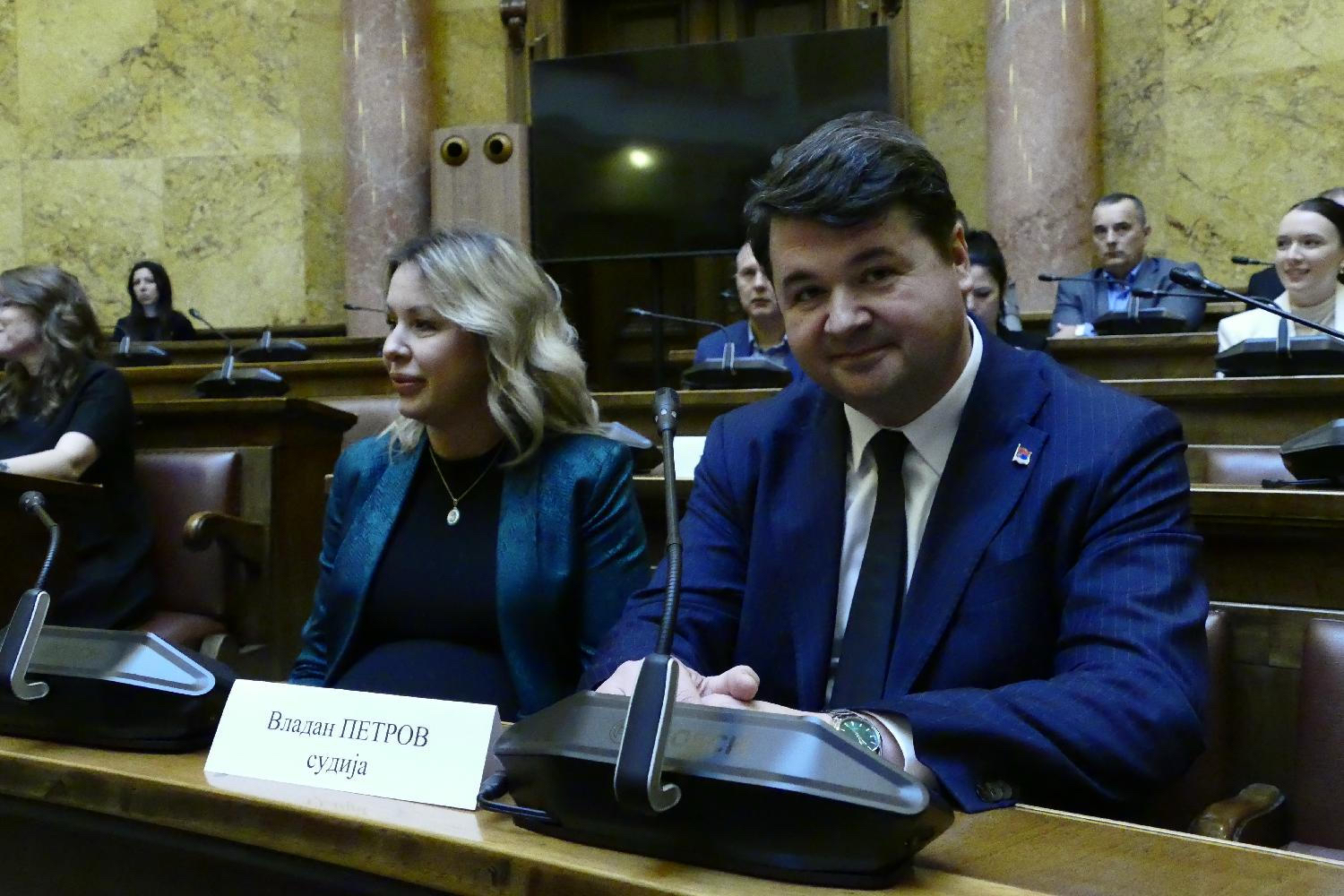
Photo: Fonet
Concluding observations
The Constitutional Court judges took office in 2025 in a timely manner. However, numerous criticisms have been raised in legal expert circles regarding the personal choices made in electing this composition, given that the political and professional activities of almost all Constitutional Court judges raise serious doubts about their impartiality and independence.
In addition, the Constitutional Court has, without clear reasons, not been formed at full complement. The candidate proposals of the General Session of the Supreme Court are not known, and the Supreme Court will be able to consider joint proposals from the High Judicial Council and the High Prosecutorial Council only when and if such proposals are submitted. Given that there is still no information about the candidate list to be submitted by the HJC and HPC, it is possible that the new composition of the Constitutional Court will remain at ten newly appointed judges (those proposed by the National Assembly and the President) and two judges whose mandates have not yet expired (who were previously appointed precisely on the proposal of the HJC and HPC) - meaning the Constitutional Court may never be formed at full complement.
In addition, the Constitutional Court has, without clear reasons, not been formed at full complement. The candidate proposals of the General Session of the Supreme Court are not known, and the Supreme Court will be able to consider joint proposals from the High Judicial Council and the High Prosecutorial Council only when and if such proposals are submitted. Given that there is still no information about the candidate list to be submitted by the HJC and HPC, it is possible that the new composition of the Constitutional Court will remain at ten newly appointed judges (those proposed by the National Assembly and the President) and two judges whose mandates have not yet expired (who were previously appointed precisely on the proposal of the HJC and HPC) - meaning the Constitutional Court may never be formed at full complement.