

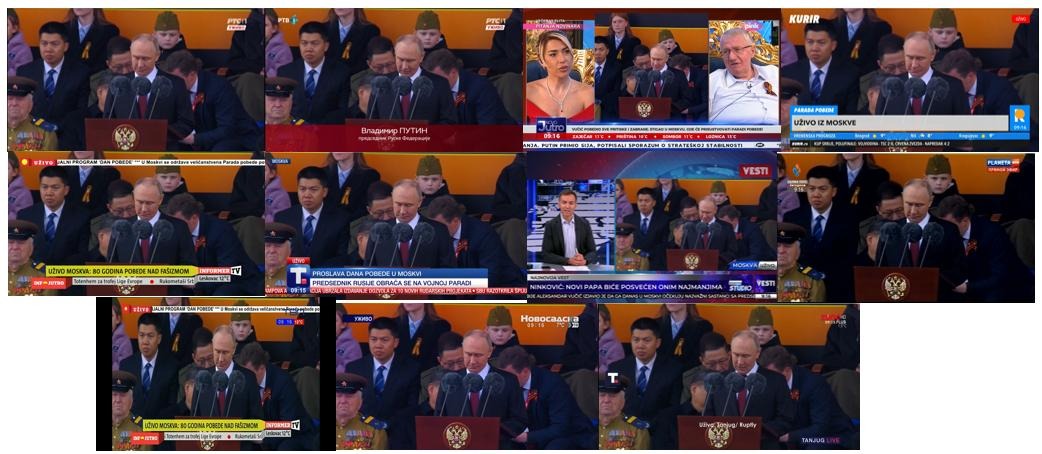
The Victory Day Parade, including the build-up to the big day, dominated the media's attention, with some television channels airing special programs and segments.
Notably, public broadcaster RTS 1 aired a special program focused on the Victory Day celebration in Moscow. Other televisions, such as TV Pink and TV Informer, featured controversial and convicted war criminals, former military officials and security experts. While some televisions broadcast the celebration sporadically, a total of 11 television channels broadcast the Victory Day Parade in its entirety, including Russian President Vladimir Putin’s speech (these include public broadcasters RTS 1 and RTV; national channel TV Pink; cable TV channels Kurir, Informer, Tanjug and Vesti; and local TV channels Novosadska, Pančevo, Zona and Palma).However, Belgrade also took part in the Victory Day celebrations through the civil-military commemorative “Immortal Regiment” march together with its Russian counterparts. Seen at the head of the convoy were Minister of Culture, Nikola Selaković, Minister of Economy, Adrijana Mesarović, Minister of Environmental Protection, Sara Pavkov, Minister of Public Administration and Local Self-Government Snežana Paunović, Minister of Sport, Zoran Gajić and Ambassador of Russia, Alexander Botsan-Kharchenko.
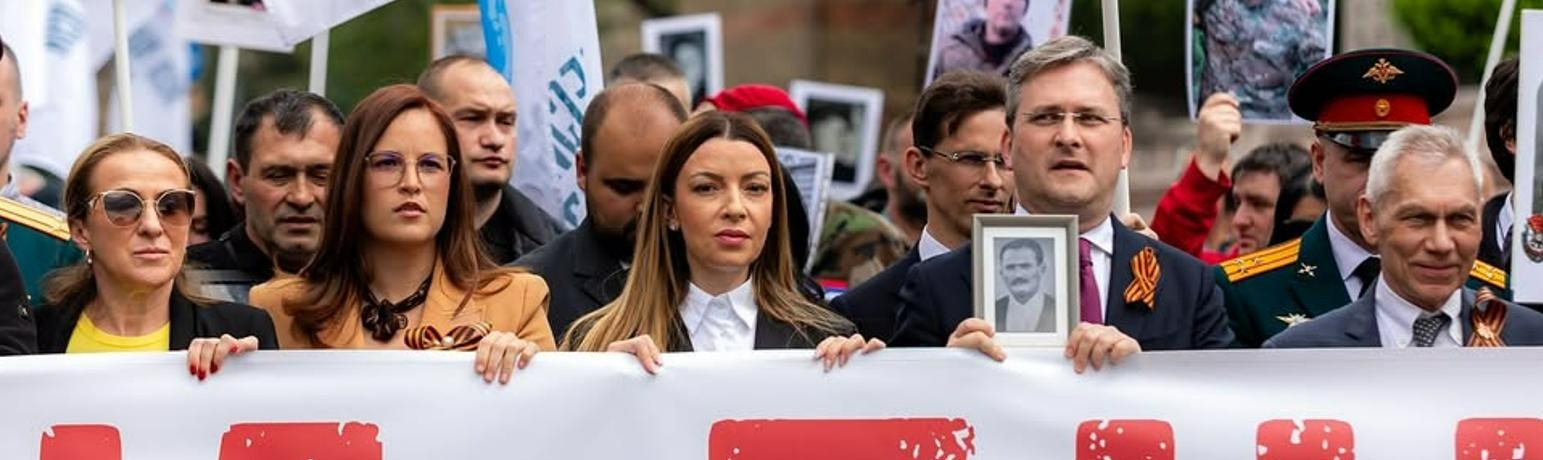

Instagram, Serbian Ministry of Economy
Rolling out the red carpet
After the media reported that the Serbian President Aleksandar Vučić had initially been prevented from flying into Moscow, he was finally given the go-ahead and landed in Moscow on 7 May, two days before the Parade. His arrival kept the media buzzing as outlets reported that special billboards have been displayed all over Moscow in honour of the Serbian President. On the ground, media reported that Vučić had received a welcome that featured a red carpet and an honour guard, all under the watchful eye of the Russian television’s media lenses. After being welcomed by the Deputy Minister of Foreign Affairs of Russia, Alexander Grushko, President Vučić relayed his appreciation to his Russian hosts.
"If someone has to pay the price, as I said, it will be me, not Serbia,"
President Vučić said to journalists in Moscow on 8 May, 2025.
However, the media also engaged in speculation about the implications of Vučić’s visit for Serbia and the potential pressure it may face moving forward. While some outlets warned that there will be future attacks on Serbia because of this, Vučić stated that if anyone has the right to attend Victory Day, it is the Serbian people. Adding to this, the President claimed that if he had not come it would have counted towards betrayal, again playing up the card of Serbia’s independent politics. On the other hand, Speaker of Parliament, Ana Brnabić, was quick to jump to the President’s defense, stating that Vučić is prepared to take on sanctions himself for visiting Moscow. Similarly, Minister of Foreign Affairs, Marko Đurić iterated that there will be no EU sanctions in response to Vučić’s visit.
"If someone has to pay the price, as I said, it will be me, not Serbia,"
President Vučić said to journalists in Moscow on 8 May, 2025.
However, the media also engaged in speculation about the implications of Vučić’s visit for Serbia and the potential pressure it may face moving forward. While some outlets warned that there will be future attacks on Serbia because of this, Vučić stated that if anyone has the right to attend Victory Day, it is the Serbian people. Adding to this, the President claimed that if he had not come it would have counted towards betrayal, again playing up the card of Serbia’s independent politics. On the other hand, Speaker of Parliament, Ana Brnabić, was quick to jump to the President’s defense, stating that Vučić is prepared to take on sanctions himself for visiting Moscow. Similarly, Minister of Foreign Affairs, Marko Đurić iterated that there will be no EU sanctions in response to Vučić’s visit.
Putin in parade, the EU cold-shouldered
The media, keeping a very close eye on Parade proceedings and Putin’s speech, employed a manipulative narrative through a video montage depicting 'two Serbias' - one in Moscow and the other in Strasbourg - using this contrast to amplify national pride and portray defiance against Western influence. Some media went even further, labeling Tonino Picula, Member of the European Parliament, an 'Ustasha' and portraying Serbian students visiting the European Parliament during Vučić’s Moscow trip as manipulated 'blockaders', using hate speech to discredit them and reinforce the narrative of betrayal versus patriotic loyalty.
Russian officials were also quick to weigh in, and Serbian media eagerly echoed their statements. The spokeswoman of the Russian Ministry of Foreign Affairs, Maria Zakharova, called the warnings of the European Union to the President of Serbia, regarding his visit to Moscow for Victory Day "banditry and blackmail". Meanwhile, Minister of Foreign Affairs, Sergey Lavrov, said that what is being asked of Serbia is “shameful”.
Russian officials were also quick to weigh in, and Serbian media eagerly echoed their statements. The spokeswoman of the Russian Ministry of Foreign Affairs, Maria Zakharova, called the warnings of the European Union to the President of Serbia, regarding his visit to Moscow for Victory Day "banditry and blackmail". Meanwhile, Minister of Foreign Affairs, Sergey Lavrov, said that what is being asked of Serbia is “shameful”.
Bilateral in the Kremlin
Much media attention was given to the arrival of the Prime Minister of Slovakia, Robert Fico, who had experienced similar travel setbacks, being prevented from flying like the Serbian President. Prior to the Parade, Vučić had said that he hoped Prime Minister Fico would be able to come, stating that it would be better if he was not the only official from Europe at the Parade. For the Serbian media, Vučić and Fico stood out as emblems of honor and dignity, stronger than all threats, warnings and bans. Fico’s remarks vowing to prevent the EU from attempting to erect a new 'Iron Curtain' were widely circulated, reinforcing a broader narrative of resistance to Western institutions and support for an alternative, sovereign political course.
In the Kremlin, President Vučić took part in a string of meetings, including a meeting with Milorad Dodik, the President of the Republic of Srpska and a meeting with Abdel Fattah el-Sisi, the President of Egypt. During his official visit, Vučić also presented Patriarch Kirill of Moscow the order of the Republic of Serbia for its outstanding contribution to the development of friendly relations between the fraternal Slovenian countries and Orthodox peoples.
In the Kremlin, President Vučić took part in a string of meetings, including a meeting with Milorad Dodik, the President of the Republic of Srpska and a meeting with Abdel Fattah el-Sisi, the President of Egypt. During his official visit, Vučić also presented Patriarch Kirill of Moscow the order of the Republic of Serbia for its outstanding contribution to the development of friendly relations between the fraternal Slovenian countries and Orthodox peoples.
The highlight of the visit, however, was Vučić’s meeting with Putin, a moment the media portrayed precisely as such.
Headlines suggesting that Serbia has never been shown respect to such a high level underscored the triumphant tone of coverage, with the media presenting the meeting as a major diplomatic success. Outlets further highlighted the personal rapport between the two leaders, emphasizing details such as Putin’s informal greeting, “You’ve arrived!”, emphasizing once again the Serbo-Russian friendship, closeness, trust, and mutual recognition.
Outlets once again played up China and Serbia’s reliable strategic and economic partnership, reporting positively on the meeting between President Vučić and Chinese President Xi Jinping. Vučić sung his praises for China, emphasizing that “China is becoming a lifeline for us”, and called for an even stronger Chinese presence in Serbia, particularly in light of EXPO 2027 in Belgrade. Vučić also relayed to Xi that, according to public opinion research, Serbia had “defeated the attempt at a color revolution” — a message the media framed as evidence of political stability and China’s key role in preserving domestic order, sidelining the EU.
Outlets once again played up China and Serbia’s reliable strategic and economic partnership, reporting positively on the meeting between President Vučić and Chinese President Xi Jinping. Vučić sung his praises for China, emphasizing that “China is becoming a lifeline for us”, and called for an even stronger Chinese presence in Serbia, particularly in light of EXPO 2027 in Belgrade. Vučić also relayed to Xi that, according to public opinion research, Serbia had “defeated the attempt at a color revolution” — a message the media framed as evidence of political stability and China’s key role in preserving domestic order, sidelining the EU.